





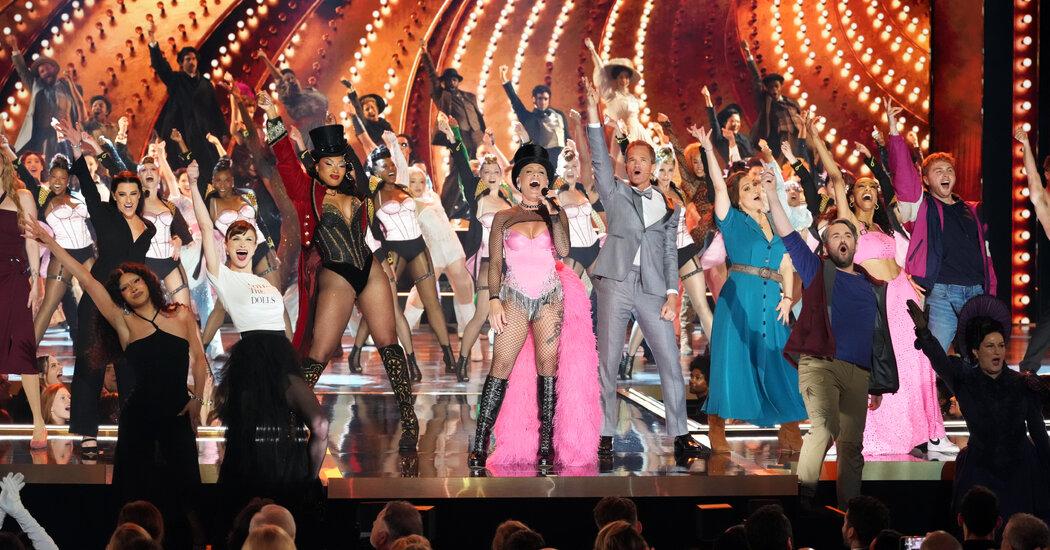
To those cultural purists who vigilantly watch over the gate of the Great White Way, the initial announcement that global pop icon Pink would host this year’s Tony Awards was met with a mixture of skepticism and quiet anxiety. After all, here was a Grammy-winning singer-songwriter who, despite her gravity-defying arena tours and chart-topping anthologies, had never once trod the historic boards of a Broadway stage. To some, her casting felt like a purely commercial gimmick, perhaps even a desperate bid by nervous network executives to lure mainstream television viewers to a three-plus-hour broadcast dedicated to a highly insular, specialized, and often self-congratulatory art form. Yet, from the very moment she stepped into the spotlight for the opening number, Pink shattered these cynical apprehensions with a performance that was as disarmingly self-aware as it was electrifying. Admitting her own unlikely placement with the cheeky, shrug-of-the-shoulders confession, “For some reason, I’m the host,” she instantly dissolved the invisible barrier between the elite theater community and the millions of curious spectators watching from home. What followed was a true hosting masterclass defined by a rare and beautiful artistic balance: she was warm without being cloying, glittering but entirely devoid of sanitized Hollywood slickness, and deeply confident without ever overshadowing the stage performers she was there to champion. Whether she was casually tossing off a sharp-witted, self-deprecating quip or leaning into her powerhouse vocals to belt out a thrilling, mid-show rendition of “All That Jazz”—complete with a stylized, jazz-hands choreography that would have made Bob Fosse proud—she made the grueling marathon of the awards show feel like an intimate living room gathering. More than just a highly charismatic entertainer, Pink acted as a crucial demographic bridge; as a self-proclaimed outsider to the Broadway ecosystem who happens to be the mother of a passionate, theater-obsessed young daughter, she perfectly represented the exact message the American Theatre Wing wants to sell to the world: that while theatrical art is meticulously crafted by dedicated, lifelong insiders, its raw emotional magic is meant to be loved, shared, and claimed by absolutely everyone.
This year’s ceremony also stood out as a triumph of technical wizardry, particularly in how the broadcast directors and camera crews tackled the notoriously difficult task of translating the three-dimensional, kinetic energy of live stage performance onto a flat, two-dimensional television screen. Historically, the transition from the physical, breathing thrum of a theatrical space to the sterile boundaries of a home television can flatten complex choreography, draining a musical number of its urgency, scale, and spatial depth. However, the production team at this year’s Tonys rose to the occasion with breathtaking visual artistry, capturing the sprawling, delightfully chaotic stage pictures of boundary-pushing productions like Cats: The Jellicle Ball and The Rocky Horror Show with dynamic fluidity and cinematic intelligence. Instead of resorting to static, safe wide-angles that distance the viewer, the cameras moved in perfect harmony with the dancers, diving directly into the theater aisles, tracking actors as they stormed down the wooden catwalks, and framing explosive choreography through glittering, rain-drenched curtains. This masterful lens-work succeeded in conveying both the sheer velocity and the deliberate, glorious “too-much-ness” of these highly unconventional revivals, refusing to flatten their eccentricities into comfortable broadcast standards. This visual kineticism was matched step-for-step by the visceral, ecstatic reaction of the audience inside Radio City Music Hall, creating an ongoing feedback loop of pure, unadulterated joy. In a year that many theatrical critics had written off as one of the slimmest and most creatively conservative seasons for new musicals in recent memory, the live performances on Sunday night were nothing short of a revelation. Driven by Alex Newell’s gravity-defying, range-stretching vocal acrobatics in tribute to Chicago, spectacular, death-defying drops that left the crowd screaming, and a fictional rock concert from The Lost Boys that possessed all the sweat-soaked, adrenaline-pumping authenticity of a real stadium gig, the cavernous room vibrated with high-octane energy. The audience reacted not as polite, detached observers, but as active, passionate participants—waves of fan-flapping, spontaneous cheers, and standing ovations signaling a community hungry for theatrical abundance and ready to embrace a bold, risk-taking future.
Yet, beneath the glittering surface of the evening’s musical spectacles lay a more somber, reflective undercurrent that spoke directly to the systemic struggles still facing the theater community, particularly the female artists who fight to get their narratives heard on Broadway’s biggest stages. This quiet tension came to the forefront of the national broadcast during a deeply poignant moment when Bess Wohl accepted the coveted Best Play award for her brilliant, emotionally complex ensemble piece Liberation. Radiating joy, relief, and pride, Wohl took the microphone not just to celebrate her own creative team, but to ground her landmark victory in a sobering, historic truth that echoed the very feminist, history-reclaiming spirit of the play itself. She pointed out to the hushed crowd that it had been over three decades since an American woman had taken home the Tony for Best Play, tracing the historical lineage all the way back to Wendy Wasserstein’s landmark 1989 win for The Heidi Chronicles. While the brilliant French playwright Yasmina Reza has managed to claim the honor twice in the intervening years, the category has otherwise remained a remarkably consistent, disheartening roll call of male playwrights—a stark, mathematical reflection of a Broadway landscape where male-written dramas are still disproportionately greenlit, financed, and produced by risk-averse investors. What makes this artistic disparity even more glaring is the sharp, baffling contrast between Broadway’s preferences and those of other major literary institutions; both Liberation and The Heidi Chronicles also clinched the prestigious Pulitzer Prize for Drama, an accolade that historically has recognized female playwrights with far greater frequency and enthusiasm than the commercial theater has. Wohl’s elegant but pointed reminder served as a powerful, necessary critique of the industry’s gatekeepers, transforming what could have been a standard, fleeting acceptance speech into an urgent manifesto, demanding that producers finally recognize that complex human stories written by women are not niche projects, but the very lifeblood of our cultural future.
This year, the profound thematic current of human connection extended far beyond the written scripts, weaving itself directly into the emotional tapestry of the acceptance speeches through a recurring, deeply moving celebration of family—both the biological relatives we are born with and the unconventional, artistic families we build within the creative arts. In an industry where artists are often forced to choose between the relentless, grueling demands of the eighth-show-a-week stage schedule and the quiet, grounding realities of domestic life, the winners of the night proudly brought their personal lives into the spotlight. Shoshana Bean, taking home a well-deserved trophy for her performance in The Lost Boys, delivered a beautifully emotional tribute to single mothers everywhere, reflecting on the immense sacrifices made by her own mother to foster her creative dreams. Similarly, Caissie Levy of the revival of Ragtime spoke representationally of the complex, daily tightrope walk of playing a mother on stage while navigating the messy, beautiful reality of being a mother in her off-stage life, while her co-star Joshua Henry melted hearts by thanking his wife for putting their children to bed and supporting him through the endless sacrifices of a theater career. Even the co-directors of Cats: The Jellicle Ball, Bill Rauch and Zhailon Levingston, shared their moment at the podium to pay tribute to their loved ones in a beautifully synchronized dance of gratitude, while writer-composer Cinco Paul of Schmigadoon brought a wave of laughter by using his speech to affectionately clarify that his wife does not actually hate musicals. This raw, human vulnerability was echoed in the speeches of theater veterans John Lithgow and Lesley Manville, who brought a refreshing, unvarnished sincerity to their respective wins for Giant and Oedipus. Despite possessing over a century of combined stage experience, neither actor treated their victory as routine; Lithgow was visibly shaken with emotion as he described the moment as one of the absolute highlights of his legendary career, while Manville, making her long-awaited Broadway debut, expressed a giddy, infectious gratitude that peaked with a cheeky, empowering plea for playwrights to write bankable roles for ensembles of women.
While the evening was rich with tears and historic milestones, it was also elevated by moments of exquisite comedy, reminding viewers that live television is at its absolute best when it embraces spontaneous chemistry and human vulnerability. Nothing exemplified this better than the electric, instantly iconic pairing of Maya Rudolph and Cole Escola, who took the stage to present the award for Best Actor in a Leading Role in a Play. Escola, who had won the very same award the previous year for creating and starring in the satirical smash hit Oh, Mary!, had recently passed the proverbial crown of Mary Todd Lincoln to Rudolph, who is currently dazzling audiences in the role. The comedic alchemy between the two was nothing short of brilliant; they possessed a delightfully daffy, off-the-cuff looseness that felt thrillingly unscripted, presenting a masterclass in comedic timing that left the audience clamoring for them to host next year’s entire ceremony, the red carpet, and perhaps even the viewer’s collective subway rides home. This joyous, unpredictable spirit found an accidental counterpart in a wonderfully charming mishap involving sound designer Kai Harada. Finding himself nominated twice in the same category—for his exceptional work on both Cats: The Jellicle Ball and Ragtime—Harada walked up to the microphone to accept his trophy only to realize, in a hilarious variation of the classic “actor’s nightmare,” that he had forgotten to listen to which specific show had won. Standing before the star-studded crowd, he had to sheepishly turn around to the announcers to ask, “What am I up here for?” only to beam with relief upon learning it was Ragtime. It was a delightfully human moment of vulnerability that stripped away the formal stiffness of the awards ceremony, proving that behind the glamorous facades, these are real people navigating live, high-pressure situations with grace and humor.
Of course, no live broadcast is entirely without its creative missteps, and this year’s ceremony faltered most noticeably in its attempt to showcase the nominated plays through a series of cold, sterile video packages. While musicals can easily captivate a television audience with a single high-energy, self-contained performance, distilling the complex narrative arcs and delicate emotional atmospheres of non-musical plays has always been a notoriously difficult puzzle for Tony producers. Unfortunately, the decision to use slick, over-produced minidocs that aired immediately following commercial breaks fell entirely flat, blending so seamlessly into the stream of corporate pharmaceutical advertisements that viewers were left temporarily wondering if theater legends like Nathan Lane were trying to pitch them allergy medications. These uninspired video packages stripped the nominated plays of their theatricality, doing a disservice to powerful works that deserved to be showcased with the same raw immediacy as their musical counterparts. Yet, even this minor stumble could not dampen the overarching triumph of the evening, which served as a vibrant testament to the enduring, communal power of live theater. By centering the broadcast around human-scale stories, genuine emotional breakthroughs, and an overriding theme of artistic family, the Tonys managed to remind us why we continue to gather in the dark to watch stories unfold under the spotlight. It proved that despite the economic hurdles and shifting landscapes of the modern entertainment industry, the theater remains a beautifully chaotic, deeply vital space of human connection—an artistic sanctuary where outsiders are welcomed, legends can still find themselves moved to tears, and the shared experience of storytelling continues to light up our collective imagination.