


The Belfast Flashpoint: How a Brutal Assault Sparked a Night of Flame and Fury in Northern Ireland
The Spark in North Belfast – A Brutal Attack and a City on Edge
The fragile peace of Belfast’s northern quarters was violently shattered on Monday night, setting off a chain reaction of communal fury, political recrimination, and street violence that has left Northern Ireland gripped by deep-seated anxiety. At approximately 10:30 p.m., a routine evening inside an apartment complex turned into a scene of primal horror when a physical altercation escalated into a vicious knife attack. Within minutes, graphic, citizen-recorded footage of the encounter began circulating across social media platforms, bypassing traditional news filters and igniting an immediate public firestorm. The deeply unsettling video clip captured a man pinned to the floor, his face and neck slicked with blood, while his assailant repeatedly targeted his upper body. The desperation of the scene was punctuated by the dramatic arrival of a nearby resident who intervened to stop the carnage by striking the attacker with a hurley—the heavy, traditional wooden stick used in the Irish sport of hurling. While police officers arrived within minutes to secure the scene, prevent further bloodshed, and arrest the suspect, the digital damage had already been done. Long before the morning light could break over the city’s historic skyline, the graphic footage had been weaponized by online factions, transforming a localized criminal act into a explosive rallying cry for anti-immigrant groups eager to expose what they labeled a systemic failure of national security.
Flames in the Night – How Belfast Erupted into Civil Unrest
                      BELFAST UNREST MAP (TUESDAY NIGHT)

                      [ North Belfast ] ------ (Initial Attack Site)
                             |
                             V
     [ East Belfast ] <=============> [ Citywide Infrastructure ]
     - Double-decker bus torched      - Transit lines halted early
     - Barricades of burning bins     - Businesses shut down pre-emptively
     - Targeted housing attacks       - Police reinforcing key sectors
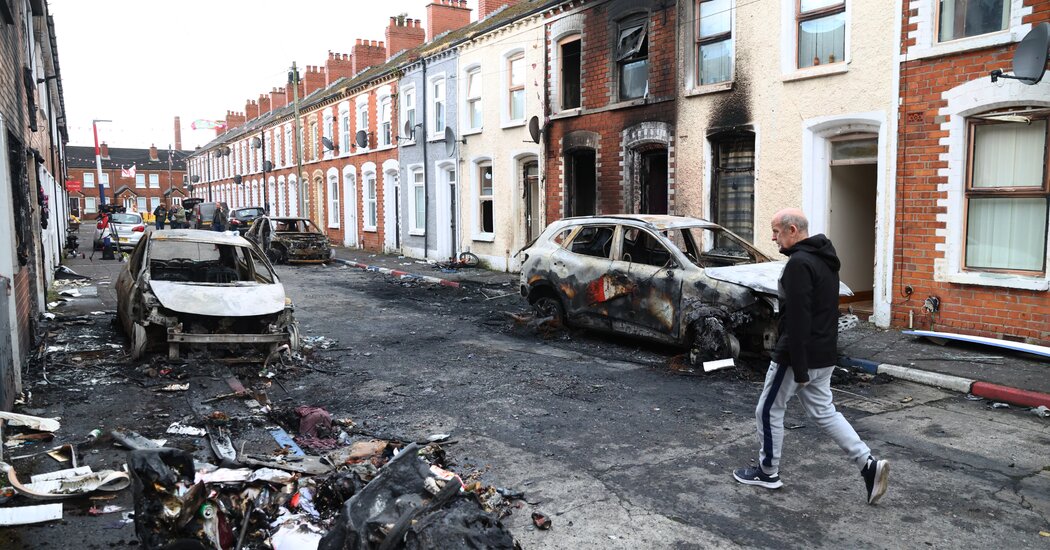
By Tuesday evening, the digital outrage had materialized into physical destruction as sporadic bursts of violence rippled across Belfast and neighboring districts, overwhelming local communities and stretching emergency resources to their limits. In the shadows of East Belfast, rioters erected impromptu roadblocks with large metal garbage bins, dousing them in accelerants and setting them ablaze to block police access and disrupt the flow of traffic. The escalation reached a terrifying peak when a double-decker city bus was hijacked and set on fire, illuminating the dark streets with towering plumes of black smoke. Of even greater concern to human rights observers and local authorities was the targeted targeting of minority households; emergency responders spent the night scrambling through volatile neighborhoods to safely escort terrified immigrant families from their homes, several of which had been pelted with fireworks and deliberately set alight. Sensing the gathering storm, transport authorities canceled late-night bus and rail services across metropolitan Belfast, while local businesses and government offices shuttered their doors early in a desperate attempt to protect workers from the impending chaos. The visual of burning vehicles against the backdrop of Belfast’s storied streets served as a grim reminder of how quickly modern political grievances can resurrect the destructive habits of the region’s turbulent past.
Behind the Charges – Hadi Alodid and the UK Refugee Debate
At the center of the judicial and political storm is 30-year-old Hadi Alodid, a Sudanese refugee who appeared under heavy security in a Belfast courtroom on Wednesday to face charges of attempted murder. Court documents and Home Office records reveal that Alodid entered the United Kingdom in 2023, rapidly securing official refugee status that granted him legal residency in the country until at least 2028. As prosecutors laid out the initial charges, they detailed the catastrophic bodily harm suffered by the victim, Steven Ogilvy, a local man in his 40s who remains hospitalized in serious condition with extensive wounds to his face, neck, and back, including the tragic loss of an eye. The Police Service of Northern Ireland (PSNI) moved quickly to de-escalate international speculation, stating that while they are still working diligently to establish a clear motive, there is no evidence to suggest the stabbing was an act of organized terrorism, nor are they searching for any other accomplices. This distinction, however, did little to soothe a public already primed for discord; indeed, Alodid’s legal asylum seeker status has instantly placed him at the heart of an ongoing, highly polarized UK-wide debate regarding border enforcement, immigration vetting procedures, and the capacity of public services to integrate displaced populations arriving from conflict zones.
The Digital Megaphone – How Far-Right Agitators and Tech Executives Fueled the Fire
The speed with which the Belfast stabbing transformed into a province-wide riot is a testament to the highly coordinated nature of modern far-right digital networks, which used the incident to test the limits of online mobilization. High-profile nationalist agitators, led most prominent by the British far-right figure Tommy Robinson, immediately shared the raw bystander video to orchestrate a narrative of an “invader attack” on native citizens, actively encouraging their millions of followers to descend on the streets of Northern Ireland. This localized outrage received a massive global amplifier when tech billionaire Elon Musk used his personal platform to share lists of protest locations across the United Kingdom, boosting incendiary posts from far-right accounts and lending executive legitimacy to conspiracy theories surrounding the event. The resulting digital echo chamber flooded platforms with unverified claims, doxxing data, and explicit calls for mass deportations, effectively bypassing the deliberate, stabilizing messaging of local community leaders and traditional journalism. By the time physical protests materialized outside government buildings and housing complexes, many participants had been thoroughly radicalized by an unchecked, algorithmically accelerated flow of disinformation that framed the defense of local neighborhoods as an existential battle for cultural survival.
A Pattern of Discontent – The Broader Context of Anti-Immigrant Unrest in the UK
┌─────────────────────────────────────────────────────────────────────────┐
│ CHRONOLOGY OF ESCALATING UNREST │
├───────────────────┬─────────────────────────┬───────────────────────────┤
│ Date │ Location │ Trigger Event │
├───────────────────┼─────────────────────────┼───────────────────────────┤
│ July 2025 │ Ballymena, NI │ Sexual Assault Allegation │
│ December │ Southampton, England │ Henry Nowak Stabbing │
│ Current Week │ Belfast, NI │ Steven Ogilvy Stabbing │
└───────────────────┴─────────────────────────┴───────────────────────────┘
The violence in Belfast does not exist in a vacuum; rather, it represents the latest eruption in a series of highly publicized domestic incidents that have steadily built a reservoir of xenophobic resentment across the United Kingdom. Only months earlier, in December, the tragic death of 18-year-old student Henry Nowak in the southern English city of Southampton sparked similar national outrage after leaked police footage showed the dying teenager handcuffed on the pavement, a controversial visual that right-wing politicians like Nigel Farage quickly seized upon to claim “anti-white prejudice” by law enforcement, who had initially favored the account of the attacker, a British-born Sikh man. This incident followed closely on the heels of another explosive flashpoint in July 2025 in the Northern Irish town of Ballymena, where two 14-year-old boys of Romanian descent were charged with a severe sexual assault of a local girl, sparking days of destructive protests that targeted Eastern European businesses and residences. These recurring cycles of violence point to a deeply worrying trend identified by social psychologists and security experts, wherein localized, singular criminal acts are immediately abstracted, amplified, and romanticized on social media as symbols of an ongoing cultural clash, triggering pre-planned urban riots before the courts can even begin to establish the basic facts of the case.
The Path Forward – Stormont’s Dilemma and the Fragile Peace of Northern Ireland
As the ashes cool on the streets of East Belfast, the political leadership within the Stormont Assembly faces the daunting task of preserving Northern Ireland’s fragile, post-conflict social fabric against these volatile new vectors of division. Unlike the historical, binary sectarianism that defined the Troubles, this new wave of unrest pits a rapidly diversifying society against a globalized, digitally native far-right movement that seeks to align traditional unionist and nationalist working-class communities under a shared banner of anti-immigrant hostility. Cross-party leaders have united in their condemnation of the violence, pleading for community restraint while warning that the destruction of public property and the targeting of vulnerable minority families will only alienate the very neighborhoods these protesters claim to protect. For a region still navigating the delicate logistics of post-Brexit trade, economic recovery, and historical reconciliation, the arrival of viral, cyber-fueled racial tension threatens to derail years of hard-won progress, leaving policymakers with the urgent, seemingly impossible mandate of policing digital disinformation while simultaneously addressing the real-world anxieties of disillusioned citizens.
Key Takeaways from the Belfast Crisis
- The Instigating Event: A violent knife attack on Monday night in North Belfast left 40-something Steven Ogilvy with severe, life-altering injuries, including the loss of an eye.
- The Suspect: Hadi Alodid, a 30-year-old Sudanese national holding legal UK refugee status through 2028, was formally charged with attempted murder; police have explicitly ruled out terrorist motives.
- Outbreak of Rioting: Tuesday night saw coordinated looting, vehicle arson (including a public bus), and roadblocks across Belfast, forcing the emergency evacuation of multiple immigrant families.
- The Role of Social Media: Extremist agitators and high-visibility tech figures accelerated the crisis by sharing graphic bystander footage alongside call-to-action protest maps.
- A Growing Trend: This clash reflects a broader pattern of anti-immigrant unrest seen in recent UK flashpoints, including Southampton and Ballymena, posing a novel threat to Northern Ireland’s complex domestic peace.