

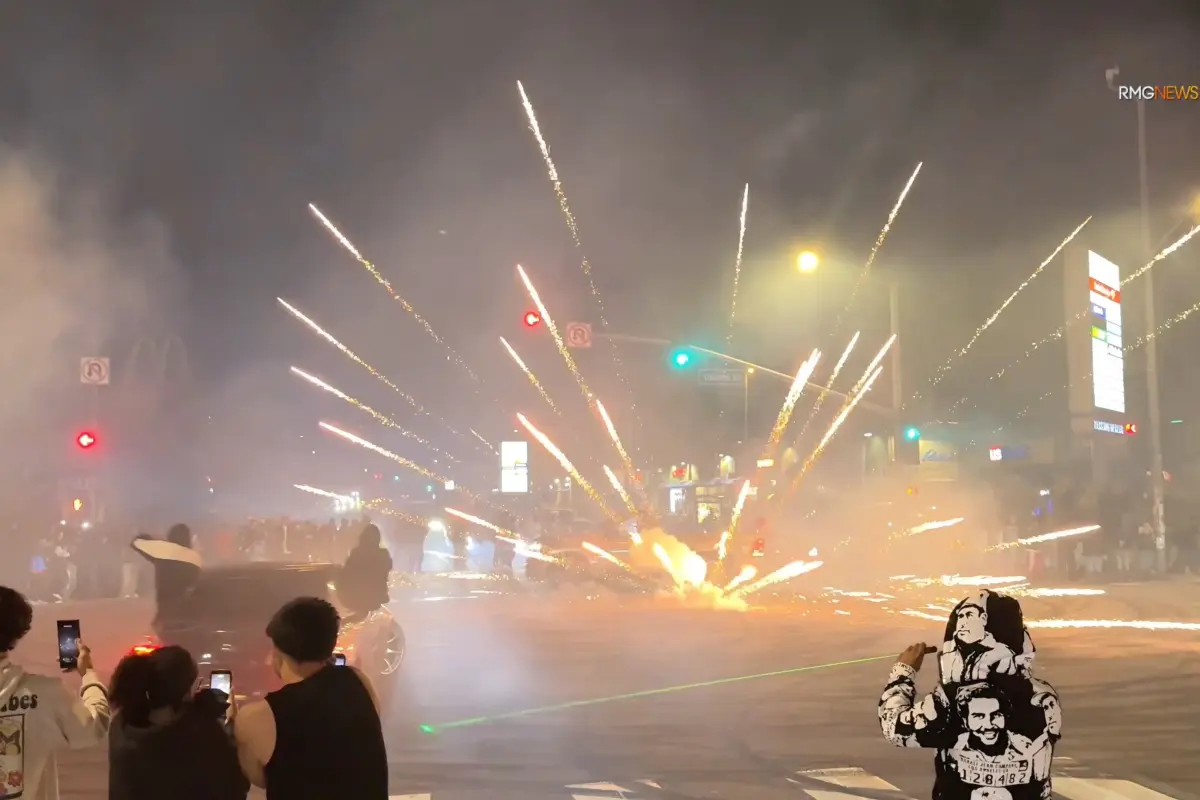
Under the quiet, amber glow of the streetlights at the intersection of La Brea Avenue and Obama Boulevard, the peaceful repose of an early Saturday morning in Baldwin Hills was violently shattered at approximately 2:30 a.m. What began as a typical, cool Southern California night quickly transformed into a volatile theater of deliberate chaos as a massive convoy of souped-up vehicles synchronized their arrival to seize the public asphalt. Within minutes, the intersection was transformed into a dense, lawless arena for an illegal street takeover, a highly controversial subcultural phenomenon that has increasingly laid siege to Los Angeles’ public spaces and residential neighborhoods. A restless, hyper-stimulated crowd of hundreds of onlookers emerged from the shadows of the darkened neighborhood, forming a tight, pulsing ring of humanity around the perimeter of the asphalt. Their faces were illuminated by the harsh, fractured glare of smart screens recording the madness for social media, flashing green laser pointers cutting through the darkness, and the sudden, rhythmic explosions of illegal fireworks launching into the night sky. The night air, normally crisp and quiet, grew thick, grey, and suffocating with the acrid, chemical stench of burning synthetic rubber as heavily modified engines screamed to life, their exhaust systems popping with the startling intensity of gunfire. High-horsepower cars began spinning in violent, rapid circles, executing high-speed “donuts” that sent massive plumes of white tire smoke billowing into the surrounding atmosphere, waking sleeping families in nearby homes. The onlookers, swept up in a collective fervor of adrenaline and digital bravado, surged forward, pressing dangerously close to the spinning metallic beasts, seemingly entirely indifferent to the catastrophic reality that a single mischaracterization of distance, a blown tire, or a sudden loss of traction by the drivers would result in multiple casualties. This was a spectacle designed specifically for the digital internet age, a high-stakes performance where the physical safety of human bodies was traded for fleeting moments of online notoriety, leaving the local neighborhood to bear the psychological and physical scars of the overnight intrusion.
The absolute recklessness of the spectacle reached dizzying heights as young men and women were seen precariously hanging out of the passenger-side windows of the drifting vehicles, their upper bodies suspended over the spinning asphalt as the cars slid sideways across the lanes. This dangerous display of bravado was captured on various camera feeds, showcasing a bizarre, almost hypnotic disregard for gravity, physics, and biological mortality. As the thick tire smoke grew denser and settled over the intersection, a physical gridlock began to ripple backward through the surrounding arterial streets, ensnaring unsuspecting motorists who had the misfortune of traveling through the Baldwin Hills area at that ungodly hour. Among the stranded vehicles was a surreal line of Waymo self-driving cars, their rooftop sensor pods spinning uselessly in the heavy haze. These highly advanced autonomous vehicles, programmed to obey the strict letter of traffic law and protect human safety at all costs, sat completely immobilized in a state of technological bewilderment. They stood in stark, silent contrast to the erratic, intensely human lawlessness occurring just yards ahead of them, symbolizing a poignant clash between a highly regulated, technological future and a chaotic, untamed present. To the ordinary commuters trapped behind this artificial wall of steel, smoke, and human bodies, the takeover was not a thrilling display of urban automotive subculture, but a terrifying and deeply frustrating hostage situation that disrupted their journeys, compromised their personal safety, and hijacked their fundamental right to navigate their own city streets. The spectators, far from being passive observers, actively cheered on the drivers, egging them on to push the limits of their vehicles closer and closer to the human barrier, turning a public thoroughfare into a highly unpredictable concrete colosseum.
Amidst the screeching tires and the primal roars of the crowd, the true human cost of the evening’s lawlessness was brought into sharp, terrifying focus when the distinctive, urgent wail of an emergency siren pierced the cacophony. An ambulance, its red and blue lights painting the thick cloud of tire smoke in urgent hues of violet and magenta, attempted to navigate through the gridlocked intersection on a life-saving mission. Inside that vehicle, paramedics were undoubtedly working under immense pressure, caring for an anonymous patient whose survival might have depended on every precious, fleeting second saved during transport to a local trauma center. Yet, as the emergency vehicle pushed forward, its path was utterly blocked by the wall of spectator cars and the shifting, indifferent crowd, which seemed momentarily disconnected from the life-and-death crisis unfolding right in front of them. The driver of the ambulance was forced to halt, the siren screaming uselessly against a wall of apathy, as the reckless drivers continued to spin their vehicles in the center of the intersection, treating the life-saving vehicle as merely another obstacle in their makeshift playground. It was an agonizing, tense standoff between the forces of civic duty and mindless hedonism, highlighting a profound breakdown of empathy on the streets of Los Angeles. Eventually, after an agonizingly long delay that felt like an eternity to anyone who has ever waited for emergency aid, a brief, chaotic break in the drifting action allowed the ambulance to squeeze through the gauntlet of cars and escape down the darkened boulevard. Shockingly, the moment the emergency vehicle cleared the intersection, the takeover instantly resumed with a vengeful energy, as a sleek black sedan swung its rear end within inches of the surging crowd, nearly striking several bystanders who scrambled backward in a state of hyper-stimulated panic.
How this particular flashpoint of urban chaos finally dissolved remains somewhat shrouded in the quick-dispersing haze of the late-night air, but the end pattern was all too familiar to the residents of Los Angeles. By the time responding officers from the Los Angeles Police Department arrived on the scene after receiving multiple frantic calls from terrified local residents, the high-octane energy of the takeover had already begun to evaporate. As the first blue and red police cruisers appeared on the horizon, the closely knit web of participants and spectators dissolved with astonishing speed, scattering into the side streets of Baldwin Hills like a flock of startled birds. Drivers slammed their vehicles into gear, accelerating away in all directions to blend seamlessly back into the quiet fabric of the broader city, leaving behind a neighborhood gasping for breath. Consequently, despite the massive scale of the disruption and the clear evidence of traffic laws being shattered, the LAPD confirmed to local outlets that they were unable to make a single arrest during the rapid dispersion. This lack of immediate consequence left a lingering sense of frustration and vulnerability among the local community, who are left to sweep up the physical debris of the takeover the next morning. When daylight finally broke over La Brea Avenue and Obama Boulevard, it revealed a scarred battleground of heavy black tire tracks, discarded firework casings, trash, and the persistent smell of burnt rubber clinging to the morning dew. The intersection, returned to its quiet role as a neighborhood conduit, stood as a silent, scarred monument to a midnight raid that had utterly paralyzed a community, leaving residents to wonder when the next weekend would bring another uninvited invasion of their peace.
This dramatic incident in Baldwin Hills is far from an isolated anomaly; rather, it is a localized symptom of a sprawling, systemic issue that has plagued the metropolis of Los Angeles for several years. The sheer volume of these illegal gathering points has forced local law enforcement into a perpetual game of cat-and-mouse, one that heavily strains municipal resources and tests the patience of taxpaying citizens. LAPD Chief Jim McDonnell has publicly acknowledged the immense scope of this modern policing challenge, shedding light on the astronomical numbers associated with these vehicular flash mobs that continue to terrorize neighborhoods. According to department data, the LAPD responded to nearly 700 individual street takeovers across the city last year alone, a staggering figure that translates to multiple high-risk events occurring almost every single weekend. In an aggressive bid to reclaim control of the streets, officers executed over 1,700 targeted traffic stops directly related to this vehicular mayhem and subsequently issued more than 1,700 citations to participants, spectators, and owners of modified vehicles. Furthermore, law enforcement made nearly 300 arrests at these takeovers throughout the year, demonstrating that when police are able to safely intervene, they do not hesitate to enforce the law and impound the offending vehicles. Yet, Chief McDonnell has candidly admitted that crushing this subculture remains an uphill battle. The primary obstacle is the sheer scale and rapid self-organization of these events; a single takeover can draw hundreds of vehicles and thousands of active participants within minutes, utilizing encrypted messaging apps and social media coordination to outmaneuver police patrols, rendering traditional crowd control methods difficult and potentially dangerous to execute.
Ultimately, the recurring nightmare of street takeovers like the one in Baldwin Hills forces Los Angeles to confront a deeper, more human crisis regarding the shared custody of its public infrastructure and the erosion of civic respect. While the drivers and their digital audiences view these events as a thrilling form of self-expression, a high-stakes counterculture born from California’s historic love affair with car culture, the reality for everyday residents is a profound loss of peace, security, and basic municipal safety. For the families living near La Brea and Obama Boulevard, the weekend has transformed from a period of rest into an anxious vigil, punctuated by the terrifying dread of a runaway car crashing through their homes or a loved one being blocked in a medical emergency. The humanization of this issue lies not in the sleek steel of the muscle cars, but in the vulnerable voices of the paramedics delayed on their way to save a life, the exhausted shift workers stuck in gridlock, and the parents who worry about their teenagers being drawn into the dangerous orbit of these lawless spectacles. As the LAPD and city leaders scramble to find innovative solutions—ranging from physical road design interventions like plastic bollards and raised pavement markers to tougher vehicle impoundment laws—the city must bridge the gap between keeping order and addressing the cultural impulses that fuel this behavior. Until a sustainable, systemic solution is realized, the streets of Los Angeles remain a contested terrain, where the fragile peace of a neighborhood can be instantly hijacked by a handful of spinning tires, the roar of modified engines, and the fleeting, selfish pursuit of a viral video.