


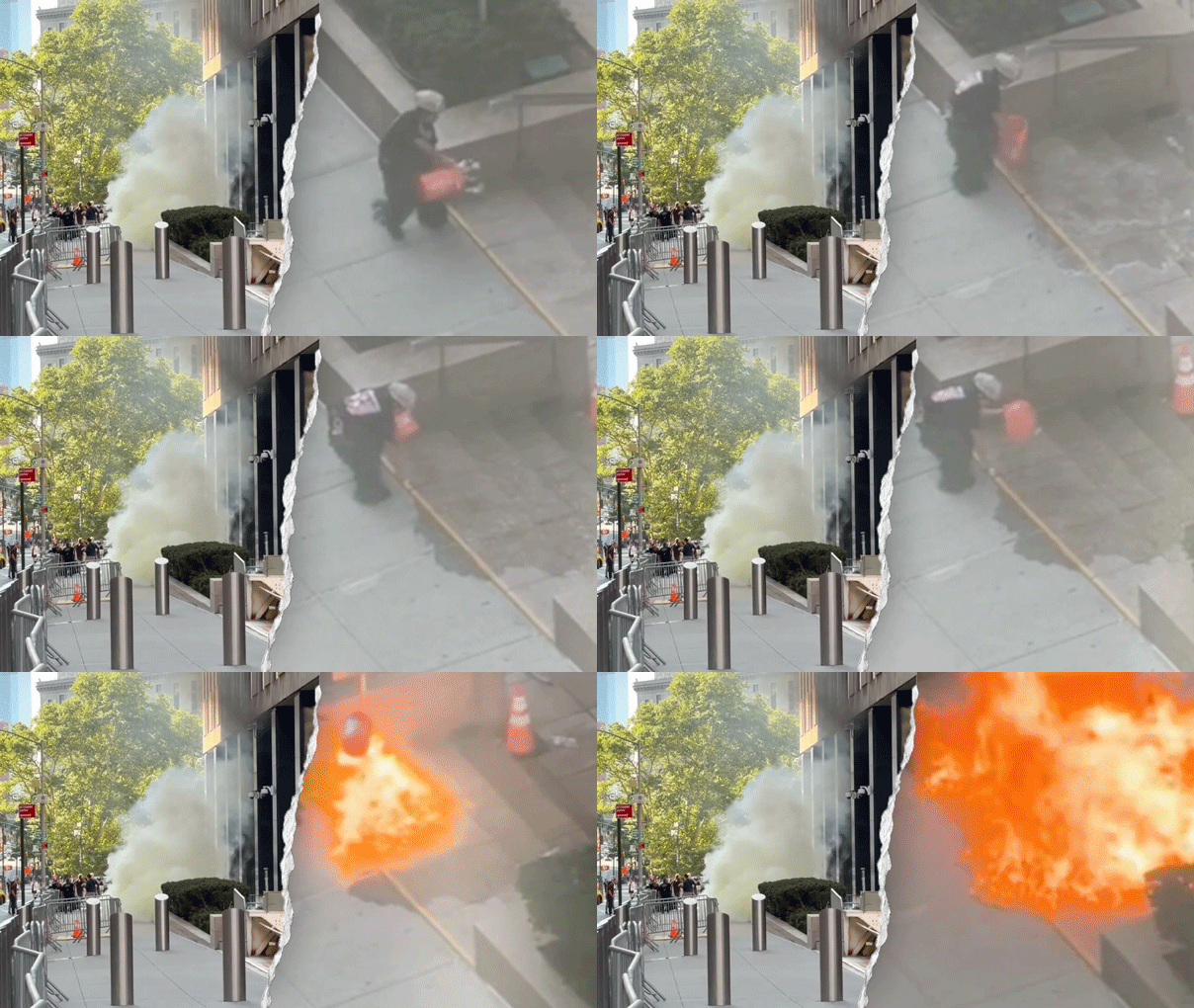
The morning of a typical work week in Lower Manhattan usually begins with a predictable, rhythmic hum, as thousands of professionals, civil servants, and ordinary citizens navigate the concrete canyons of the city to start their day. However, last Monday, this familiar routine was violently shattered outside of 26 Federal Plaza, a looming skyscraper that serves as a major hub for several critical government entities, including the Federal Bureau of Investigation and the executive offices for immigration review. Shortly after eight o’clock in the morning, a thick, acrid plume of dark gray smoke and bright orange flames suddenly erupted near one of the building’s busy entrances, transforming a space dedicated to civic order into a chaotic combat zone. Witnesses watched in disbelief as a lone figure, later identified as forty-three-year-old Andrew Arrabaca, detonated a powerful firework and doused the area with a highly flammable liquid, setting off a dangerous blaze right where employees and visitors were attempting to enter. In the midst of the billowing smoke, the crackle of gunfire—which was later determined to be five to seven high-velocity projectiles fired from an airsoft rifle—sent bystanders scrambling for cover behind concrete barriers and nearby vehicles, fearing for their lives in what appeared to be a coordinated terrorist attack. Law enforcement officers, displaying immense bravery and swift tactical coordination, rushed toward the source of the danger, tackling the agitated suspect to the ground and bringing a swift end to an escalation that could have easily resulted in a mass-casualty event. The arrest was caught on bystander video, showcasing a raw, highly charged moment where the vulnerability of public spaces was laid bare, leaving the city to grapple with the terrifying reality of how quickly peace can be compromised by a single, deeply disturbed individual harboring a stockpile of weapons and a heart full of unresolved resentment.
To understand how such an act of public violence could occur on a Monday morning in the heart of one of the world’s most secure cities, one must look closely at the complex and tragic human profile of Andrew Arrabaca, a man whose life story represents a harrowing journey from dedicated national service to profound alienation and violent despair. Arrabaca was not always a threat to the nation’s stability; in fact, he was once sworn to defend it, having served honorably in the United States Army, where he was trained as a highly specialized mechanic responsible for maintaining Patriot missile systems—advanced defensive weapons designed to protect American forces from aerial threats. This background of high-stakes military engineering makes his descent into domestic extremism all the more jarring, highlighting a stark and painful contrast between his past dedication to his country and his present hostility toward its institutions. Following his military service, Arrabaca’s life appears to have spiraled into extreme instability, marked by chronic joblessness, a lack of permanent housing, and the crushing, invisible isolation of living out of his vehicle in upstate New York. Day after day, as he navigated the margins of society from the cramped confines of his car, his sense of disconnection from the thriving communities around him likely intensified, feeding a growing bitterness against the system. This state of severe domestic displacement and systemic neglect created a fertile ground for severe psychological deterioration, a critical factor that his defense attorneys have pushed to the forefront of his current legal case, highlighting his long-standing, unaddressed struggles with severe mental illness. By exploring Arrabaca’s background, we are forced to confront the harsh, uncomfortable reality of the nation’s military veterans who fall through the cracks of civilian social safety nets, where untreated psychological trauma and economic hardship can fester in the dark, slowly transforming a highly trained former soldier into a deeply marginalized individual harboring dangerous delusions, untreated psychiatric distress, and a profound, unchecked sense of abandonment by the very government he once sacrificed his youth to protect.
The ideological path that led Arrabaca to the steps of 26 Federal Plaza is highly indicative of a broader, increasingly volatile landscape of modern domestic radicalization, where deeply personal grievances and psychological distress are easily projected onto high-profile government institutions. According to federal investigators and the FBI’s New York Field Office, Arrabaca had developed deeply entrenched anti-government and anti-Immigration and Customs Enforcement (ICE) views, transforming his internal pain into a highly politicized crusade against federal authority. Interestingly, public voter registration records reveal that Arrabaca was a registered Democrat and an active member of the Working Families Party, a progressive, left-wing political organization, indicating that his violent motivations were heavily intertwined with contemporary, highly charged national debates surrounding immigration enforcement, border control, and human rights. This political background adds a profound layer of complexity to his overall profile, demonstrating that the roots of modern radicalization do not belong to any single ideology, but can instead manifest across the entire political spectrum when fueled by deep personal instability, isolation, and unmanageable despair. In his chilling admissions to law enforcement officers following his swift arrest, Arrabaca did not mince words, openly expressing his deep-seated animosity toward federal immigration agencies while making the horrifying declaration that he was entirely at peace with the prospect of killing or severely injuring anyone who happened to cross his path that morning, regardless of whether they were federal employees executing their daily duties or innocent civilians simply trying to navigate their morning. This flagrant disregard for human life highlights how deeply his radicalized views had eclipsed his basic human empathy, transforming what could have been a symbolic protest into a potentially lethal mission where any human being entering the federal building was viewed merely as an acceptable collateral casualty in his localized, delusional war against the state.
What makes Arrabaca’s actions on Monday morning particularly terrifying is that they were not the result of a sudden, impulsive break from reality, but rather the culmination of a highly calculated, cold-blooded plan that had been meticulously engineered over the course of several months. Federal prosecutors revealed that Arrabaca’s preparations began as far back as January, when he embarked on a deliberate campaign to acquire a small arsenal of sharp-edged weapons and tactical gear, including an airsoft pellet rifle, utility axes, a heavy hammer, a massive machete, and three distinct knives. Throughout the spring and summer, he engaged in active reconnaissance, traveling from his vehicle in upstate New York to various locations across New York City to scope out potential targets, weighing his options and assessing security measures to maximize the physical and psychological impact of his eventual strike. He admitted to law enforcement that he had actively considered attacking several other highly sensitive, crowded sites across the metropolitan area, carrying his materials with him on dry runs, before ultimately deciding that 26 Federal Plaza in Lower Manhattan would serve as the most impactful stage for his violent message. On the Sunday evening prior to the attack, Arrabaca made his final journey down to Lower Manhattan, carrying his deadly cargo, and spent the night sleeping in a public park, physically and mentally preparing himself to cross a point of no return. As dawn broke, he walked the short distance to the federal plaza, specifically choosing to launch his strike during the morning rush hour at a heavily trafficked entrance because he knew it would be packed with arriving employees and vulnerable members of the public, fully aware and accepting of the fact that his calculated assault could easily result in his own death or the tragic end of innocent lives.
The heartbreaking irony of Arrabaca’s violent, anti-government crusade is that the primary human casualties of his rage were the exact people who are already the most vulnerable to the whims of state power. Among the individuals injured during Monday’s chaotic attack was an immigrant who had arrived at 26 Federal Plaza early that morning specifically to attend a high-stakes, life-altering court hearing regarding their legal status in the United States. This innocent civilian, already navigating the intense anxiety, bureaucratic hurdles, and profound uncertainty associated with the American immigration system, became the literal collateral damage of a heavily armed veteran who claimed to despise the very agency prosecuting their case. This tragic, senseless intersection of lives highlights the fundamental folly of modern political violence, where high-minded, extremist rhetoric and ideological wars directed at massive, faceless federal bureaucracies almost always end up hurting the marginalized, the working-class, and the completely powerless who are caught in the physical crossfire. The federal plaza itself has long been a focal point for peaceful, highly public political activism, serving as a historic backdrop for numerous vocal civil rights protests against federal immigration policies and the highly controversial enforcement crackdowns that have defined successive presidential administrations. By introducing weapons, chemical accelerants, fire, and targeted terror into this politically charged space, Arrabaca did not advance a meaningful dialogue or aid those seeking justice; instead, he deeply traumatized low-wage public workers, terrified vulnerable immigrants who were trying to comply with legal processes, and forced a heavy, militarized security response upon a civic institution. This physical assault underscores a painful, recurring truth about domestic terrorism: when isolated individuals decide to wage a physical war against systemic administrative operations, they do not bring down the untouchable figures of political authority, but rather shatter the fragile lives of everyday people, security guards, civil servants, and desperate seekers of refuge who happen to be walking through the front doors.
Following his arrest, Arrabaca’s journey moved from the smoky steps of the federal building to the stark, quiet confines of a Manhattan federal courtroom on Tuesday, where the complex intersection of criminal justice and mental health was laid bare. Appearing before a federal judge, the forty-three-year-old suspect did not enter a formal plea, instead standing silently as the heavy weight of federal arson charges and potential life-altering prison sentences were presented against him. Recognizing the deep psychological fractures in their client’s life, defense attorneys immediately pushed for a humanitarian intervention, asking the court to place Arrabaca in a specialized Department of Veterans Affairs (VA) mental health hospital where he could undergo comprehensive psychiatric evaluation and receive the intense clinical treatment his condition desperately requires. This request highlights a critical, often-overlooked systemic failure: the glaring absence of proactive mental health support for veterans before they reach a point of complete psychological collapse and public devastation. Prosecutors, while recognizing his background, remained focused on the calculated nature of his actions, pointing out that his lack of a stable home or steady income made him a profound flight risk and a continuing danger to the public, requiring his ongoing detention in a secure federal facility. As the legal proceedings move forward, Arrabaca’s case serves as a somber, urgent warning about the critical dangers of ignoring the mental health needs of our military veterans and the ease with which extreme political rhetoric can weaponize the minds of our most isolated citizens. It calls for a profound societal reckoning, urging communities, veteran support organizations, and federal institutions to work collaboratively to identify and support those struggling in the shadows, ensuring that those who once bore the physical and emotional scars of defending our nation are never left to harbor the kind of despair that leads to violence on our city streets.