

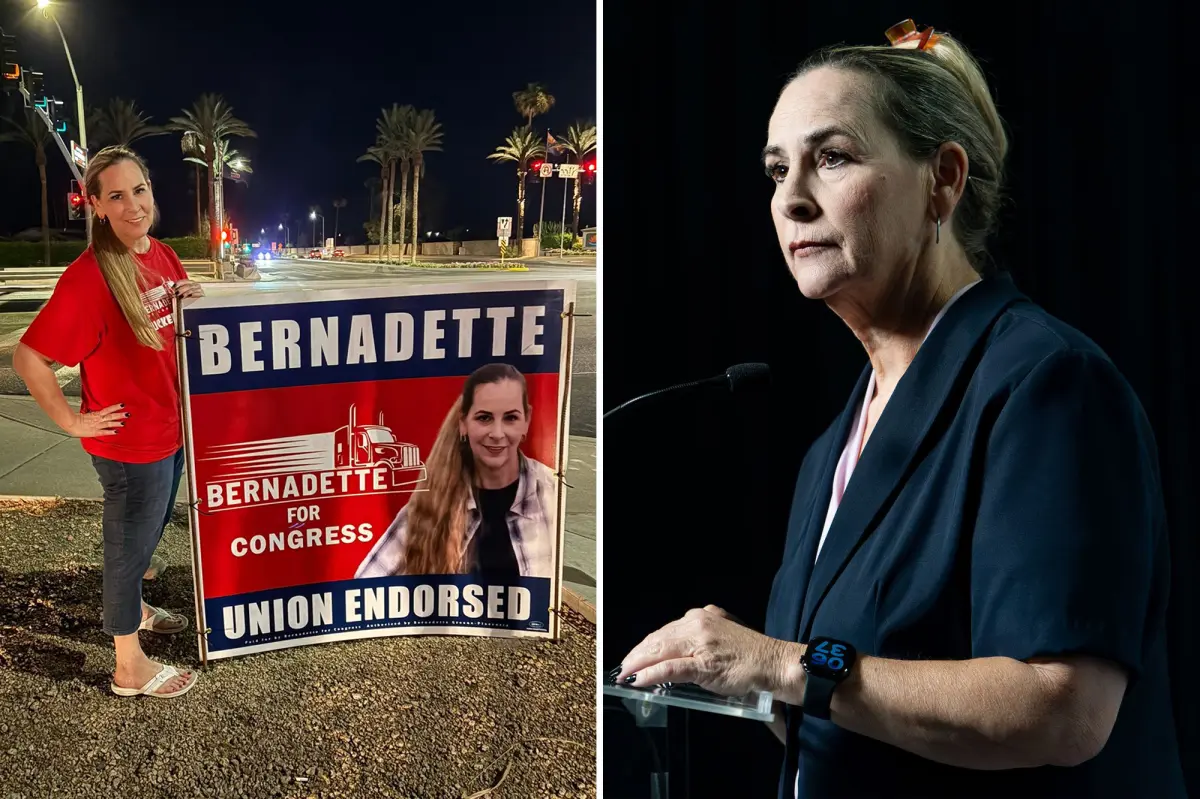
Bernadette Greene-Placentia has spent much of her life behind the wheel of a long-haul truck, a profession that demands alertness, endurance, and a quiet trust in the road ahead. But on an August night in Sun City, Arizona, the Democratic nominee for the 8th Congressional District found herself in a nightmare that no amount of driving could have prepared her for. She had gone out in the middle of the night to repair one of her campaign signs, a routine she had adopted to avoid the unbearable heat of the Arizona summer. In a parking lot, she was knocked unconscious. When she came to, she was being raped. The man, she later told The Phoenix New Times, called her a “bitch” and “not a very good f—k.” A second man then tried to assault her as well, but she kicked at him, and he walked away, muttering “not even worth it.” The attack left her bleeding vaginally for three days, and it carved a hole in her memory that she is still trying to piece together. She remembers flashes, not a full sequence: the dark, the violence, the terror, and then nothing—not even how she got home. Her campaign later told The Guardian that the attack occurred early on Aug. 14. The incident was not immediately reported. She sequestered herself in her apartment, went “missing in action” from her campaign, and spent two days in a fog before telling her husband and staff. Then she waited another two weeks to file a report with the Maricopa County Sheriff’s Office, because, as she put it, she was “embarrassed.” It is a painfully human response to an inhuman act: the impulse to hide, to forget, to wish the trauma away. But Greene-Placentia has now chosen to speak publicly, not for attention, but because she believes silence protects no one.
Greene-Placentia is not a career politician. She is a long-haul trucker who decided to challenge incumbent Rep. Abraham Hamadeh in Arizona’s 8th Congressional District, a race that has drawn attention as Democrats try to compete in a traditionally Republican area. Her campaign has been a grassroots effort, one built on yard signs, door-knocks, and small-dollar donations. In the Arizona summer, that kind of work is punishing. Temperatures routinely climb past 100 degrees, and the sun can make outdoor labor dangerous. So Greene-Placentia often waited until night to go out and repair or replace signs that had been damaged or stolen. Sometimes her husband went with her; sometimes she went alone. On the night of the attack, she was wearing a campaign shirt, a detail that has taken on a sinister weight in her memory. She told the New Times that her attacker may have called her a “Democratic bitch,” though she cannot be certain. She also cannot be certain why she was targeted, whether it was random, politically motivated, or something else entirely. What she does know is that a moment of civic dedication—trying to keep a campaign sign standing—turned into an assault that has shaken her sense of safety and self. The parking lot, the darkness, the ordinary errand: all of it now belongs to a before-and-after story she never expected to tell. Her husband and staff were devastated when she finally told them, and their support has been a lifeline. But the memory remains fragmented. “It’s just these little tiny flashes of things that I do remember,” she said. “As much as I don’t want to remember, I’ve tried very, very hard to remember more stuff. But that’s where I’m at.” That honesty—about the limits of memory and the desire to both forget and recover—captures the complicated reality of trauma. She is not offering a tidy narrative of healing; she is offering a raw account of survival. And she is doing it while running for Congress, which means she must relive the assault in interviews, face questions about her credibility, and continue campaigning in a district where the political stakes are high. It is a heavy burden, and she is carrying it in public.
In the days after the attack, Greene-Placentia did what many survivors do: she tried to disappear. She retreated to her apartment and stopped communicating with the outside world. Her campaign staff, who had been working alongside her, did not know where she was or why she had gone silent. She was “missing in action,” as she later described it, a phrase that suggests both the operational gap in her campaign and the emotional vacancy she felt inside. She did not call police right away. She did not go to a hospital, at least not immediately. She simply wanted to forget. “I just wanted to forget it,” she told the New Times. But the body does not forget so easily. She bled for three days. She experienced waves of rage and sorrow, what she called “crying times and angry times.” The memory of the assault kept surfacing in fragments: the sound of a voice, the feeling of being hit, the terror of waking up in the middle of a violent act. She was embarrassed, a word that survivors often use even when they have done nothing wrong. Embarrassment is a strange companion to trauma—it makes the victim feel complicit, dirty, somehow responsible. Greene-Placentia had to fight through that shame just to tell her husband. When she finally did, two days later, the people closest to her were horrified and heartbroken. They urged her to report the attack, but she needed more time. She needed to process the impossible: that she had been violated in a parking lot while doing something as mundane as fixing a sign. The delay in reporting is common among survivors, who may fear disbelief, judgment, or the grueling process of the criminal justice system. In Greene-Placentia’s case, the eventual report was filed on Aug. 31, more than two weeks after the assault. The Maricopa County Sheriff’s Office confirmed the report and said the investigation is ongoing. For now, there are more questions than answers. But Greene-Placentia’s decision to eventually speak out suggests that the shame is beginning to shift. She is no longer hiding. She is no longer silent. She is turning her pain into something that might help other women.
The police report, reviewed by The Phoenix New Times, documents the physical toll of the assault: vaginal bleeding for three days, bruising, the trauma of a stranger’s violence. Greene-Placentia told the outlet that she has gone through “crying times and angry times,” a phrase that captures the nonlinear nature of healing. Some days she is overwhelmed by sadness; other days she is consumed by fury. She wants answers. She wants justice. But she also knows that the legal process is slow and uncertain. The Maricopa County Sheriff’s Office has confirmed that her report was filed on Aug. 31, but has declined to provide further details while the investigation remains open. That means Greene-Placentia is living in a limbo of uncertainty: no arrest announced, no resolution in sight, and no way to know whether her attacker will be found. She is also living with the public scrutiny that comes from being a political candidate. Every interview she gives, every statement she releases, is read through the lens of the campaign. Some will accuse her of politicizing her assault; others will demand that she prove her story. This is an all-too-familiar reality for women in public life, especially those who dare to speak about sexual violence. But Greene-Placentia is not using her story as a political weapon. She is using it as a bridge. “I need to let women know that it’s okay to talk about it,” she said. That sentence is both a message of solidarity and a challenge to a culture that too often tells survivors to stay quiet, to move on, to protect the reputations of institutions and campaigns. She is refusing to do that. She is asking the public to sit with discomfort, just as she has been forced to sit with discomfort. “We’re asking people to stand up and donate or volunteer,” she said. “We’re asking those folks to be uncomfortable … then I have to be willing to be uncomfortable too.” It is a striking statement of accountability—not because she owes anyone her pain, but because she believes that meaningful change requires shared vulnerability. She is not asking for pity. She is asking for action, and she is leading by example.
Greene-Placentia’s decision to go public was not made lightly. She knew that revealing her assault would invite a wave of questions, some compassionate, some skeptical. She knew that her private pain would become public property, dissected by journalists, opponents, and strangers on social media. She also knew that her campaign, already a difficult race against a well-funded Republican incumbent, would be complicated by the added scrutiny. But she chose to speak anyway. Why? Because she believes that silence is a kind of complicity. If she stayed quiet, she would be sending a message to other survivors that their stories should be hidden, that their pain is shameful, that they should suffer alone. She refused to accept that. “I need to let women know that it’s okay to talk about it,” she said, and in those words there is an unmistakable echo of the #MeToo movement, which has encouraged millions of survivors to break their silence. But Greene-Placentia is not just talking about the past; she is talking about the future. She is asking people to donate to her campaign, to volunteer, to become involved in the political process—not because her race is more important than her trauma, but because the two are inseparable. She is running for Congress to represent her community, and her community includes survivors. It includes women who have been assaulted and blamed. It includes people who have been told to move on, to be nice, to not make waves. By telling her story, she is making waves. She is also making space. Her campaign, in a sense, has become a vehicle for advocacy. Every time she steps onto a stage or knocks on a door, she is proving that survivors can lead, can run for office, can demand better from the systems that too often fail them. She is not a victim in the passive sense; she is a survivor in the active sense. She is still standing, still fighting, still trying to repair the signs—literal and metaphorical—that have been damaged along the way.
This is not a story about politics, at least not only about politics. It is a story about the human cost of public service, about the dangers women face simply for showing up, and about the courage it takes to speak truth in a world that prefers comfortable fictions. Bernadette Greene-Placentia went out in the middle of the night to fix a campaign sign. She was doing something ordinary, something necessary, something that thousands of volunteers and candidates do every election cycle. And she was attacked. The assault was not her fault. Nothing about it was her fault. But she has chosen to carry the weight of telling it, in her own words, with all the messy fragments and unresolved questions. She has chosen to be uncomfortable so that other women might find it a little easier to be brave. The investigation is ongoing, and there may be more chapters to come. There may be arrests, trials, verdicts, or there may be silence and a closure that never quite comes. Whatever happens, Greene-Placentia has already changed the conversation in her district and beyond. She has shown that a candidate can be both a survivor and a leader, that vulnerability is not weakness, and that a woman’s right to be heard is not a favor—it is a fundamental part of democracy. Her campaign for Congress is about more than winning a seat; it is about showing that survivors belong in rooms where decisions are made. It is about insisting that the issues that affect women—safety, health, justice, bodily autonomy—are not side issues, but central to the work of governance. In telling her story, she is asking every voter to look at the world with a little more compassion and a little less judgment. She is asking them to understand that the person next to them, the volunteer on the street corner, the candidate at the podium, may be carrying a trauma they have never revealed. And she is reminding us all that healing is not a straight line. It is a winding road, full of crying times and angry times, flashes of memory and long stretches of forgetting. But it is a road that can be traveled. Greene-Placentia is traveling it, and she is inviting others to walk beside her.