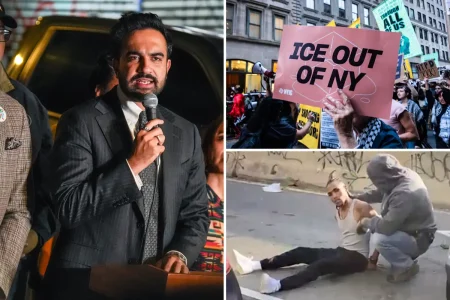



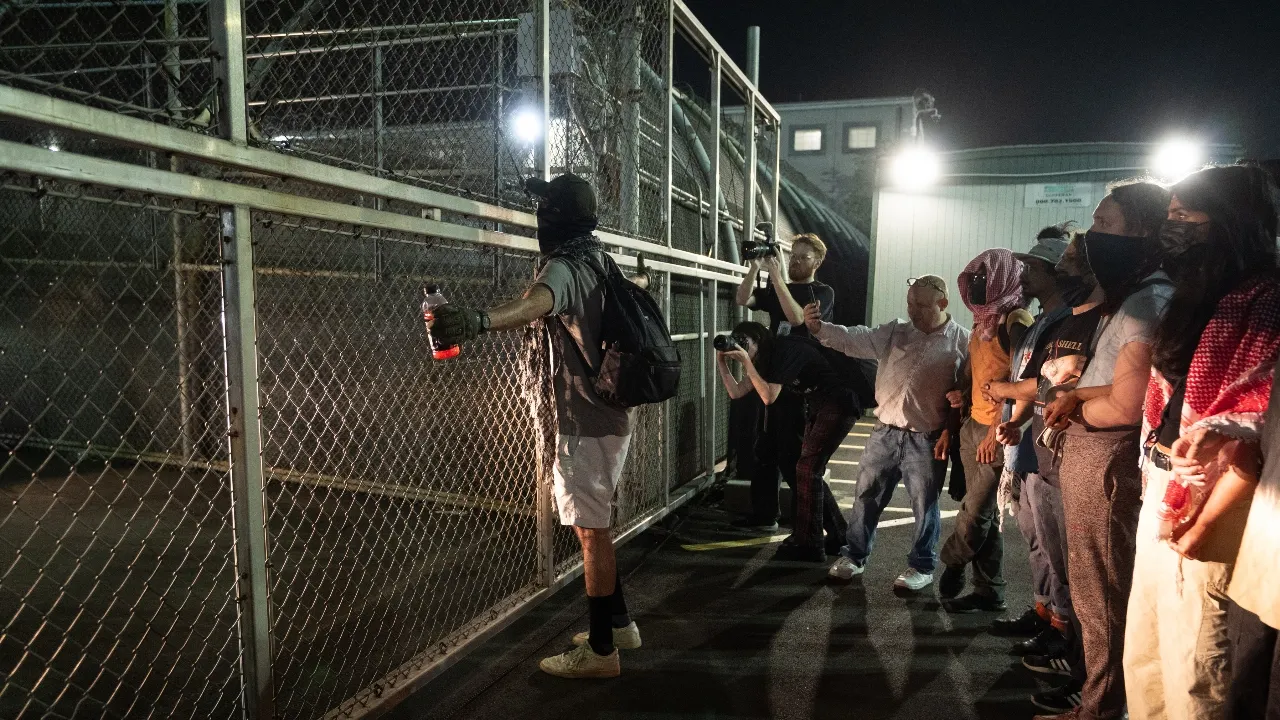
On a damp, tension-filled Monday morning, the cracked asphalt outside the Delaney Hall detention facility in Newark, New Jersey, became both a physical and symbolic battleground for one of America’s most deeply polarizing humanitarian crises. What began as a peaceful demonstration quickly escalated into a chaotic scene of physical and emotional clashes, as anti-ICE protesters attempted to form a protective human chain around the perimeter of the private contract facility. The air was thick with the sounds of desperation and anger: demonstrators shouting “No more ICE!” and “Free them all!” while standing eye-to-eye with heavily geared Immigration and Customs Enforcement federal agents. Water bottles were thrown, voices cracked with emotion, and several protesters were swiftly tackled and detained as agents struggled to push the surging crowd back toward a designated grassy area off the main road. The confrontation was not merely a dispute over federal immigration policy; it was a raw, visceral manifestation of human frustration, where advocates, family members, and local citizens put their bodies on the line to protest what they allege are cruel, unseen realities occurring behind the facility’s heavily secured, newly fortified concrete walls. This physical theater of protest represents the deep-seated polarization of American immigration policy, where a single street in Newark becomes the epicenter of an ideological and humanitarian war, exposing the deep-seated rift between law enforcement directives and basic human empathy in modern-day America.
The conflict at Delaney Hall reached a critical political boiling point when New Jersey Governor Mikie Sherrill arrived at the facility, seeking to personally inspect the conditions inside, only to be flatly denied entry by the facility’s administration and federal authorities. This high-profile rejection sent shockwaves through the local political landscape, transforming a localized protest into a major constitutional and administrative standoff over transparency, accountability, and public oversight. Governor Sherrill expressed her deep distress and suspicion following the incident, declaring that the formal denial of her request for access raised serious, troubling questions about what the facility’s private operators are actively trying to hide from the public and elected representatives. Her public stand against Delaney Hall is part of a broader, principled opposition to the existence of private, for-profit detention facilities throughout New Jersey, as she vowed to continue advocating tirelessly for the complete closure of Delaney Hall and to fiercely resist any future attempts to expand mass detention capabilities within the state, such as a highly controversial proposed facility in nearby Roxbury. This political stonewalling highlights a worrying trend where high-ranking state officials find themselves locked out of federal facilities operating in their own backyards, effectively shielding the private immigration enforcement apparatus from necessary democratic scrutiny and leaving vulnerable populations without a voice.
Beyond the concrete walls of the facility, away from the screaming crowds and political speeches, a silent and desperate struggle for survival and dignity was unfolding among the hundreds of human beings trapped inside. Nearly 300 detainees had recently banded together to launch a coordinated, high-stakes hunger and labor strike, risking their own fragile health to draw attention to what they describe as profoundly inhumane living conditions, systematic medical neglect, and the denial of basic human rights, including regular family visits. In a deeply moving joint letter smuggled out of the facility, these individuals laid bare their psychological and physical agony, describing a reality where they feel less like civil detainees and more like victims of a terrifying, state-sanctioned kidnapping. While the writers of the letter made a humble, heart-wrenching plea for forgiveness for entering the United States without prior legal authorization, they explained that their decision to cross the border was born out of sheer terror, a desperate bid to escape lethal violence and persecution that placed their lives and the lives of their families in immediate danger. For these striking migrants, the daily physical torment of eating spoiled, inadequate food and living in filthy, isolated conditions is compounded by the psychological torture of indefinite detention—a painful limbo where their humanity feels entirely stripped away and replaced by an administrative designation.
In stark and uncompromising contrast to the painful descriptions provided by the detainees and their advocates, federal authorities and Department of Homeland Security representatives have mounted a robust defense of the Delaney Hall operations, asserting that the facility adheres to exceptionally high operational and humanitarian guidelines. A DHS spokesperson strongly disputed the allegations of neglect, stating that every individual held within the facility is provided with three nutritionally balanced, dietician-certified meals per day, along with clean drinking water, seasonal clothing, bedding, regular hot showers, and essential hygiene toiletries. Furthermore, federal officials emphasized that these detainees maintain consistent access to communication channels, specifically through telephones, allowing them to remain in contact with their loved ones and legal representation as they navigate their complex immigration proceedings. To counter the narrative of cruelty, the government argues that ICE’s detention standards are actually significantly higher and more comfortable than those found in the vast majority of standard United States prisons that house convicted American citizens. This defense is bolstered by a hardline security perspective, such as that voiced in February 2025 by then-DHS Assistant Secretary Tricia McLaughlin, who asserted that the facility is not holding harmless families, but rather serves as a vital shield for the public, housing high-risk individuals including murderers, suspected terrorists, child rapists, and dangerous members of trans-national criminal organizations like MS-13, painting a picture of an indispensable facility designed to protect national security.
While the war of words and policies rages on between federal agencies and civil rights organizations, a quieter, deeply poignant tragedy has been playing out along the perimeter of the facility, where families, partners, and friends of those detained have maintained an emotional, round-the-clock vigil since Friday. These loved ones stand huddled together against the elements, watching the heavy metal gates open and close, holding onto the hope of catching a fleeting glimpse of their relatives or sending a silent message of solidarity through the walls. For these families, the detention of their loved ones is an agonizing, daily trauma that disrupts their homes, finances, and emotional stability, leaving them in an agonizing state of limbo as they wonder if their spouses, parents, or siblings are safe, healthy, or receiving the medical care they desperately need. The presence of these families serves as a powerful, living reminder that the immigration system does not operate in a vacuum; its impacts ripple outward, tearing at the fabric of local communities and leaving innocent children and relatives to bear the heavy psychological burden of separation and uncertainty. This ongoing vigil transforms the cold, industrial landscape of Delaney Hall into a sacred space of communal grief and endurance, where the simple act of refusing to leave becomes a potent form of resistance against a system that seeks to render their loved ones invisible and forgotten.
The compounding tensions at Delaney Hall have rapidly catalyzed a powerful and growing coalition of federal, state, and local elected officials who are joining the grassroots call for immediate oversight, reform, or the outright closure of the controversial New Jersey facility. Prominent political figures, including Senator Andy Kim, along with Representatives Rob Menendez Jr., Nellie Pou, LaMonica McIver, Analilia Mejia, and veteran lawmaker Frank Pallone Jr., have either personally visited the site or demanded immediate congressional investigations into the alleged abuses occurring within. Their unified political stance signals that the crisis at Newark’s detention center is no longer just a localized activist protest, but a key focal point in a much larger, nationwide battle over the ethics of privatization in law enforcement and the moral responsibilities of a democratic nation toward migrant populations. As investigations loom and the community continues to demand justice, Delaney Hall stands as a stark and painful monument to the unresolved contradictions of American immigration policy—a place where the rigid enforcement of national security mandates collides daily with the fundamental, non-negotiable demands of human dignity, empathy, and human rights, leaving a community divided and a nation searching for a more humane path forward.