



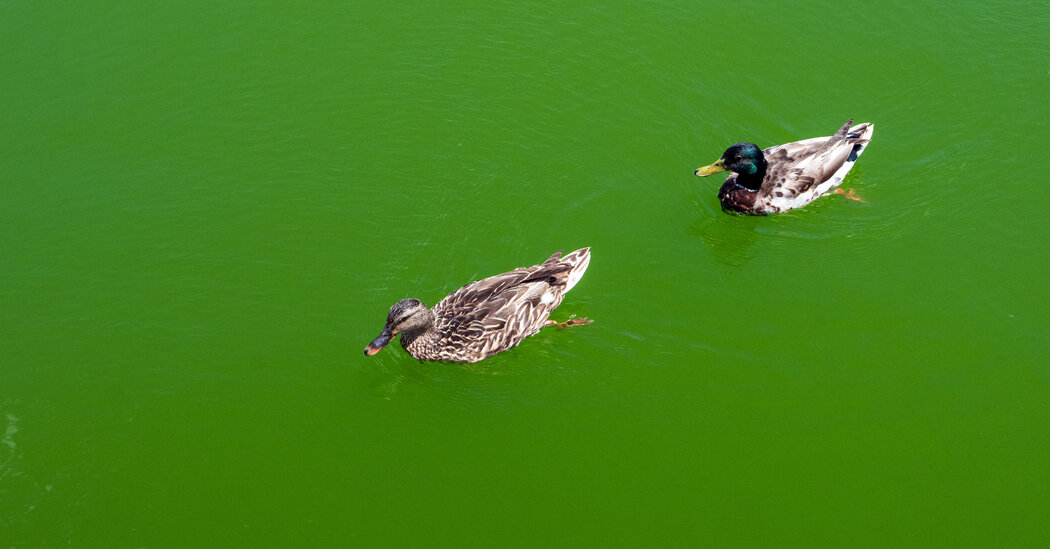
The sweltering, heavy heat of a Washington, D.C. summer has a long history of melting even the grandest of human ambitions, a lesson that was made vividly clear this week at the base of the Lincoln Memorial. For over a century, the iconic Reflecting Pool has stood as a majestic, silent stage for American history, capturing the solemn image of the Great Emancipator and the shifting colors of the sky. However, the monument has also been plagued by a stubborn, earthly problem: persistent water leaks and ugly blankets of green algae fueled by the intense mid-Atlantic sun. Seeking to present a flawless, gleaming face to the world ahead of the nation’s upcoming 250th semi-quincentennial anniversary, the Trump administration launched a highly publicized, $14.2 million renovation project. The concrete basin was drained, repaired, and coated in a specialized waterproofing material to finally give the historic landmark a brilliant, uniform baseline. Yet, just days after the pool was triumphantly refilled with fresh water, the relentless power of biology staged an unyielding comeback. Under the baking heat of the weekend sun, thick clumps of bright green algae rapidly blossomed across the surface, transforming parts of the newly restored basin into a murky, emerald-tinted pond and proving that nature rarely bows to human construction deadlines.
Despite the sudden and visual return of the persistent green slime, representatives of the Trump administration quickly moved to defend the massive undertaking and downplay the biological intrusion. While officials from the Interior Department, which oversees the National Park Service and the National Mall, did not immediately provide a formal response to incoming press inquiries, spokesperson Katie Martin offered an optimistic explanation via email. According to Martin, the unsightly green patches were merely a temporary setback caused by “residual algae from the supply lines which have been sitting dormant for eight weeks while construction has been taking place.” She confidently assured the public that the biological residue would be flushed out and eliminated in short order, emphasizing the long-term durability of the project. To drive the point home, Martin proudly championed the president’s personal involvement in the revitalization, declaring that “President Donald J. Trump is an expert builder who has fixed the Reflecting Pool for good.” This statement mirrored Trump’s own outspoken criticisms of the landmark’s aesthetic state; just a month prior, the president had publicly lamented that the pool had been “filthy” and “dirty” for many years, promising that his administration’s intervention would make the historic site truly “beautiful” once again by coating its concrete floor in a specific, patriotic shade he proudly termed “American flag blue.”
To achieve this rapid turnaround and bypass the notoriously slow gears of federal bureaucracy, the Trump administration took the unusual step of awarding no-bid contracts to two handpicked companies. Typically, large-scale federal public works require a rigorous, competitive bidding process designed to protect taxpayer funds and ensure transparency. However, administration officials legally bypassed this requirement by declaring an “urgent need” to have the symbolic pool completely restored in time for the fast-approaching celebration of the nation’s 250th birthday. The first of these lucrative, sole-source contracts went to Atlantic Industrial Coatings, a Virginia-based specialty firm tasked with the painstaking job of sealing the leaky joints between the pool’s massive concrete slabs and applying the dark “American flag blue” waterproofing layer. The second crucial contract was awarded to Greenwater Services, an Ohio-based company hired to bring the pool’s mechanical operations into the modern era by installing an upgraded, state-of-the-art water-purification system. Though Atlantic Industrial Coatings successfully completed its physical application of the blue coating on schedule by June 4, allowing the park service to begin refilling the pool, it remained highly unclear in the days following whether Greenwater Services’ advanced new purification machinery had actually been fully installed, calibrated, and turned on to fight off the impending algal blooms.
As the summer sun beat down on the National Mall, the physical struggle to maintain the pool’s appearance transitioned from high-tech contracting to low-tech, manual labor. On Sunday, visitors watched as National Park Service employees in tall rubber waders walked through the shallow, lukewarm waters, using hand-held skimmers in a tedious attempt to scoop the floating green algae off the bright blue floor. The government workers were joined in their efforts by staff from Pearl Purity Water Solutions, a Maryland-based private contractor that has held a dedicated service agreement since 2021 to chemically treat and maintain the massive pool’s water quality. As of Monday, representatives from both Greenwater Services and Pearl Purity Water Solutions remained tight-lipped, failing to respond to requests for comment regarding why the newly renovated pool had succumbed so quickly to the algae, or what chemical interventions were being deployed to restore the water’s clarity. The sight of workers wading through the water with nets offered a stark, grounded contrast to the lofty administrative promises of a permanent, high-tech cure, highlighting the relentless daily upkeep required to keep a massive, open-air body of water looking clean in the middle of a humid swamp.
Meanwhile, the unfolding drama in the water did little to deter the steady streams of tourists who crowded the paved walkways of the National Mall, though the green water elicited very different reactions from those who stopped to look. For some, like Bonnie Garvin, a visiting schoolteacher from Monticello, Georgia, the presence of the green algae was a minor, natural detail that did not detract from the deep historical significance of the monument. Strolling along the water’s edge in the bright summer sunshine, Garvin shrugged off the aesthetic imperfection with a practical perspective, noting, “We’re not swimming in it, so it’s not really an issue.” However, other tourists who had traveled long distances expecting to see the classic, mirror-like vista were left feeling deeply underwhelmed. Jessica Lea, a licensed therapist visiting all the way from Portland, Oregon, expressed her disappointment upon seeing the century-old landmark for the very first time. Peering out across the patchy, green-stained water under the hot sun, Lea lamented the lack of maintenance, describing the scene as “pretty swampy” and noting that it “could be cleaner.” For her, the sudden return of the algae had ruined the very feature that gave the monument its iconic name, as she disappointedly observed, “I can’t see any reflecting.”
Ultimately, the battle over the Lincoln Memorial Reflecting Pool highlights the eternal, humbling tug-of-war between human engineering and the relentless forces of the natural world. No matter how much money is spent, how quickly red tape is cut, or how patriotic the shade of blue paint applied to the concrete floor is, water exposed to sunlight, heat, and organic nutrients will inevitably harbor life. The $14.2 million effort to quickly beautify the Mall for the nation’s milestone birthday represents a classic American desire to project strength, perfection, and architectural dominance. Yet, the stubborn green film creeping across the “American flag blue” pool serves as an organic reminder that nature operates on its own schedule, indifferent to political legacies, high-profile anniversaries, or the label of “expert builder.” As tourists continue to gather at the steps of the Lincoln Memorial to reflect on the nation’s complex past and uncertain future, they are left with a landmark that is deeply human—not because it is perfectly pristine and synthetic, but because it requires constant, daily care, struggle, and humility to keep the swamp at bay.