




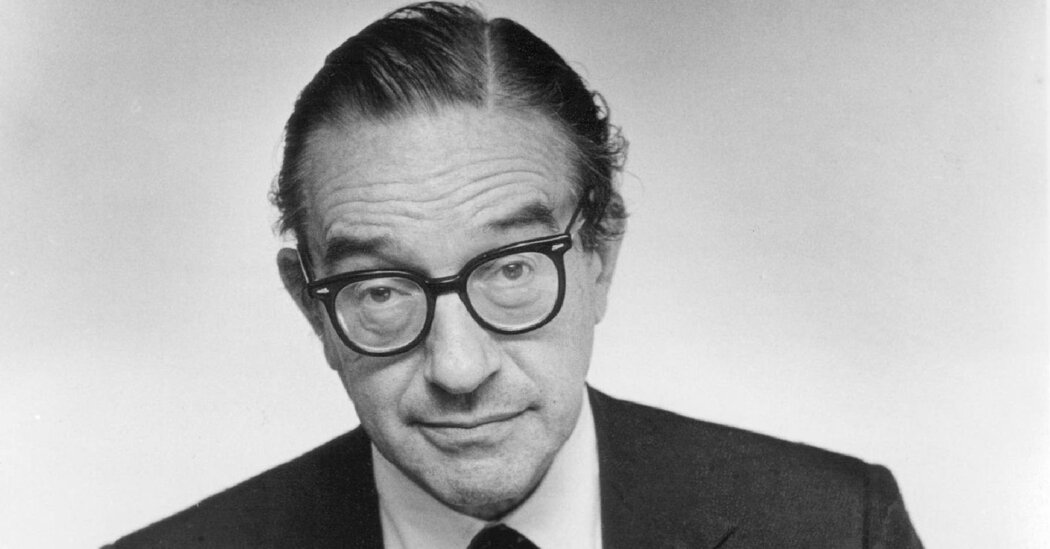
On a quiet Monday in Washington, inside the home he shared for decades with his wife, the prominent journalist Andrea Mitchell, Alan Greenspan drew his final breath at the age of 100. His passing, brought on by complications of Parkinson’s disease, closed the final chapter on a life that was deeply intertwined with the rise, triumph, and eventual reckoning of modern American capitalism. For nearly twenty years, Greenspan was not merely the Chairman of the Federal Reserve; he was the primary architect of the global financial system, a soft-spoken titan whose decisions could ignite prosperity or plunge markets into panic with a single, carefully calibrated phrase. To active participants in the global economy, he was a secular high priest, a man whose enigmatic public persona and famously dense “Greenspeak” fascinated the public and baffled Congress. Yet, behind the black-rimmed glasses and the austere, professorial exterior lay a deeply human story of a boy from Brooklyn who loved jazz and numbers in equal measure. Born in 1926, Greenspan grew up in a world defined by the Great Depression, a formative experience that instilled in him a lifelong fascination with economic data. In his youth, he was a talented clarinetist who studied at the Juilliard School and toured with a swing band, learning the rhythms of improvisation before trading his saxophone for the structured logic of economic forecasting. This transition from musician to monetary master set the stage for a career of unparalleled influence, turning an introverted intellectual into an indispensable advisor to four American presidents of both political parties from 1987 to 2006.
To understand the immense scale of Greenspan’s influence, one must recall the cultural and political landscape of the late twentieth century, an era in which he stood as the definitive embodiment of American economic exceptionalism. Appointed by Ronald Reagan and subsequently reappointed by George H.W. Bush, Bill Clinton, and George W. Bush, Greenspan presided over the Federal Reserve during a period of historic, uninterrupted expansion. It was a time when the Cold War had ended, democracy seemed triumphant, and there was a profound, almost religious faith in the power of free markets to lift humanity to unprecedented heights of comfort and wealth. Under his watchful eye, the emerging computer age revolutionized American industry, driving productivity gains that Greenspan was among the very first to recognize and champion. He became a cultural icon, dubbed “The Maestro” by the media, a wizard who possessed an almost supernatural ability to read the economic tea leaves. His daily routine became legendary: taking long, hot baths at dawn to soothe his aching back while reading thousands of pages of obscure industrial data, seeking patterns that academic economic models missed. For the average American, Greenspan was a comforting, steadying presence, a symbol of stability who promised that as long as he was at the helm of the central bank, the engine of American prosperity would keep humming smoothly along, delivering rising home ownership, booming retirement accounts, and a seemingly endless horizon of consumer abundance.
This unparalleled public trust was anchored in a deeply held, highly personal economic philosophy that Greenspan formed early in his adulthood. In the 1950s, he fell in with the inner circle of the controversial libertarian novelist Ayn Rand, becoming a frequent guest at her intellectual salon and absorbing her radical belief in the moral righteousness of laissez-faire capitalism and individual self-interest. This philosophical foundation profoundly shaped how Greenspan approached his role as the nation’s chief economic regulator. He fervently believed that markets were inherently self-correcting and that government intervention, though sometimes necessary, was more often than not a clumsy force that stifled innovation and limited human freedom. This hands-off conviction became the defining characteristic of his tenure, aligning perfectly with the political winds of the 1990s and early 2000s. Under his guidance, the Federal Reserve systematically dismantled older regulatory boundaries, encouraging the rapid growth of complex financial instruments and allowing Wall Street investment banks to police themselves. While critics warned that this hands-off approach was dangerous, Greenspan remained steadfast in his conviction that the pursuit of profit would naturally compel financial institutions to manage their own risks prudently, rendering aggressive government supervision obsolete. For a long time, the spectacular wealth generated by this deregulated environment seemed to validate his worldview, cementing his reputation as an untouchable oracle of the free market.
Despite his aversion to government interference, Greenspan’s longevity as a policymaker was defined by his extraordinary ability to act decisively in moments of acute national crisis, saving the financial system from collapse on numerous occasions. Just weeks after he took office in the autumn of 1987, the stock market suffered its catastrophic “Black Monday” crash, with the Dow Jones Industrial Average plummeting more than twenty-two percent in a single day. Moving with an agility that surprised his detractors, the rookie chairman immediately flooded the banking system with liquidity, reassuring a terrified public that the central bank stood behind the nation’s financial institutions and successfully preventing a broader economic depression. This crisis-management blueprint would define his response to successive global shocks, including the 1997 Asian financial crisis, the sudden collapse of the massive hedge fund Long-Term Capital Management, and the agonizing uncertainty following the terrorist attacks of September 11, 2001. In each instance, Greenspan deployed the full power of the Federal Reserve’s balance sheet, cutting interest rates to rock-bottom levels to provide a comforting cushion of cheap money that allowed the American consumer to keep spending. These episodes cast him as a heroic economic firefighter, a man whose swift and creative interventions kept the fragile global economy from careening off the rails, earning him the gratitude of a nation that came to view his economic interventions as a safety net against any disaster.
However, the very easy-money policies and deregulatory zeal that made Greenspan a hero during his career would ultimately cast a long, dark shadow over his historical legacy after he stepped down in early 2006. In the years following his retirement, the American landscape was shattered by the catastrophic subprime mortgage collapse, the near-total meltdown of Wall Street, and the grinding misery of the Great Recession. In the painful national post-mortem that followed, the public and academic consensus shifted dramatically, and the former “Maestro” was suddenly cast as a primary culprit of the disaster. Critics argued passionately that by keeping interest rates too low for too long in the early 2000s, Greenspan had unwittingly inflated the massive, unsustainable housing bubble that lay at the heart of the crisis. Worse still, his stubborn refusal to use the Fed’s power to regulate predatory subprime lending practices and exotic financial derivatives was seen as a catastrophic failure of oversight that left the American public defenseless against corporate greed. The most poignant moment of this public reckoning occurred in late 2008, when a visibly older, more vulnerable Greenspan sat before a hostile congressional committee and admitted, in a voice stripped of its old authority, that he had found a major “flaw” in his lifelong libertarian ideology, having overestimated the ability of free markets to self-regulate.
With his passing at the remarkable milestone of one hundred years, Greenspan leaves behind a legacy that is as complex, contradictory, and deeply human as the century he inhabited. He was a man who lived through the entire arc of modern American economic history, rising from modest Depression-era roots to steer the financial destiny of the world’s sole superpower, only to witness the dramatic fraying of the intellectual paradigm to which he dedicated his life. To his admirers, he remains a brilliant, devoted civil servant whose steady hand and deep understanding of data guided the nation through decades of unprecedented prosperity and successfully averted numerous financial catastrophes. To his detractors, he remains a tragic figure of intellectual hubris, a philosopher-king whose unyielding faith in the inherent rationality of markets blinded him to the systemic greed and instability that eventually brought the global financial system to its knees. In the end, Greenspan’s life stands as a powerful testament to the heavy burden of leadership and the profound fragility of human theory in the face of a chaotic, unpredictable world. As his family, colleagues, and the nation mourn his passing, we are left to grapple with the enduring questions he spent a century trying to solve: how to balance the creative power of human freedom with the stabilizing necessity of guardrails, and how to govern a vast, complex economy while remaining humble before the unpredictable currents of history.