


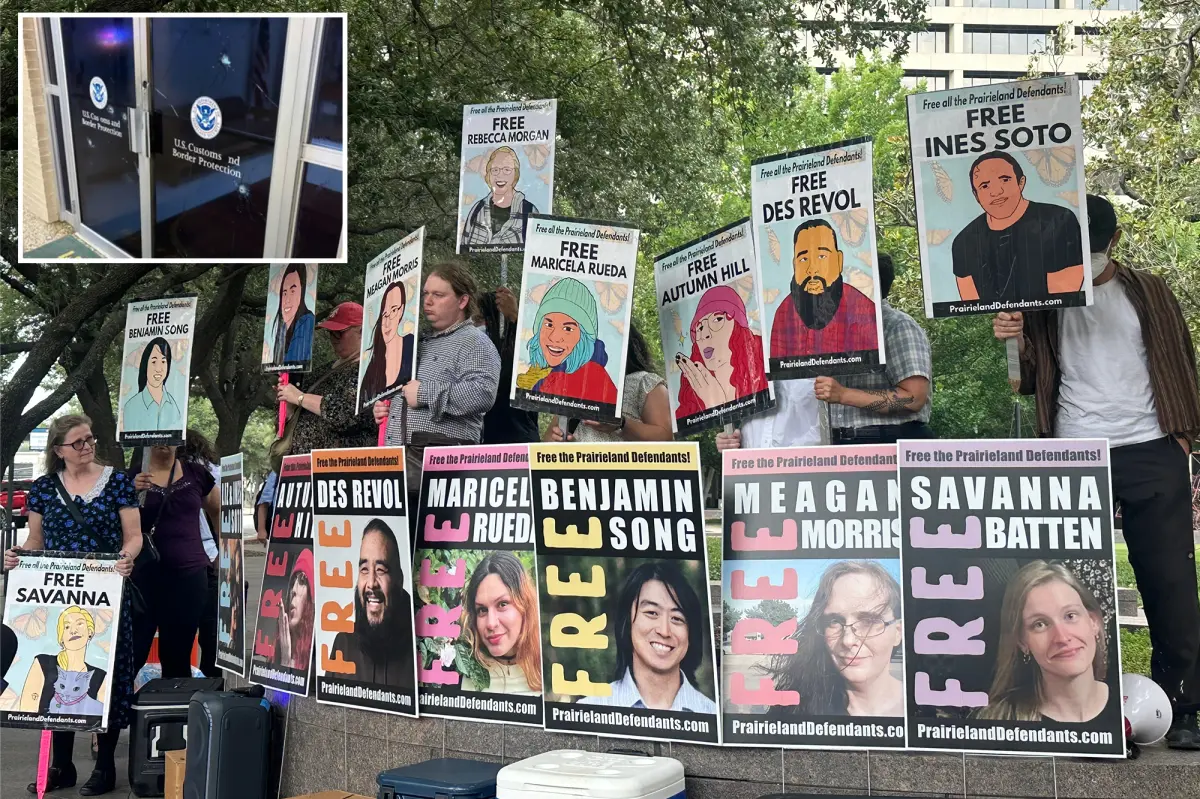
The atmosphere in the Fort Worth federal courtroom was heavy with a cold, suffocating silence, broken only by the sudden, sharp gasps of family members who watched their loved ones’ futures disintegrate in a matter of minutes. Tuesday’s hearing marked a devastating culmination of a government crackdown, as a former Marine reservist and seven other young activists received sentences spanning decades. The severity of the punishment sent shockwaves far beyond the courtroom walls, with the defendants’ loved ones left in a state of raw disbelief and grief. The harshest blow was dealt to Benjamin Song, a former Marine reservist convicted of opening fire during a July 4th protest at the Prairieland Detention Center, who received the absolute maximum penalty of 100 years in prison—essentially a life sentence with no hope of a future. The remaining seven co-defendants received sentences ranging from 30 to 70 years, prompting visceral outcries of anger and pain from their families. Lydia Koza, whose wife Autumn Hill was sentenced to 50 years, voiced the collective anguish of the families, declaring herself utterly livid that the government would strip a young person of their entire life for attending a protest where, ultimately, no one was killed. However, the presiding federal judges, including U.S. District Judge Reed O’Connor, rejected any pleas for leniency, framing the late-night clash not as a passionate exercise in civil disobedience, but as a calculated, violent assault on democratic institutions. O’Connor emphasized the pressing societal need to deter such disruptive conduct, signaling that the federal government was prepared to use the full weight of its judicial machinery to crush political dissent that crosses into violence. For the crying families huddled in court hallways, the sentences felt less like a measured application of justice and more like a cruel, highly politicized execution of their children’s futures.
To fully comprehend the tragedy, one must look back to the night of July 4th at the Prairieland Detention Center, a stark immigration facility near Dallas. The gathering was conceived as a noisy demonstration of solidarity, timed so detained immigrants would hear the fireworks and know they were not forgotten. However, the line between peaceful activism and tactical confrontation blurred rapidly as the night progressed. Federal prosecutors presented a dark, calculated narrative to the jury, arguing that the protesters did not arrive merely to make noise, but had prepared for an armed guerrilla conflict. They pointed to the defendants’ possession of firearms, tactical body armor, and first aid kits as undeniable indicators of a sinister, premeditated ambush. In stark contrast, defense attorneys maintained that the demonstration was intended to be peaceful and celebratory, and that those who brought firearms did so strictly for self-defense at an isolated facility in a highly polarized environment. The fragile peace shattered when police officers arrived on the scene; amid the confusion, Benjamin Song reportedly shouted instructions to retrieve the rifles and opened fire, striking and wounding an arriving officer. What was supposed to be a night of expressive protest and symbolic fireworks instantly devolved into a chaotic exchange of gunfire, setting off a chain of events that would ultimately lead to the systematic destruction of eight young lives under the banner of national security. The prosecution’s narrative transformed a messy, chaotic midnight scuffle into an organized cell operation, weaponizing the presence of basic emergency medical supplies like first aid kits as proof of tactical combat planning. Conversely, the defense highlighted the profound fear that many left-wing activists felt when protesting in rural Texas, explaining that carrying legal firearms was a defensive precaution, not an offensive plan. When a squad car pulled up, overwhelming panic triggered a split-second decision by Song, whose training may have tragically overridden his judgment, resulting in a single bullet that wounded the officer and sealed their fates.
At the heart of this legal storm are human beings whose profiles have been reduced to flat caricatures of extremism by the state. Benjamin Song, the former Marine reservist who now faces a century behind bars, was described by his attorney, Phillip Hayes, not as a ruthless terrorist, but as an idealistic young man with a big heart who deeply wanted his voice to be heard in a system he believed was fundamentally broken. Hayes emphasized that Song and his friends never intended for anyone to get hurt, let alone for weapons to be discharged at law enforcement. This sentiment was echoed by Autumn Hill, who received a staggering 50-year sentence. Her lawyer, Cody Cofer, painted a portrait of a gentle, exceptionally conscientious young woman who viewed the protest not as a paramilitary operation, but as a spirited community gathering resembling a block party. Cofer pointed out that Hill did not carry a weapon, nor did she advocate for violence as a means of political expression. In a poignant detail that illustrated her gentle nature, the court heard that even after the chaos of the fireworks and confrontations, Hill stayed behind to diligently clean up the trash and debris left on the ground, demonstrating a quiet respect for the community. The state’s insistence on portraying these individuals as threat-hardened infidels of democracy ignored their youthful idealism, replacing their human nuances with the terrifying label of extremist to justify locking them away for the majority of their adult lives. Prosecutor Frank Gatto asserted that individuals with such radical, anti-establishment beliefs require prolonged incarceration because they purportedly view violence as a legitimate tool, effectively criminalizing their ideological leanings alongside their actions. This heavy-handed characterization left no room for the defense’s dynamic description of these defendants as compassionate, if incredibly naive, young citizens who desperately wanted to make a difference.
The most alarming aspect of this federal prosecution is the draconian punishment meted out to individuals with minimal or non-existent involvement in the actual violence. Consider the heartbreaking case of Daniel Sanchez Estrada, who was not present at the Prairieland Detention Center when the shooting occurred, nor did he participate in the tactical planning of the protest. His only crime was moving a personal storage box belonging to him and his wife—another defendant in the case—after the incident occurred. His attorney, Christopher Weinbel, demonstrated that the box contained nothing illegal, but rather deeply personal items including original artwork, poetry, journals, and self-published political zines. Yet, under the sweeping dragnet of the federal joint terrorism task force, Sanchez Estrada was convicted of concealing documents and sentenced to a breathtaking 30 years in federal prison. Similarly, Savanna Batten was sentenced to a half-century behind bars, despite her attorney, Chris Tolbert, proving that she did not bring weapons, spray paint, or fireworks to the facility, nor did she assist in organizing the demonstration. These terrifying outcomes illustrate a systemic shift toward collective punishment, where association with a radical cause is treated with the same judicial severity as committing an act of physical violence. By targeting peripheral figures with life-altering sentences, the justice system has sent a chilling message that proximity to dissent is a crime in itself, leaving families to mourn the loss of young artists, writers, and dreamers who were swallowed whole by a system determined to make an example of them. For these families, the realization that a life can be dismantled over a box of poetry or a shared car ride is a horrifying testament to the overreach of modern counter-terrorism laws. It highlights an era where the boundary between absolute innocence and ideological complicity has been entirely erased by a state determined to secure maximum convictions.
This landmark case reflects the highly charged political landscape of America, where the label of Antifa is wielded as a potent weapon of criminalization. The Justice Department proudly announced these sentences as the first major federal convictions of defendants affiliated with Antifa, following a controversial executive order signed by President Donald Trump that labeled the decentralized movement as a domestic terrorist organization. This move occurred despite the glaring legal reality that there is no official domestic equivalent to the State Department’s foreign terror list, exposing the highly political nature of the prosecution. Antifa is not a highly structured organization with cards, dues, or a singular leader; rather, it is a broad, decentralized umbrella term for decentralized cells and far-left activists who organize to oppose neo-Fascism and white supremacy. Yet, Acting Attorney General Todd Blanche seized upon this loose affiliation to declare that Antifa terrorists who target federal installations would face uncompromising, swift retribution. By elevating a chaotic, local protest into a major national security threat, the government successfully pressured jurors and judges to view these passionate, anti-detention activists through the terrifying lens of international terrorism. Critics and civil rights advocates across the nation have expressed profound alarm over this dangerous precedent, warning that using terrorism enhancement statutes against left-wing protesters undermines the fundamental constitutional protections of the First Amendment, threatening the future of free speech and peaceful assembly for all Americans. When a decentralized ideology is treated as a cohesive, militarized enemy of the state, any citizen who aligns with its broad goals—such as advocating for the humane treatment of immigrants—faces the terrifying prospect of being labeled a combatant. This systemic inflation of charges of civil disobedience into federal terrorism cases effectively narrows the space for legitimate political expression, turning the courtroom into a theater of political warfare where the primary objective is the total neutralization of dissent.
The impact of this trial reaches far beyond Texas, casting a long shadow over progressive activism across the United States. This aggressive federal strategy is already being replicated on a national scale, as seen in Minnesota, where federal prosecutors recently charged fifteen individuals with conspiring against the government to disrupt immigration enforcement by building blockades and throwing ice at ICE vehicles. For the families of the Texas defendants, however, the grand political debates are secondary to the raw, visceral pain of empty bedrooms, fragmented holidays, and the agonizing prospect of decades of separation. As defense attorneys begin the arduous, emotionally exhausting process of appealing these staggering sentences, the community is left to grapple with the disturbing moral reality of a justice system that prioritizes political deterrence over genuine rehabilitation and proportionality. The horrific reality of a young veteran facing a century in prison, and his peers spending their youth behind concrete walls, stands as a bleak monument to a nation deeply fractured by fear and political division. Inside the silent visiting rooms of federal penitentiaries, the human cost of this political crackdown is measured not in legal triumphs or press releases, but in the quiet tears of parents and partners who must watch their loved ones grow old behind bars, victims of a harsh, uncompromising new era of American justice. In trying to protect its borders and institutions from what it deemed a threat to democracy, the state has paradoxically eroded the very democratic values of proportional justice, mercy, and free expression. The empty chairs at family dinner tables will remain a haunting reminder of the night that a protest for human dignity ended in a tragedy of systemic vengeance, leaving a generation of young idealists to pay the ultimate price for raising their voices.