





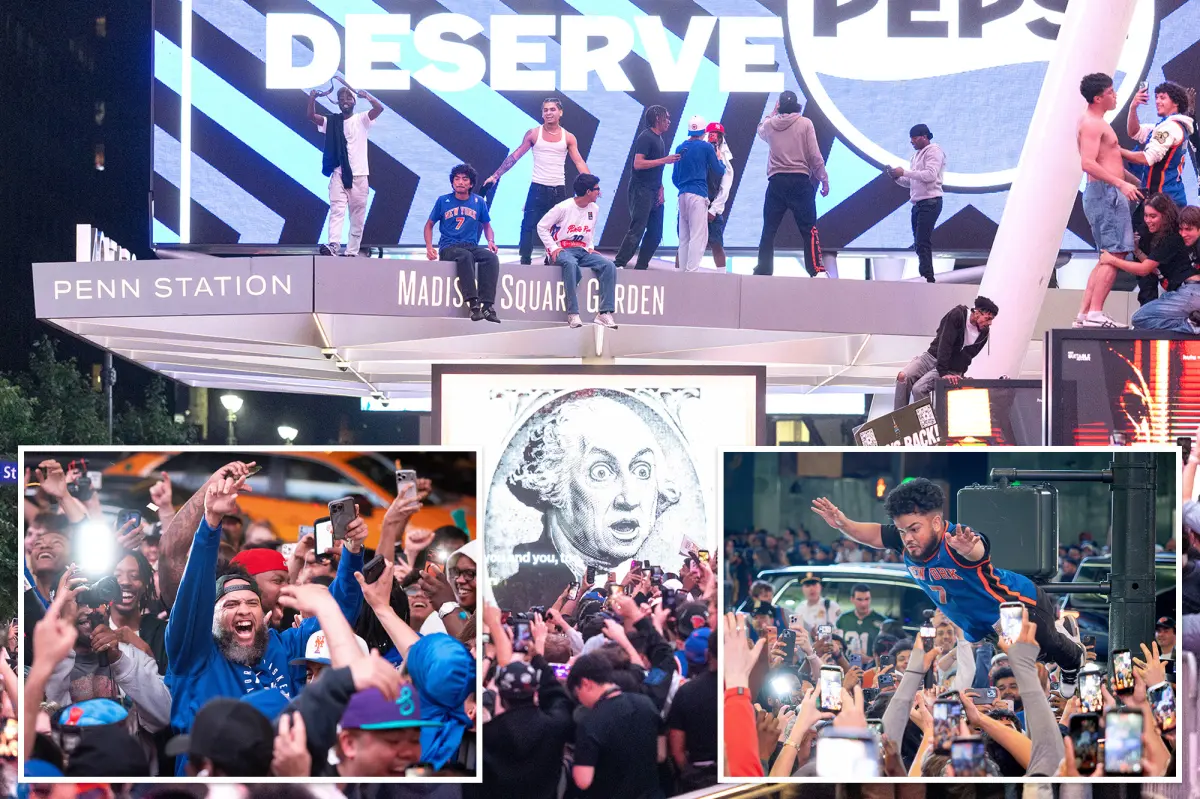
For nearly three decades, the concrete canyon of Seventh Avenue outside Madison Square Garden had functioned as a monument to deferred dreams, a place where generations of New York Knicks faithful swapped stories of near-misses and long-faded glories while walking home in the cold. But on a historic Monday night, twenty-seven years of agonizing sports grief, collective anxiety, and pent-up athletic desire evaporated onto the asphalt in a glorious, deafening explosion of orange and blue. As the final buzzer sounded thousands of miles away, transforming the heart of midtown Manhattan into a roaring, living organism, the surrounding blocks erupted into a state of celebratory madness that felt less like a modern sporting triumph and more like the turn-of-the-millennium ecstasy of 1999. In the shadow of the Empire State Building, this concrete plaza, which usually bustles with silent commuters, corporate suits, and tired tourists hurrying to catch suburban trains, became a thunderous theater of raw human emotion, painted in vivid strokes of corporate-defying, blue-collar spirit. Thousands of diehard fans, desperate for a taste of the promised land, poured into the streets in a spontaneous carnival, instantly neutralizing the sterile corporate atmosphere of the modern plaza with the raw, uncensored heartbeat of New York City. Men and women of every demographic wept, embraced total strangers, and screamed into the humid night air, their voices vibrating through the subway grates and echoing off the towering glass structures surrounding Penn Station. To understand the sheer scale of the raucous energy that seized the city, one had to look past the clinical box scores and peer directly into the eyes of the crowd, where decades of loyalty had finally been redeemed in a singular, chaotic instant of pure civic catharsis. It was a carnival of the long-suffering, an unscripted street theater where the long, dark winter of New York basketball was officially declared over, illuminated by the neon glare of the legendary arena itself. The pavement seemed to shake under the rhythm of thousands of jumping feet, a collective heartbeat of a city that had forgotten what it felt like to sit at the absolute pinnacle of the basketball universe, now screaming its liberation into the Manhattan sky.
The catalyst for this historic release of energy was happening halfway across the country at the Rocket Arena, where the Knicks were busy administering a masterclass in basketball dominance, bludgeoning the Cleveland Cavaliers with an emphatic 130-93 blowout victory to officially punch their long-awaited ticket to the NBA Finals. While the physical action unfolded on a court miles away, the emotional epicenter of the game remained firmly rooted in the streets of New York, where fans hung onto every possession, block, and transition bucket as if their own lives depended on the outcome. At the center of this basketball revolution stood Jalen Brunson, the brilliant and unflappable guard who was unanimously crowned the series Most Valuable Player, cementing his status as a neighborhood deity in the five boroughs. His journey to the top, characterized by smart playmaking, physical toughness, and an elite mid-range game, resonated with a local demographic that values hard work and grit above flashy, effortless talent. For the average fan on the street, Brunson’s gritty, intelligent, and relentless style of play mirrored the very soul of the city he represented, making the championship berth feel intensely personal. “This is amazing! I waited years for this. I love Jalen Brunson,” gushed one ecstatic, teary-eyed member of the Knicks nation, his voice hoarse from hours of shouting, standing as a living testament to the millions of New Yorkers who had endured the franchise’s darker, leaner decades. For the younger generation of supporters, this was their first taste of genuine basketball excellence, a dizzying departure from the cautionary tales told by their parents of the legendary 1990s teams. This blowout victory was not just a checkmark in a win column; it was an exorcism of decades of draft-lottery disappointments, front-office failures, and the persistent sting of national irrelevance, replaced in one glorious evening by the devastatingly beautiful symmetry of a championship-caliber team built in the city’s own rugged, uncompromising image.
Yet, as is often the case when the boundary between supreme joy and unrestrained chaos becomes blurred, the celebrations quickly escalated into a high-stakes standoff between the jubilant populace and law enforcement. The sheer mass of humanity outside the Arena began to swell past the limits of civil structure, with overzealous fans scaling light posts, climbing onto traffic barriers, and invading the iconic, glowing marquee of Madison Square Garden itself as if trying to physically touch the history they were witnessing. Below them, a sea of bodies blocked automotive traffic along Seventh Avenue, turning yellow cabs into trapped islands amidst a roiling ocean of blue and orange jerseys. In the middle of this intoxicating frenzy, the NYPD moved in to restore order, leading to several highly charged confrontations that captured the complicated relationship between the city’s authorities and its passionate sports culture. One particular moment, captured on a viral video that quickly circulated through social media, showed a youthful reveler—who looked no older than his early teenage years—hoisting himself high up a metal light pole to bask in the cheers of the crowd below. The young boy, balanced precariously on the slippery green metal of the municipal lamp post, raised his arms in a messianic gesture of youth and defiance, perfectly embodying the unbridled spirit of a city that had discarded its collective inhibitions under the starry New York sky. The moment he slid back down to earth, several police officers immediately grabbed him and successfully slapped handcuffs onto his wrists, a sudden and stark transition from sporting hero to precinct detainee in a matter of seconds. This swift action instantly sour-faced the surrounding crowd, transforming their triumphant cheers into a defensive, echoing wall of jeers, with hundreds of voices uniting in desperate cries of “Let him free!” and “Boo!” as they watched the young fan get led away into the flashing red and blue lights. Nearby, other fans perched precariously atop the lit-up outdoor signage faced similar warnings from realistic-minded bystanders shouting, “You’re going to jail,” highlighting the fine, volatile line between innocent legendary revelry and modern criminal misdemeanor.
This dramatic clash between the ecstatic public and the city’s blue line was not entirely unexpected, but rather the culmination of a mounting bureaucratic dispute over how to handle the sheer gravity of the Knicks’ historic postseason run. Fearing the escalating scale of the public gatherings, city officials and the NYPD had proactively taken measures to curb the madness prior to Monday’s game, actively denying the venue’s usual outdoor watch party permits for the Eastern Conference Finals Game 4. The decision, handed down by the city’s Street Activity Permit Office, was the direct result of increasingly chaotic scenes during the early games of the series, where municipal planners noted that critical sidewalks surrounding Penn Station were becoming virtually impassable and public safety was being compromised by the sheer volume of unrestrained joy. Municipal departments, whose primary directive is the preservation of pedestrian safety and vehicular flow, found themselves struggling against a tide of euphoria that simply refused to be confined to designated sidewalks, creating a logistical obstacle course for emergency vehicles. A police department spokesperson clarified the official stance, stating that the progressive escalation of problematic issues outside Madison Square Garden—including security breaches and chaotic blockages—made it impossible for the department to safely support further official outdoor viewing events at the immediate venue unless fans could show a willingness to moderate their behavior. This systemic clampdown, however, backfired in the most New York way possible: instead of discouraging the crowds, it forced fans to create their own spontaneous, unsanctioned arenas on the public asphalt, effectively turning a simple basketball game into an organic protest of joy against administrative order. The denying of these permits highlighted a classic New York paradox, where the city’s physical infrastructure is built to showcase historic grandeur, yet its administrative machinery struggles to contain the raw human energy that such triumphs inevitably unleash upon the world.
In an attempt to manage this volatile civic energy, city planners and police authorities tried to redirect the massive ocean of fans toward more controlled, alternative gathering spaces scattered across the city’s expansive urban landscape. Locations such as Central Park’s famous SummerStage amphitheater were floated by civil authorities as potential sanctioned alternatives where fans could gather under the green canopy of trees rather than the tight shadows of midtown high-rises, offering a safer, more pastoral backdrop for massive sports viewing. Meanwhile, a completely different, almost sterile atmosphere played out just a few blocks away at the iconic Radio City Music Hall, where a highly organized, sanctioned watch party went off without a single arrest or major safety incident. Under the watchful eye of a heavy but non-confrontational police presence, thousands of orange-and-blue clad supporters gathered in a controlled environment that proved fans could celebrate historic milestones while respecting the strict boundaries of public decorum and municipal order. Here, underneath the majestic neon arches of the historic theater, the celebration took on a more theatrical, family-friendly quality, characterized by orderly cheers and communal high-fives that completely avoided any confrontation with the surrounding police patrols. This striking contrast between the polite, sanitized order of the Radio City gathering and the raw, electric defiance of the crowd outside Madison Square Garden showcased the complex, split personality of New York sports fandom itself. On one hand, the city offered structured, commercialized celebration zones designed specifically for safety and ease of transit; on the other hand lay the gritty, ancient soul of a fan base that demanded to be physically close to the concrete of “The Mecca,” even if the athlete heroes they were cheering for were performing in an arena hundreds of miles away. It proved that for the truest, most passionate believers, no manicured park lawn or velvet theater seat could ever truly replicate the sacred asphalt of Seventh Avenue, where the historic ghosts of the beloved franchise’s past seemed to linger in the steam rising from the subway grates.
As the midnight hour approached and the high-energy storm began to slowly dissipate, the reality of the night’s events left a lingering mark on both the city’s legal ledgers and the collective memory of its residents. Six deeply passionate individuals, swept up in the intoxicating madness of the moment, ended their night of historic triumph not in their own beds or celebrating at a local tavern, but being hauled off in handcuffs to the nearby NYPD’s Midtown South Precinct. Processed for various disorderly conduct summonses after refusing to disperse, scaling vulnerable public infrastructure, and jumping metal police barriers, these individuals became the literal casualties of an otherwise joyous night, their personal stories forever linked to the chaotic reopening of the Knicks’ championship window. Their names, recorded in the quiet archives of Midtown South, represent a modern form of civic martyrdom, individuals who pushed the boundaries of celebration just a bit too far in a city that is notoriously difficult to police when its heart is fully involved. Yet, despite the cold, clinical reality of those handcuffs and the temporary dampening of the spirits of those processed, the general mood of Knicks Nation remained completely unbroken and triumphantly defiant in the face of authority. The minor arrests and civil citations could not overshadow the monumental achievement of a legendary franchise that had spent twenty-seven long, painful years wandering in the basketball wilderness, now standing proudly on the precipice of the NBA Finals. Inside the precinct, the quiet scratch of pens on summons papers contrasted sharply with the echoing chants of “Let him free!” that still lingered on the streets outside, serving as a symbolic cost of a fan base that simply loves too deeply and too loudly to be contained by municipal guidelines. As the city finally fell into a restless sleep, the quiet streets of Midtown still hummed with the electric residue of a historic night, leaving absolute certainty that New York basketball was back—raw, untamed, and as gloriously, beautifully human as the diverse millions who call this metropolis their home.