



An Unexpected Rumble: Deep-Sea Faults and the Gulf of Mexico Earthquake
A Seismic Surprise in the Gulf of Mexico
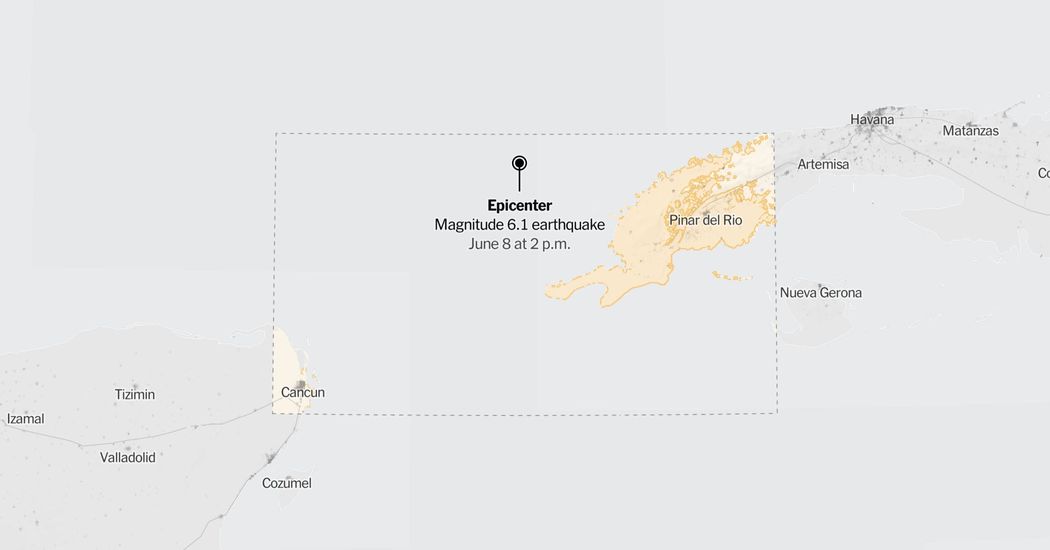
At exactly 2:00 p.m. Eastern Time on a quiet Monday afternoon, the geological tranquility of the Gulf of Mexico was abruptly shattered by a powerful 6.1 magnitude earthquake that reverberated across international waters. According to real-time data compiled by the United States Geological Survey (USGS), the epicenter of this major marine temblor was pinpointed roughly 65 miles northwest of the coastal town of Mantua, Cuba, at a depth that allowed its energy to radiate outward with surprising efficiency. While marine earthquakes of this scale frequently occur along the fractured boundaries of the world’s highly active tectonic plates, the sudden release of energy beneath the relatively stable sedimentary floor of the Gulf took both residents and regional monitoring networks by surprise. Although initial reports confirmed that the event did not trigger a destructive tsunami or cause widespread structural collapse along the nearest coastlines, the sheer magnitude of the shockwave served as a stark reminder of the restless forces operating silently beneath the ocean floor.
Tremors Echo Across South Florida and the Yucatan
Despite the earthquake’s offshore origin, the energy released near Cuba traveled hundreds of miles through the Earth’s crust, manifesting as distinct, low-frequency swaying in metropolitan areas as far away as South Florida and the Yucatan Peninsula in Mexico. In downtown Miami, office workers inside high-rise towers watched ceiling fixtures swing and felt the subtle, disorienting motion of the ground shifting beneath them, prompting a flurry of anxious calls to emergency dispatch centers. Out of an abundance of caution, emergency management officials in Miami-Dade County initiated safety protocols, leading to the temporary suspension of the Metrorail transit system and the evacuation of several commercial and residential high-rises while structural engineers assessed safety. Across the Gulf in the resort hub of Cancun, Mexico, tourists and locals alike reported feeling similar vibrations, though local civil defense authorities quickly reassured the public that no significant injuries or structural damages had occurred on either side of the Florida Straits or along the Mexican coastline.
Skepticism and Surprise in the Academic Community
The anomalous nature of the event produced a wave of professional intrigue among regional geophysicists, some of whom initially doubted that a tremor of such magnitude could have originated in the historically quiet Gulf. Dr. Jochen Braunmiller, an esteemed assistant professor and seismology expert at the University of South Florida (USF), recounted his initial skepticism when the first reports blinked across his monitoring screens, especially since he had not felt the physical movement himself. Expressing a mix of scientific curiosity and lighthearted irony, Dr. Braunmiller remarked on his own lack of sensitivity to the event, noting that despite his lifelong dedication to studying the Earth’s movements, he remained entirely oblivious to the shaking while it occurred. However, his colleagues on the upper floors of the USF campus building in Tampa—located nearly 400 miles north of the epicenter—distinctly felt the building sway, highlighting how high-rise structures are uniquely tuned to amplify the long-period seismic waves that travel vast distances from deep ocean epicenters.
The Rare Mechanics of Intraplate Seismology
To understand why this specific tremor caused such a stir within the scientific community, one must look at the fundamental differences in how tectonic plates behave across the North American continent. Unlike the highly volatile fault systems of coastal California, where earthquakes are a frequent byproduct of the Pacific and North American plates grinding past one another along active boundaries, the Gulf of Mexico sits quietly in the interior of a massive tectonic plate. These occurrences, known to geologists as intraplate earthquakes, are relatively rare because they develop away from active plate boundaries, occurring instead where ancient, deeply buried faults within the continental crust reactivate under immense, localized pressure. Dr. Braunmiller explained that because the crust beneath the Gulf of Mexico and the eastern United States is older, colder, and far more rigid than the hot, fractured crust of the West Coast, it acts as an exceptionally efficient conductor of seismic energy, allowing even moderate vibrations to travel immense distances without losing their strength.
A Century of Quiet: Placing the Event in Historical Context
Historical data maintained by the USGS highlights just how unusual this Monday afternoon event was, revealing it to be one of the most powerful earthquakes recorded within the Gulf of Mexico over the last century. Typically, the region experiences only minor, low-magnitude settling events linked to the massive volumes of sediment poured into the basin by the Mississippi River, making a 6.1 magnitude event a true departure from historical baselines. Seismologists utilize the Modified Mercalli Intensity scale to categorize these events, noting that while the physical shaking near the epicenter was registered as moderate to strong, the vast distances involved reduced the felt intensity to “weak” by the time the waves reached the shorelines of Florida and Mexico. Nonetheless, the rare occurrence of such a significant intraplate event provides researchers with an invaluable dataset, offering a rare opportunity to map the obscure, deep-seated fault lines that lie buried beneath miles of marine sediment and salt domes.
Calibrating the Data and Preparing for the Future
In the days following the main shock, USGS scientists and global monitoring networks have remained busy collecting, processing, and refining the deluge of incoming seismic data to map out potential aftershocks and locate secondary fault slips. As more information is gathered from seafloor sensors and regional stations, geophysicists may adjust the final magnitude or refine the shake-severity maps to better accurately depict how the energy dispersed across the Gulf basin. For emergency planners in vulnerable coastal states like Florida, where seismic design is rarely a primary focus of building codes compared to hurricane mitigation, this event serves as an important scientific wake-up call regarding the unpredictable nature of our planet’s interior. As the scientific community continues to analyze this historic event, the key takeaway remains one of resilience and monitoring: while the quiet waters of the Gulf of Mexico rarely hint at the geologic tensions building far below, the Earth is always speaking, and scientists are listening closely to understand what its next move might be.