



The Price of Fire: How a Paradoxical Year of Wildfires Redefined Global Climate Risk
The Wildfire Paradox: Why Record-Breaking Destruction No Longer Requires Massive Blazes
=========================================
2025 WILDFIRE AT A GLANCE
Insured Losses:……… At least $54 Billion
Total Economic Loss (LA): Approx. $140 Billion
Global Area Burned:…… 1.3 Million Sq. Miles
(2nd lowest since 2002)
The year 2025 will be remembered not for the vastness of the forests that burned, but for the unprecedented economic wreckage left in the wake of remarkably compact blazes. According to a landmark analysis published recently, the global community has crossed a highly concerning threshold where the sheer acreage of charred land has decoupled from its financial and human toll. Historically, scientists and disaster management officials evaluated the severity of a wildfire season by calculating the hectares or square miles scorched across open landscapes. Yet, while the total area burned globally in 2025 was a modest 1.3 million square miles—marking the second-lowest annual total since comprehensive satellite tracking began in 2002—insured losses soared to a record-breaking $54 billion.
This financial chasm is explained by an unsettling macroeconomic shift: fires are increasingly burning where wealth, infrastructure, and human populations are most heavily concentrated. Dr. Matthew Jones, a prominent physical geographer at the University of East Anglia who spearheaded the collaborative study, noted that we must discard the antiquated notion that large fires are the only ones that pose a threat. “Not all fires are equal,” Jones argued, emphasizing that small, hyper-localized conflagrations can carry catastrophic structural consequences for human communities, public health systems, and localized micro-climates.
Much of the overall reduction in global burned area stems from the steady agricultural conversion of African savannas, ecosystems that historically accounted for vast swaths of seasonal wildfire activity without registering significant economic damage. As these wild grasslands are systematically transformed into managed farmlands, the global fire footprint shrinks on paper, masking a much more dangerous reality. The fires of today are increasingly igniting in highly developed regions where pristine wilderness collides with high-value real estate, meaning that even a minor ignition can instantly spark an astronomical financial crisis and overwhelm regional emergency response infrastructures.
The Scar on Southern California: Deconstructing the Untold Billions of the Los Angeles Basin Fires
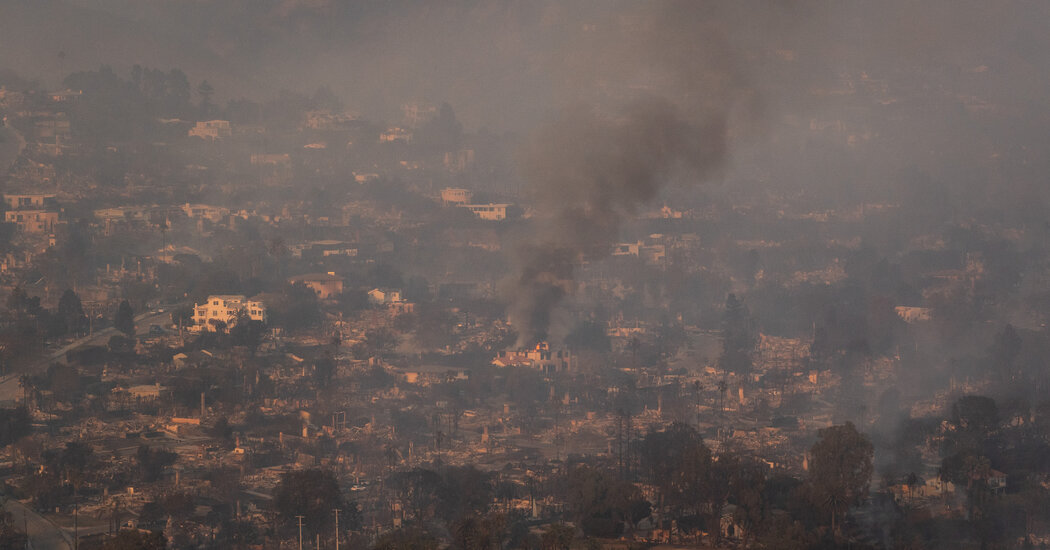
The most vivid manifestation of this new paradigm occurred early yesterday in the collective memory of Southern California, where a series of highly volatile blazes tore through roughly 90 square miles of the Los Angeles metropolitan fringe. In the context of traditional forestry metrics, a 90-square-mile fire is a minor blip; however, because these flames traveled through densely packed canyon neighborhoods and affluent wildland-urban interfaces, they triggered the costliest wildfire event in human history. The immediate structural damage was staggering, generating at least $40 billion in insured losses.
Yet, as economists look closer at the wreckage, the true societal toll is far more sweeping, with comprehensive estimates suggesting that direct and indirect losses associated with the Los Angeles disaster will ultimately add more than $140 billion to the global tally. These indirect damages—which traditional insurance claims rarely capture fully—include weeks of lost productivity as hundreds of thousands of workers were displaced, prolonged commercial closures that disrupted regional supply chains, and an unprecedented, system-wide strain on Southern California’s healthcare network.
=========================================
INDIVIDUAL & SOCIETAL COST ANALYSIS
[INSURED LOSSES] ———> $40 Billion
├── Property Destruction (WUI Zones)
└── Commercial General Liability
[INDIRECT COSTS] ———> $100+ Billion
├── Lost Labor Productivity & Closures
├── Supply Chain Bottlenecks
└── Long-Term Healthcare (Smoke/PM2.5)
The human cost was equally devastating: the fast-moving flames claimed at least 31 lives and forced the immediate, chaotic evacuation of over 150,000 residents. Behind these direct casualties lies an even grimmer epidemiological reality, as public health experts estimate that hundreds of vulnerable individuals died prematurely in the weeks following the fires due to acute smoke inhalation. The toxic plume, thick with fine particulate matter ($PM_{2.5}$) and vaporized structural synthetic chemicals, blanketed the basin for days, triggering severe respiratory failures, strokes, and cardiovascular emergencies. This invisible health crisis illustrates why modern wildfire accounting must look far beyond the immediate burn scar to capture the true, systemic impact of fires occurring adjacent to major cosmopolitan hubs.
A Global Crisis Unleashed: The Parallel Tragedies of South Korea, Spain, and Canada’s Carbon Sinks
While Los Angeles dominated the headlines, the pattern of low-acreage, high-consequence blazes repeated itself with alarming precision across multiple continents throughout 2025. In March, gale-force winds swept a highly concentrated firestorm through 400 square miles of coastal and residential land in South Korea, killing 32 people and officially registering as the nation’s deadliest and most damaging wildfire on record. Meanwhile, across the European Mediterranean, a prolonged summer heatwave coupled with unprecedented soil moisture deficits sparked intense fires throughout Spain and neighboring countries, claiming 28 lives and forcing the emergency displacement of more than 120,000 residents.
Although the European Union officially declared the 2025 wildfire season the most economically destructive in its history, researchers are still struggling to calculate the final monetary tab as claims wind their way through complex international reinsurance markets. At the same time, Canada grappled with its third consecutive year of extreme wilderness burning across its vast boreal forests. While these remote northern blazes did not directly threaten major metropolitan centers or register massive numbers of destroyed homes, they inflicted a different, deeply troubling tax on the global community.
These dense, slow-burning peat and spruce forests serve as the planet’s primary terrestrial carbon sinks, quietly absorbing immense quantities of heat-trapping greenhouse gases. By consuming millions of acres of these delicate ecosystems, the Canadian fires released vast reserves of sequestered carbon back into the atmosphere, creating a feedback loop that accelerates global warming and virtually guarantees more volatile, dry weather patterns in future years.
   Global Warming / Deficits
             │
             ▼
   Drier Weather Patterns
             │
             ▼
 More Volatile Wildfires
             │
             ▼
Release of Sequestered Carbon (Boreal)
│
▲
└───────────────────────┘
(Feedback Loop)
The Threat of the Urban Conflagration: How Structural Fuel is Redefining Wildfire Physics
To understand why modern fires have become so extraordinarily destructive, scientists are refocusing their attention on the physical transition of a forest fire into what is classified as an “urban conflagration.” Dr. Crystal Kolden, a wildfire scientist at the University of California, Merced, who contributed to the collaborative report, explains that for nearly a century, forestry management and risk assessment models were based on the assumption that vegetation—such as pine needles, dry brush, and chaparral—was the primary fuel source driving a fire’s spread.
However, as metropolitan areas continue to expand outward into historically fire-prone regions, the fuel matrix has fundamentally altered. In an urban conflagration, the primary fuel source is no longer the forest itself, but rather the highly concentrated, dry-conditioned building materials of residential neighborhoods. Tightly packed wooden framing, asphalt roof shingles, vinyl siding, and residential chemical storage areas provide an incredibly dense, continuous fuel bed that allows a fire to burn with intense thermal outputs that overwhelm traditional defense measures.
REDEFINING THE FUEL MATRIX
[Traditional Wildfire Model]
Forest Understory -> Dry Brush -> Chaparral / Pine Canopy
- Characterized by variable wind speed and topography-driven spread.
[Modern Urban Conflagration Model]
Vinyl Siding -> Asphalt Shingles -> Wooden Framing -> Vehicle Fuel Tanks
- Characterized by extreme thermal intensity, toxic emissions, and structure-to-structure hop.
These structural fires burn far hotter and faster than wildland fires, generating localized wind systems and throwing heavy showers of highly toxic, manufactured embers miles ahead of the main fire front. This makes them almost impossible for ground crews to contain using standard containment lines. Because these fires happen in places where real estate values are extremely high, they result in a dense concentration of financial loss within a small geographic area, permanently altering the risk landscape for insurers and municipal planners alike.
Re-Engineering the Actuarial Model: Mapping Complex Societal Risks in a Warming World
=========================================
EVOLUTION OF FIRE TRACKING
Legacy Metrics:
- Burn Scars (Satellite)
- Fire Perimeters
- Total Acreage Scorched
Modern Actuarial Inputs:
- Meteorological Anomalies
- Real-Time Soil Moisture
- WUI Building Density
- Fine Particulate (PM2.5) Dispersion
-
Supply Chain Interdependence
In response to this shifting reality, a quiet revolution is taking place within the fields of academic research, climatology, and global reinsurance underwriting. Historically, insurance companies relied on backward-looking actuarial models that used historic burn footprints to calculate fire risk and set annual premiums. This outdated methodology, however, has proven wholly inadequate for predicting the volatile behavior of modern conflagrations. Today, researchers are drawing data from comprehensive, communal hazard databases like EM-DAT to build dynamic, multi-dimensional models that prioritize human geography and micro-meteorology over simple fire boundaries.
As Winslow Hansen, a forest ecologist at the Cary Institute of Ecosystem Studies, aptly described it, tracking modern wildfire risk is increasingly similar to monitoring complex human health metrics. “We track a number of the body’s vital signs to see if things are deteriorating and to figure out how to mitigate that,” Hansen observed. Rather than simply asking where a fire is burning, modern predictive models examine a suite of interconnected environmental signs.
These include real-time soil moisture anomalies, fuel dryness, structural density patterns, wind vectors, and the long-range drift patterns of toxic air pollution. By analyzing these complex datasets, scientists and risk underwriters can better predict not just where ignition is likely to occur, but how a fire will behave if it enters a built environment, enabling a more accurate pricing of climate risk and helping local municipalities identify areas that need immediate defensive retrofitting.
Navigating the New Normal: Forging Resilience Against Low-Acreage, High-Impact Fires
The overarching lesson of the devastating 2025 season is that societies can no longer afford to use burned acreage as the primary metric for wildfire danger. Dr. Park Williams, a climate scientist at the University of California, Los Angeles, emphasized that while total area burned remains the easiest variable to track via satellite, it is often the least helpful for understanding societal vulnerability. “Even small fires can have catastrophic consequences for society,” Williams warned, noting that a single ignition in a vulnerable, high-density canyon can carry more economic and human pain than a million-acre fire in the remote wilderness.
=========================================
ACTIONABLE MITIGATION PILLARS
-
Municipal Zoning Reform:
Strict regulations on high-risk WUI building permits. -
Structural Retrofitting:
Mandating ember-resistant vents and non-combustible siding. -
Managed Defensible Space:
Clearance zones around critical municipal infrastructure. -
Dynamic Insurance Pricing:
Reflecting real-time climate data in property policy costs.
As the planet continues to warm, causing longer droughts and more severe heatwaves, these high-consequence, low-acreage events will become more frequent. Adapting to this reality demands an overhaul of municipal zoning laws, building codes, and community preparation strategies. Local governments must restrict new residential development in highly vulnerable wildland-urban interfaces, mandate the use of ignition-resistant construction materials, and invest heavily in creating defensible space around existing neighborhoods.
Furthermore, the insurance industry must continue to adjust its policies to encourage proactive mitigation, offering clear incentives for homeowners who harden their properties against fire. The record-shattering financial losses of 2025 are a clear warning: the nature of fire has fundamentally changed, and our approach to safety, urban planning, and economic resilience must quickly shift to match this new reality.