

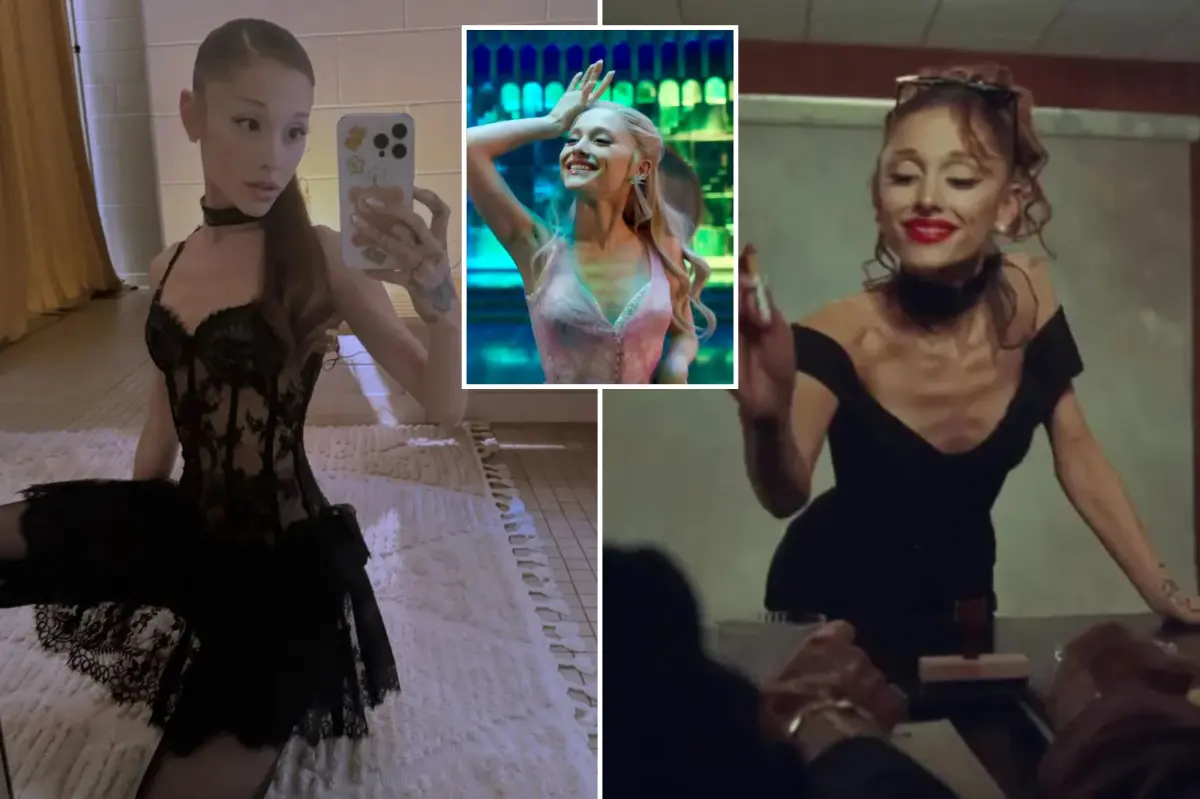
The cultural landscape has been quietly shifting beneath our feet, but nothing has crystallized this unsettling transformation quite like the release of Ariana Grande’s recent music video for her single, “Petal.” What was ostensibly designed to be a defiant artistic statement addressing the intense media scrutiny and public commentary surrounding her personal life has instead ignited a much deeper, more urgent national conversation. The thirty-three-year-old global pop star, who has spent over a decade in the global spotlight, has undergone a drastic physical transformation over the last three years, shrinking to a point that many observers find deeply alarming. During her highly publicized press tours for the cinematic adaptation of Wicked in 2024 and 2025, and throughout her subsequent Eternal Sunshine tour, fans and critics alike could not help but notice her increasingly fragile, gaunt silhouette. In “Petal,” however, her skeletal frame becomes impossible to ignore, overshadowing the narrative arc of the video itself. This visual shift has prompted deep concern among medical professionals, social commentators, and loyal supporters who fear the ramifications of normalizing such an extreme body type. While discussing a public figure’s body often carries an uncomfortable air of intrusion and judgment, ignoring this physical reality feels increasingly irresponsible given her massive global influence. With hundreds of millions of followers across various social media platforms—many of whom are young, impressionable girls navigating the tumultuous waters of identity and self-esteem—Grande’s aesthetic choices have profound real-world consequences. This is no longer merely a matter of celebrity gossip; it has become a vital entry point into a necessary discussion about the toxic return of the “thin-is-in” aesthetic and the collective responsibility we share to protect the mental health of the next generation. By stepping directly into this uncomfortable spotlight and using her art to critique the very critical gaze that judges her, Grande has, perhaps unintentionally, opened the door to a raw, honest, and necessary dialogue about body standards, celebrity culture, and the fragile nature of physical health in the modern public eye.
To understand the full weight of this cultural moment, one must look closely at the thematic structure of the “Petal” video, which acts as a dark, satirical commentary on the entertainment industry’s brutal standards. In the video, Grande portrays Pepper, a hopeful young actress in Hollywood subjected to continuous rejection by a panel of cynical male casting directors. Despite Pepper’s visibly frail and skeletal form, one of these gatekeepers goes so far as to write down a note suggesting she “couldn’t hurt to lose a few pounds,” a biting critique of the industry’s disconnect from reality. The narrative reaches its boiling point when Pepper, pushed past her psychological limit, snaps under the weight of this endless scrutiny, wielding a roaring chainsaw to violently and gorily execute her critics before emerging triumphant and covered in blood. While this gruesome climax is clearly intended to serve as a metaphor for reclaiming agency and literally destroying the patriarchal gaze that seeks to diminish women, the physical reality of Grande’s body complicates the message. Instead of feeling like a triumphant anthem of self-empowerment, the imagery is haunted by her extreme thinness, which stands out even more sharply when contrasted with the other women in the video who appear healthy and robust. These scenes are interspersed with lingering shots of her collarbones and shoulders, further accentuating her gauntness in a way that feels almost deliberate, serving as a jarring backdrop to the unfolding horror. The visual contrast is stark and highly disturbing, leaving viewers with a profound sense of cognitive dissonance. Rather than celebrating a woman reclaiming her power, we are left staring at a physical form that looks incredibly fragile, raising questions about whether the video is truly liberating or if it merely highlights a deeper, unresolved struggle with the very standards it seeks to criticize. The intended triumph of the narrative is ultimately swallowed by the alarming physical reality on display, forcing us to look past the metaphor to the stark truth of her frail appearance.
As a twenty-nine-year-old young woman who has spent over half of my life battling my own body image demons, this issue hits incredibly close to home, reflecting a broader systemic failure that we cannot afford to ignore. I remember clearly the agonizing self-doubt of my early teenage years, a time when my changing body felt like an enemy to be conquered, and I know with absolute certainty that staying silent in the face of these unrealistic standards is a form of complicity. We live in a culture that simultaneously demands women love themselves while feeding them endless images of extreme physical restriction. When we choose to stay quiet to avoid the wrath of defensive fanbases or to bypass an uncomfortable conversation, we send a quiet but devastating message to our younger sisters, daughters, and nieces: we are telling them that this level of extreme thinness is normal, attainable, and desirable. We are leaving them to navigate their own developing bodies in a vacuum of truth, wondering why their natural curves and healthy weights do not match the skeletal silhouettes of their idols. This silence is not polite; it is a passive endorsement of a standard that harms real people. The deeply personal reasons behind Grande’s weight loss are, of course, her own business, and it is not our place to diagnose or psychoanalyze her from afar; however, the broader cultural impact of her public image is absolutely our business. Young girls look at these images not as artistic expressions, but as blueprints for how they should look to be deemed successful, beautiful, and worthy of love. If we do not actively stand up and declare that a frail, sickly frame is not the healthy standard of beauty, we are failing in our duty to protect them. It is a heartbreak to think of another generation of young women starving themselves to achieve an impossible, dangerous aesthetic simply because the adults in their lives were too polite or too timid to speak up and protest.
This brings us to the core of the dilemma: how do we balance the right to personal privacy with our collective responsibility to foster a healthy, realistic environment for our children? It is a delicate tightrope to walk, because pointing out a celebrity’s weight loss can easily devolve into the very body-shaming and cyberbullying that Grande herself has spoken out against in the past. Yet, to dismiss these valid concerns as mere “busybody behavior” is to misunderstand the immense power that celebrity culture holds over our daily lives, particularly in the digital age. We live in an era where social media algorithms serve up idealized, curated, and often digitally altered images of our idols directly to the smartphones of teenagers on a constant loop. Platforms like TikTok, Instagram, and Pinterest have become modern-day breeding grounds for harmful and devastating comparisons, with toxic communities like “SkinnyTok” thriving in the shadows and promoting extreme dieting behaviors under the guise of aesthetic refinement. These digital echo chambers amplify insecure thoughts, turning fleeting doubts into full-blown obsessions that can take years of intensive therapy to undo. In this hyper-connected landscape, public figures are not just entertainers; they are highly influential cultural architects who set the baseline for what is considered aspirational. When an icon of Grande’s stature presents an extremely thin physique as her dominant visual signature, it normalizes that standard for millions of young minds who are desperately seeking validation in an increasingly superficial digital world. We owe it to these young people to engage in these difficult conversations, not with malice or a desire to tear down a talented artist, but with a deep sense of empathy, compassion, and a critical eye that prioritizes human well-being and psychological safety over blind celebrity worship. Refusing to talk about it only isolates those who are already struggling with their own body image, leaving them to believe their developing bodies are somehow fundamentally flawed and that they must continuously shrink themselves to be worthy of attention and love.
This urgent need for honest, empathetic discourse was recently highlighted by Charli Howard, a vocal body positivity activist who has used her platform to speak candidly about her own history as an eating disorder survivor. Howard took to Instagram to address the public reaction to Grande’s recent appearances and the “Petal” video, emphasizing how vital it is for society to discuss this content openly rather than sweeping it under the rug. In an emotional, all-caps post, Howard wrote that “WHAT YOU SEE HERE IS NOT NORMAL,” directly challenging the online narratives that seek to downplay or normalize Grande’s dramatic weight loss. Howard expressed her frustration with seeing worried fan comments dismissed by others who try to convince the public that the pop star simply “lost puppy fat” or is naturally healthy, with some online commentators even making light of the situation. As someone who has walked the painful path of recovery, having suffered through the brutal realities of anorexia herself, Howard pointed out that what she sees is not a natural physical evolution but someone who appears to be in desperate need of professional care and hospitalization, even though neither Grande nor her representatives have ever publicly confirmed any health issues or eating disorders. By sharing her own lived experience, Howard highlights the insidious nature of eating disorders, which thrive in isolation and are often reinforced by well-meaning but ultimately harmful online support networks. Howard’s intervention is incredibly significant because it strips away the glamorous veneer of celebrity and refocuses our attention to the dangerous reality of the situation on the human cost of these body trends. By calling out the gaslighting that occurs online when people try to normalize extreme thinness, Howard provides a crucial reality check for young fans who are uniquely vulnerable to these toxic visual standards and might otherwise be brainwashed into believing that starvation-level thinness is just a natural body type that they, too, should try to achieve through constant extreme discipline and restrictive behavior.
Ultimately, this conversation goes far beyond Ariana Grande as an individual and our responsibility to the next generation; it is a direct confrontation with a worrying, systemic shift back toward the regressive beauty standards of the early 2000s, where “heroin chic” and extreme thinness reigned supreme. Today, this resurgence is fueled by a new and terrifying medicalized edge, characterized by the widespread, casual use of weight-loss peptides and diabetes medications even among teenagers who are desperate to fit the prevailing aesthetic mold. In a world where youth culture is increasingly saturated with digital pressure and medical shortcuts to extreme weight loss, the need for realistic, healthy role models has never been more critical. We must always actively counter the growing normalization of this “thin-is-in” culture by reinforcing the idea that health, strength, and biological diversity are the true benchmarks of beauty, not a fragile or sickly frame. This does not mean we should villainize those who are struggling publicly, nor should we engage in cruel, speculative gossip; instead, we must cultivate a culture of genuine care that looks beneath the surface and questions the systemic pressures driving these trends that are actively destroying the self-esteem of young women worldwide. By choosing to speak up with empathy and critical awareness, we can help our young girls build a protective shield against the relentless wave of toxic media imagery, ensuring they know that their value is not determined by the space they occupy in the world. We must teach them that nourishment is a form of self-respect and that beauty is not a state of physical depletion. True empowerment comes from building ourselves up, not tearing ourselves down to fit a narrow template. Let us commit to having these uncomfortable but life-saving conversations, reminding the young women in our lives who are desperately seeking our guidance that a healthy, strong, vibrant, and resilient body is always the ultimate and most beautiful goal, and that they do not have to diminish themselves to be seen, loved, and celebrated.