




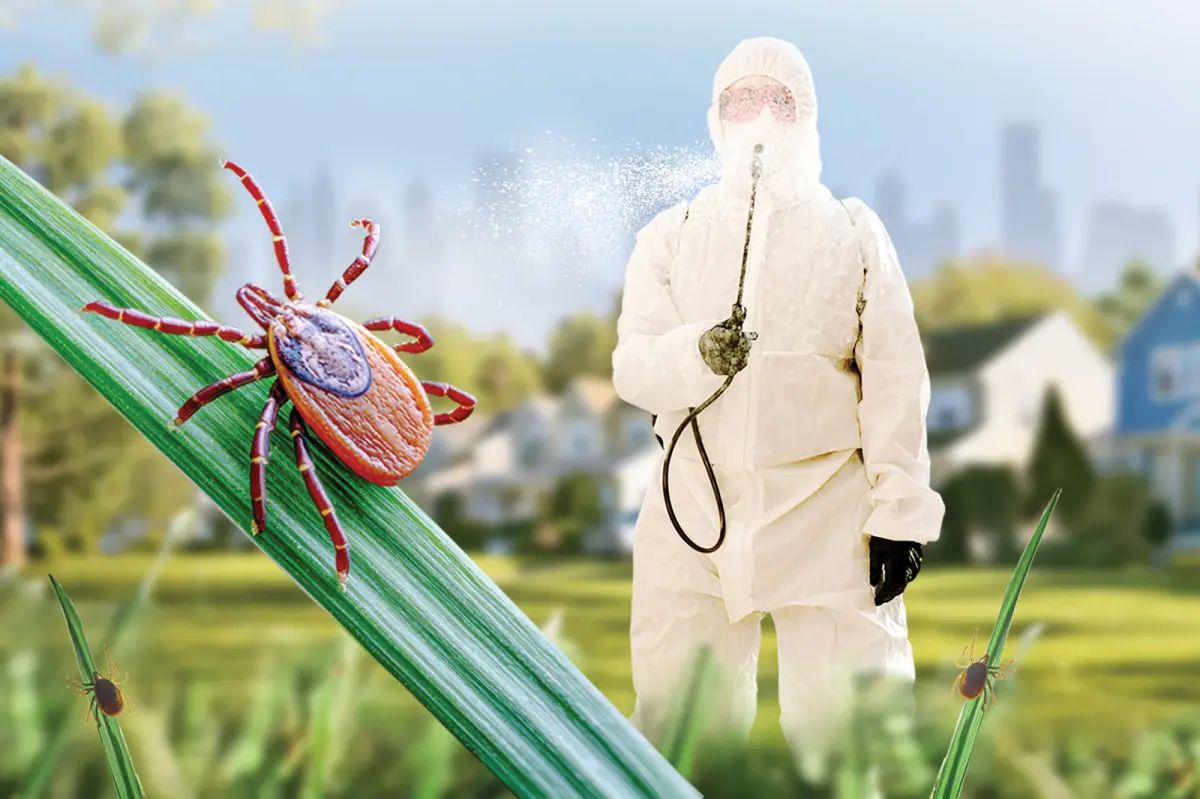
The Unwinnable War Against Ticks
This year, the ticks have been relentless, showing up earlier and in greater numbers than ever before. In April, emergency room visits for tick bites jumped to 105 per 100,000 people nationwide—a staggering 52% increase from the previous year. By May, that number climbed even higher to 112. The CDC has tracked these visits since 2017, and this spring shattered all previous records for early-season tick activity. New York alone has averaged over 17,500 new Lyme disease cases annually for the past three years, with New York City reporting nearly 3,000 preliminary cases in 2025 alone, a 15% jump from the year before. Most of these infections happened outside the city, particularly on Long Island and in upstate regions. Even California, which typically sees lower Lyme rates, isn’t safe—the western blacklegged tick has been found in 56 of the state’s 58 counties. In San Mateo County, roughly one in every twenty young ticks tested positive for Lyme-causing bacteria, and at Wunderlich County Park in Woodside, that figure exceeded 12%.
The situation has become genuinely frightening. New York just confirmed its first human case of Bourbon virus on Long Island—a rare, potentially deadly infection spread by the lone-star tick with no vaccine and no specific treatment. This adds to an already terrifying list of tick-borne threats: Lyme disease, babesiosis, anaplasmosis, ehrlichiosis, Rocky Mountain spotted fever, Powassan virus, and even red meat allergies. At some point, you have to wonder: how many diseases does one parasite get to spread before we stop politely coexisting with it? I’m tired of being lectured about wearing long pants in August, spraying chemicals on my ankles, and checking every hidden part of my body just because I brushed against a shrub. Last month, I actually tried convincing my wife to adopt an opossum as a backyard tick exterminator, only to discover that the famous claim about opossums eating ticks is just an urban myth. My anti-tick marsupial task force collapsed before it ever got off the ground.
Whenever I suggest eliminating all ticks, someone inevitably brings up the food chain argument. Every creature supposedly has a role, and removing one part of the food web would supposedly cause the whole system to crumble. Kill the ticks, they say, and Long Island could be overrun by crabs, or deer could seize control of the Hamptons, or California’s coyotes might take over Napa and start charging for wine tastings. Nature will punish our arrogance in some inventive fashion. But what would actually happen if every tick disappeared tomorrow? Do these blood-sucking disease syringes serve a real purpose, or are scientists just nervous about eliminating an entire species? According to Sam Telford III, a professor and epidemiologist at Tufts University, there’s no obvious need for or benefit of ticks in the environment. He points out that many places exist without ticks and still have perfectly healthy flora and fauna. Joanna Buchthal from MIT’s Media Lab notes that Telford often gets asked why God made ticks, and he generally responds with “beats me,” followed by an explanation that almost no animals subsist on ticks alone, and that if God vacuumed up every tick on Earth, there would be effectively zero environmental consequence.
Richard Ostfeld, a disease ecologist at the Cary Institute of Ecosystem Studies, offers slightly more caution. Scientists can’t even eliminate blacklegged and lone-star ticks from fairly small areas, which makes their ecological impact difficult to test. Still, he suspects that if we could eliminate these two tick species, we wouldn’t detect any impact on other organisms. Ants, spiders, beetles, and birds sometimes eat ticks, but most can find something else for dinner. In New York, ticks seem to be more of an occasional snack than a dietary staple. California adds a strange twist: western fence lizards provide ticks with blood meals, but their blood can also kill Lyme bacteria inside a feeding tick. When researchers removed the lizards from test plots, fewer ticks survived. The lizards make individual ticks safer while helping the larger tick population stay alive. The real danger comes from the weapons available to kill them. The acaricides and insecticides we use are broad-spectrum and toxic, killing butterflies, bees, pollinators, spiders, and potentially harming wildlife, pets, and people. Long Island covers about 900,000 acres, and blanketing it with bifenthrin would require roughly 90 million gallons. Ostfeld calls that scientifically irresponsible and financially infeasible.
What we need is a weapon with better aim. America has defeated ticks before—in 1906, federal inspectors quarantined and treated cattle carrying cattle-fever ticks, which spread a deadly livestock disease. By 1943, those ticks had been eliminated from the US except for a permanent quarantine zone along the Texas-Mexico border. But cattle-fever ticks spend all three parasitic life stages on one host, making them easier to find. Blacklegged and lone-star ticks feed on deer, mice, birds, and whatever else comes along, then drop off and disappear. The battle is much more complex, involving diverse animals, diverse habitats, densely populated areas, and no economic incentive like cattle production. Telford would begin around homes, then move into parks and environmental reservoirs. Reducing deer can make blacklegged ticks tolerable, though birds will keep importing them. Lone-star ticks may prove even harder. For now, the best strategy seems to be going after the ticks closest to people—using deer feeding stations that apply pesticide to their heads and necks, bait boxes that treat mice and chipmunks, and fungi that kill ticks in yards and wooded areas. All of this brings tick numbers down, though whether it keeps humans from getting sick remains surprisingly hard to prove.
Meanwhile, researchers at MIT are working on a more unusual solution involving genetically engineered mice. White-footed mice help keep Lyme disease in circulation—a tick bites an infected mouse, picks up the bacteria, and may eventually bite a person. The idea is to make mice immune to Lyme, then have them pass that immunity to their offspring. Her team is also investigating antibodies that would attack the tick itself, with genes placed in mice whose blood would then interfere with a feeding tick and kill it. The same approach could extend to other tick-borne illnesses. Scientists could instead try to alter ticks so their offspring inherit a trait that eventually shrinks the wild population, but getting that trait into circulation would require breeding and releasing millions of engineered ticks. Nobody wants millions of ticks released into the environment to suppress other ticks. Ticks also reproduce too slowly for a suppression gene drive to spread quickly. Kevin Esvelt from MIT’s Media Lab would love to eliminate ticks entirely if people agreed, but their long generation time means any suppression gene drive would take several decades to make a dent, even with millions of engineered ticks introduced into the environment. Give Telford a billion dollars for a Manhattan Project against ticks, and he’d combine every available weapon—and hire lawyers. A substantial portion of that money would go toward fighting lawsuits from animal-rights advocates resisting deer removal, environmental groups challenging pesticides, and property owners refusing access. Any intervention won’t make the problem go away overnight. It took more than 70 years for the problem to emerge, and it shouldn’t take that long to make it more manageable, but that’s the way public health works.
Ticks have yet to make a convincing case for their right to exist. They’re still here because killing them without killing a lot of other things is nearly impossible. Any parasite that gives Long Islanders Lyme disease, a red-meat allergy, and an untreatable virus, while making Californians inspect themselves after a hike through the redwoods or Sierra foothills, has made a persuasive case for its own removal. We simply need to kill it without taking the butterflies with it.