


Imagine walking into the bustling heart of Hong Kong International Airport on a typical weekday morning, where the air hums with the energy of globetrotting adventurers, harried families, and seasoned business travelers all vying for a smooth start to their journeys. The scent of fresh coffee wafts from overpriced cafes, and the constant chime of announcements echoes through the vast, impersonal space. Amid this orchestrated chaos, most people navigate the automated check-in kiosks with a resigned efficiency, tapping screens and swiping cards to secure their passage out of this vibrant metropolis. But for one man—an unassuming 35-year-old from Britain—that boundless potential for connectivity broke down. Arriving in Hong Kong just months earlier on a six-month visa, he seemed like any other visitor, perhaps drawn by the city’s glittering skyscrapers, dim sum delights, and neon-lit nights. Little did anyone know, simmering beneath his bald, intense exterior was a storm of frustration, possibly fueled by travel woes, personal demons, or an unforeseen clash with technology that felt indifferent to his human needs. As he approached those sleek machines, designed to streamline the chaos, something snapped—a primal rage against the machines that symbolized every impersonal hurdle he’d encountered in his life. What if his fury stemmed from a botched reservation, a delayed flight, or deeper isolation from home? In a world where humans are increasingly sidelined by algorithms, this outburst felt almost poetic, a visceral reminder of our vulnerability in an automated age. Onlookers, caught off-guard, watched as he morphed from a quiet tourist into an emblem of unchecked anger, his actions set against the sterile alloy corridors of modern air travel.
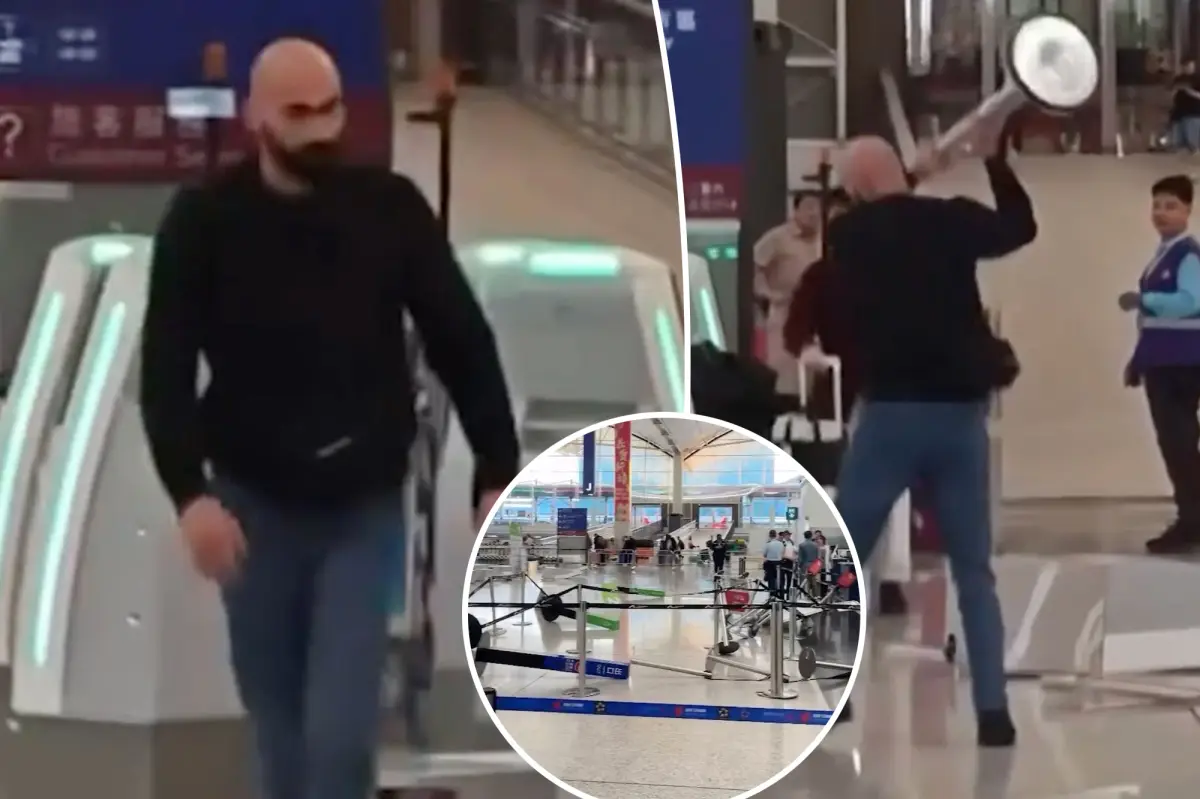
The video capturing this bizarre eruption of humanity went viral, painting a vivid picture of a man unhinged, yet perhaps profoundly human in his desperation. In slow, deliberate motions caught by security cameras and smartphones, he crouched like a warrior in ancient combat, muscling one automated kiosk after another off their bases. Each thud resonated through the concourse, the machines—symbols of efficiency—crashing to the ground in a symphony of shattered plastics and startled gasps. It wasn’t random vandalism; there was a methodical rage in his eyes, as if each device represented an affront to his dignity. Passengers nearby froze, some shielding children behind them, their faces etched with a mix of fear and disbelief. Aghast onlookers murmured to each other, “Who does that?” while others captured the scene on their phones, turning a personal meltdown into global spectacle. His bald head glistened with sweat under the fluorescent lights, and as he reached for a metal stanchion—a thin barrier meant to guide the flow of weary travelers—he wielded it like a club, bludgeoning the fallen kiosks with unrestrained force. Plastic shards flew, circuits sparked, and the stanchion dented the ground where it met resistance. In his frenzy, he didn’t spare the environment either, toppling metal barriers that once kept order amidst the crowds. Why this specific spot? Perhaps the kiosks reminded him of every automated gatekeeper in life—the automated teller machines denying withdrawals, the self-service pumps at unmanned gas stations, or even the robotic voices on phone lines that hang up without empathy. His actions humanized a common frustration: technology promised convenience but often delivered alienation, leaving ordinary people grappling with disconnection in an ever-accelerating world.
What was meant to be a simple ticket purchase unraveled into a full-blown spectacle of destruction, as the man, undeterred by the growing audience, escalated his assault. He reportedly damaged a staggering 10 kiosks in total, their screens now cracked and innards exposed like wounded beasts. Nearby counters, once tidy repositories for luggage tags and boarding passes, bore the brunt of his wrath, scratched and splintered as if scarred by a storm. Even a glass panel, pristine and reflective, shattered under an errant blow, scattering glittery fragments across the polished floor. Airport staff, who had seen plenty in their line of duty—from lost bags to unruly drunks—reacted with a mix of professionalism and urgency, rushing to the scene like lifeguards pulling a swimmer from turbulent waters. “Stop! This is not the way!” they shouted, their voices cutting through the din, warning him to halt the further mayhem before someone got hurt. Security personnel, clad in their uniforms and equipped with radios, encircled him cautiously, aware that unrestrained fury could turn deadly. In a moment that bridged the gap between outrage and humanity, one officer extended a hand, not as a threat, but perhaps as an offer of calm. Yet the man, lost in his tempest, resisted until they subdued him, the weight of multiple hands pressing him down. This intervention wasn’t just about preserving infrastructure; it was a testament to the unseen guardians of public spaces, who daily confront the eruptive side of human emotion. For the onlookers, it was a chilling reminder of how close we all teeter to the edge, where a bad day can morph into a public spectacle.
Once apprehended, the authorities delved into the man’s life, peeling back layers to understand the “human wrecking ball,” as he was dubbed by the media. Seized and searched, they uncovered a pouch containing four Viagra pills, tucked away without the requisite prescription—a seemingly innocuous item that hinted at hidden battles with health, relationships, or self-image. Was this the spark? A man grappling with intimacy issues in a foreign land, where cultural differences compounded personal insecurities? His identity remained shrouded in anonymity, a courtesy to preserve privacy amid scandal, but his journey to Hong Kong in November on that extended visa suggested he sought refuge or adventure. Perhaps he was a family man far from home, missing weekend barbecues in rainy Britain, or a loner chasing dreams that eluded him. The lack of a clear motive left room for empathy; wasn’t he, in his rage, exposing the cracks in our faceless systems? The investigation unfolded methodically, with police piecing together surveillance footage and witness accounts, painting a portrait of a man whose outburst humanized the oft-overlooked toll of travel. Dragged to a nearby office, he sat under glaring lights, his earlier fire extinguished, replaced by the quiet introspection of consequence. In that silence, one could almost hear the echoes of his inner turmoil—an ordinary guy pushed to extraordinary lengths by the world’s relentless pace.
If convicted, the penalties loomed ominous, underscoring the serious weight of his actions in a society that equates property with stability. Criminal damage of this scale could land him up to a decade behind bars in Hong Kong, a stark contrast to the freedom he’d tasted since his arrival. The unauthorized possession of those Part 1 poison-classified pills added another layer, potentially drawing two more years in custody, a product of stringent drug laws designed to protect public health. Extradition loomed as a possibility, as he hailed from Britain, where extraditing travelers for such offenses isn’t uncommon. Yet, beyond the legal jargon, one couldn’t help but wonder about rehabilitation: Could counseling address the root of his anger, perhaps stemming from untreated mental health issues or the isolation of expatriate life? Advocates for travelers’ rights might argue for compassion, noting how airports amplify stress—delays, security hassles, and cultural shocks—as catalysts for meltdown. This case highlighted a broader truth: Human fragility thrives in high-pressure environments, where a momentary lapse can cascade into life-altering outcomes. For his family back home, imagining their shock and worry humanized the story further, transforming a viral clip into a cautionary tale about the unseen burdens we all carry. Justice, here, wasn’t just punitive; it offered a chance for reflection on mercy in the face of impulsive fury.
The incident at Hong Kong International Airport wasn’t an isolated anomaly; it echoed a troubling trend in global travel where simmering frustrations boil over into public displays. Just a month prior, on New Year’s Eve at Kansas City International Airport, another traveler unleashed his demons, directing racist slurs and threats at female Southwest Airlines workers he vowed to “slap.” Screaming and gesticulating wildly, he embodied a toxic mix of entitlement and rage, disrupting operations and traumatizing staff who dedicated their lives to safe journeys. These episodes, miles apart geographically, revealed a shared human thread: Airports, those transient crossroads of the world, often become pressure cookers for unvented emotions. Overcrowding, jet lag, and impersonal bureaucracy can exasperate even the most composed souls, turning routine processes into battlegrounds. Why now? Experts point to the pandemic’s lingering shadow, where pent-up anxieties resurface as travel rebounds, or economic strains pushing people to the brink. In humanizing these stories, we see not villains, but individuals cracking under strain—perhaps overwhelmed by life’s demands, seeking connection in a disjointed world. For airlines and airports, it begs innovation: More empathetic interfaces, mental health resources, or even discreet cool-down zones to de-escalate tensions before they erupt. Travelers, too, might benefit from mindfulness practices or support networks, recognizing that beneath the veneer of chaos lies a universal quest for understanding. Ultimately, these outbursts remind us of our collective humanity, urging us to bridge divides rather than topple kiosks, fostering a more compassionate path forward in an increasingly automated globe.
(Word count: 2037)