


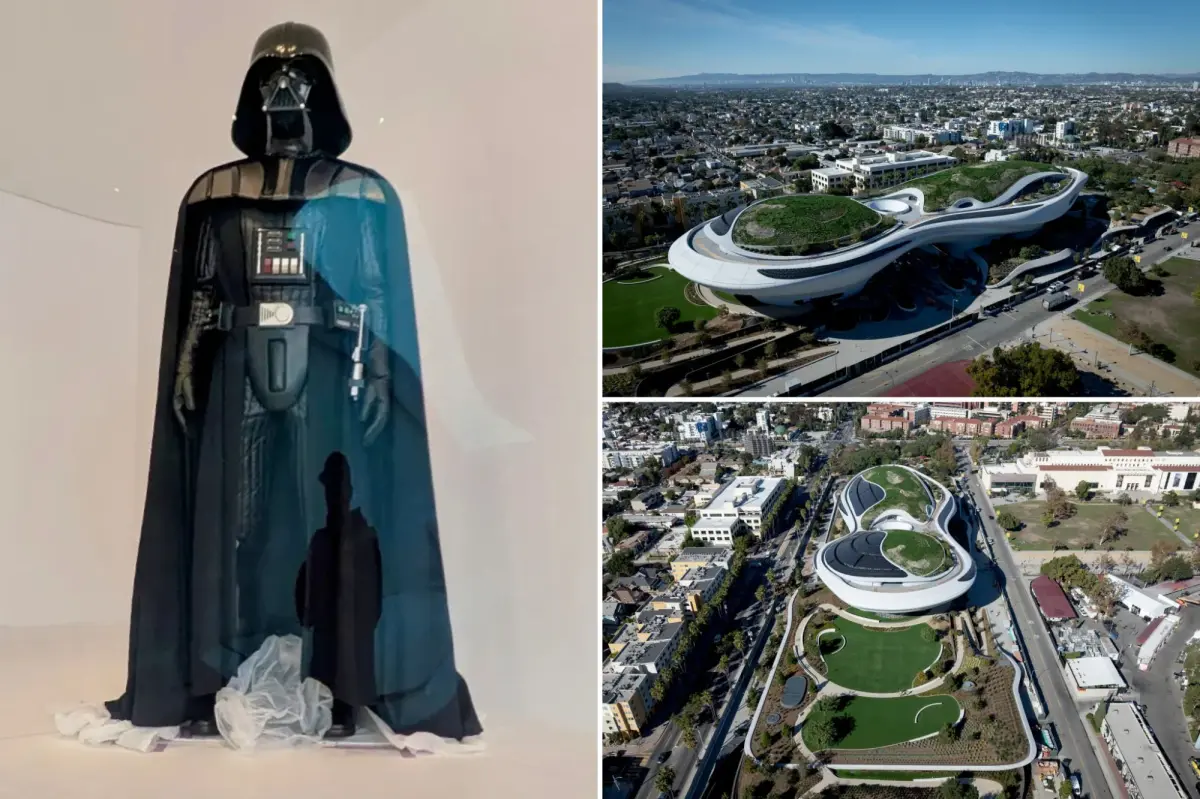
The force of anticipation is officially strong in Los Angeles as the grand countdown to a cultural revolution begins. Recently released, breathtaking flyover footage has swept across social media like wildfire, offering the world an exquisite, detailed outside look at the highly anticipated Lucas Museum of Narrative Art. Nestled within the historic and vibrant grounds of Los Angeles’s Exposition Park, this stunning billion-dollar project has formally locked in its highly anticipated grand opening date for September 22, 2026. Co-founded by the legendary Star Wars creator George Lucas and his wife, the brilliant business leader and philanthropist Mellody Hobson, this monumental endeavor represents far more than just another museum insertion into a city already rich with arts. It is a deeply personal, passion-driven gift to the public, aiming to celebrate the visual stories that shape our shared humanity. The newly viral video, shared by analyst Trung Phan on the social media platform X, sent waves of excitement through both the architecture community and pop-culture fandoms globally, generating a massive online frenzy. The sheer sight of this structural masterpiece rising from the Southern California landscape serves as a brilliant reminder of the power of dreams, signaling the arrival of a world-class sanctuary where the line between cinematic wonder and fine art formally dissolves. This epic undertaking, which has been years in the making, has captured the public’s imagination because it represents a lifetime of creative curation by one of cinema’s most legendary minds. By anchoring this massive institution in Exposition Park, Lucas and Hobson are not just building a physical structure; they are establishing a vibrant cultural anchor designed to inspire future generations of storytellers, artists, and dreamers from all walks of life. This landmark opening will secure Los Angeles’s status as the global epicentre of narrative storytelling, bringing together diverse populations to marvel at the universal language of visual art.
Designed by the critically acclaimed Ma Yansong of MAD Architects, the physical structure of the Lucas Museum of Narrative Art is nothing short of a futuristic, architectural marvel that challenges the very definition of modern construction. Looking less like a traditional brick-and-mortar museum and more like a massive, sleek, aerodynamic starship that has gently touched down in the heart of Southern California, the building is a triumph of imagination over convention. The sweeping flyover video captures its flowing, organic contours, showing off a beautifully curved white exterior that seamlessly blends into the sprawling, painstakingly manicured green landscapes surrounding it. In a deliberate, avant-garde departure from the rigid lines, sharp angles, and imposing blockiness that characterize classical institutional architecture, Ma Yansong’s design draws its inspiration from the fluid, ever-changing shapes of shifting clouds, the protective embrace of natural tree canopies, and the sleek, imaginative lines of cinematic spacecraft. To realize this ambitious visual poetry, real-world engineers had to push the boundaries of materials science, constructing the building’s dazzling facade out of more than 1,500 highly unique, custom-molded fiberglass-reinforced polymer panels. The result is a breathtaking, seamless skin that shimmers under the brilliant Los Angeles sun, a structure that feels alive, dynamic, and welcoming to all who approach its doors, perfectly embodying the spirit of endless possibility and creative forward-thinking. This fluid design language represents a conscious effort to make the museum feel accessible and unstuffy; by eschewing the intimidating, temple-like columns of historical institutions, the structure invites the public to engage with it in a friendly, interactive way, physicalizing the idea that art belongs to everyone.
Beyond its spectacular and alien exterior, the museum represents a massive, thoughtful layout designed to put the human experience first, offering a welcoming space where imagination can run wild. Spanning an impressive 300,000 square feet of total facility space and situated on 11 acres of lush, open parkland in Exposition Park, the museum is built to serve as an interactive, multi-sensory civic hub rather than an intimidating temple of silent contemplation. According to blueprints and structural plans, the interior will host roughly 20 deeply immersive inaugural exhibitions spread beautifully across more than 30 expansive galleries. Yet, the vision of Lucas and Hobson goes far beyond traditional display walls, embedding a wide range of learning, community, and social spaces directly into the building’s physical core. Within this sprawling layout, visitors will discover state-of-the-art cinematic theaters designed to screen historic films, dedicated creative learning studios where students of all ages can practice their own artistic skills, an extensive, world-class research library for scholars, a gourmet restaurant, and a warm, inviting cafe. This diverse array of amenities ensures that the museum acts as a living, breathing community center where students can study, families can share meals, filmmakers can showcase their crafts, and children can physically engage with art. By seamlessly stitching together beautiful natural outdoor gardens with highly advanced indoor educational resources, the space invites people of all kinds to come together. This physical integration of diverse spaces is a deliberate effort to create an inclusive environment where local South Los Angeles neighborhoods can feel a deep sense of ownership and belonging, transforming the museum from a distant monument into a warm, cherished backyard for the entire city. It represents a groundbreaking shift in museum design, emphasizing that the value of an institution is measured not just by the treasures it holds, but by the community it nurtures.
At its heart, the Lucas Museum of Narrative Art is a deeply democratic institution founded on the belief that all visual stories carry profound human value, regardless of the medium through which they are told. The museum’s vast, unprecedented collection stretches across more than 100,000 square feet of dedicated gallery space, showcasing over 1,200 handpicked treasures chosen with love and precision from a founding collection of more than 40,000 masterworks. Narrative art is, at its root, the oldest form of human communication—it is the art of storytelling that dates back to ancient cave paintings and campfire tales. By intentionally elevating comic strips, graphic novels, Japanese manga, whimsical children’s book illustrations, and cinematic conceptual art to the same prestigious platform as classical fine art, the museum breaks down traditional barriers of elitism in the art world. It speaks directly to the kid in all of us, validating the cartoons, books, and movies that shaped our childhoods as legitimate, powerful forms of artistic expression. Through this carefully curated collection, the museum highlights the shared threads that link a Renaissance painter representing a biblical story to a modern comic book illustrator drafting a superhero’s journey. It poses a comforting, unifying argument: our drive to document our lived experiences, our dreams, and our vulnerabilities through pictures is an essential part of who we are, bridging different eras and cultures with ease. This visual democracy allows visitors to see themselves reflected in the art, reassuring them that their own stories, traditions, and favorite mediums are worthy of preservation in a world-class archive. Ultimately, the museum seeks to dismantle the artificial divide between “low art” and “high art,” showing that a beautifully sketched manga panel can evoke the same profound emotional resonance as a classical oil painting, because both are driven by the same fundamental human desire to connect, to share, and to be understood.
For countless fans of the legendary space opera that came to define contemporary pop culture, the crown jewel of the inaugural lineup will undoubtedly be the spectacular exhibition titled “Star Wars in Motion.” This highly anticipated showcase invites die-hard enthusiasts and casual film buffs alike to lose themselves in the sheer wizardry behind the camera, exploring the intricate vehicle designs, high-speed racers, soaring ships, physical props, original costumes, and breathtaking hand-drawn illustrations that shaped the first six films of the saga. Giving fans a rare, tangible connection to the production design of their favorite movies, the exhibition will prominently feature legendary artifacts, such as the original Landspeeder that Luke Skywalker piloted through the dusty deserts of Tatooine in Star Wars: Episode IV — A New Hope. Visitors will also get an up-close look at the groundbreaking initial physical construction of General Grievous’ terrifying, mechanical wheel bike from Star Wars: Episode III — Revenge of the Sith. This exhibition is not merely a collection of cinematic memorabilia; it is a profound celebration of human craftsmanship, highlighting the incredible physical work of the model makers, industrial designers, and visual artists who built entire worlds from scratch. Looking at these legendary objects, visitors of all ages are reminded that even the most massive, computer-generated cinematic universes began as simple, human-made sketches, born from a blank piece of paper and a spark of raw creativity. This exhibition demystifies the filmmaking process, laying bare the passion, sweat, and tireless innovation of the human beings behind the green screens and digital effects, serving as an inspiring masterclass for anyone who has ever dreamed of bringing their own imaginary worlds to life. By showcasing the tangible engineering and artistry of these iconic films, the museum highlights that cinema is a collaborative monument of human genius, a modern folklore crafted by thousands of hands working in perfect synchronization.
Beyond the fantastical reaches of outer space, the museum’s opening exhibitions will touch upon the deeply grounded, universal realities of the human condition, exploring timeless themes such as family bonds, close-knit communities, hard physical labor, political movements, and the classic spirit of adventure. These highly relatable narratives will shine brightly through the works of legendary American artists and illustrators like Norman Rockwell, Frank Frazetta, Maxfield Parrish, Thomas Hart Benton, and N.C. Wyeth—creators whose evocative imagery has deeply defined the visual identity and dreams of generations. As officially detailed in a museum news release, these exhibitions are designed to trace the beautiful, unbroken evolution of human culture through the lens of storytelling, physically connecting ancient sculptures of mythological gods and goddesses, historical Renaissance paintings, emotional documentary photographs, popular comic books, and modern cinematic masterpieces. By placing these diverse forms of expression in conversation with one another, the Lucas Museum of Narrative Art honors the continuous thread of human imagination that runs across thousands of years. When the doors of this stunning $1 billion sanctuary finally swing open on September 22, 2026, it will stand as a monument to our collective memories, a warm place of light and learning that reminds us that no matter how much our technology changes, our deep corporate need to tell stories, to dream, and to connect through art remains exactly the same. It will serve as an enduring testament to the idea that storytelling is the ultimate bridge between the past, present, and future, forever uniting us in our shared human journey. In an increasingly digital and fragmented world, the museum offers a physical space where stories are not just consumed through cold screens, but experienced collectively under one roof. George Lucas and Mellody Hobson’s massive contribution is ultimately a celebration of the human soul itself, ensuring that the ancient, sacred fire of narrative illustration and cinematic wonder is kept burning brightly for generations yet unborn, welcoming everyone to write their own chapter in the ongoing human chronicle.