


Capt. Jon Jackson had always dreamed of soaring through the skies, a passion that started in his childhood when he watched planes streak across the blue canvas of his hometown in Florida. Now, after decades of faithful service as a Spirit Airlines pilot, he was set to embark on his final flight—a ceremonial send-off into retirement from Fort Lauderdale to Baltimore-Washington International Airport on a crisp Saturday morning. The airline’s bright yellow jets, laden with their promise of adventure and affordability, had been his second home for years. But little did Jackson know, this farewell voyage would be marred by an unexpected upheaval, a stark reminder of the fragility of dreams in the ever-shifting world of aviation. Spirit Airlines, the ultra-low-cost carrier that had revolutionized travel for millions by offering budget fares and charging extra for everything from seats to bags, announced its sudden closure in the dead of night. In a shocking statement, company officials declared operations “effective immediately,” citing the failure to secure a $500 million bailout from the federal government. Over 17,000 employees, including Jackson, were left stunned, their livelihoods evaporating like mist over the ocean. Flights across the nation were canceled—277 on Saturday alone, with 379 more slated for Sunday—and thousands of passengers found themselves stranded at airports, clutching boarding passes that had turned worthless overnight. For Jackson, a man in his late 50s whose silver hair and weathered hands told stories of countless takeoffs and landings, the news hit hard. He had poured his life into Spirit, rising from a junior pilot to captain, mentoring young aviators along the way. His wife, Laura, had supported him through the long nights away from home, raising their three kids on her own while he navigated storms and turbulence. Now, with retirement plans—fishing trips, family reunions, and perhaps finally building that shed in the backyard—thrown into chaos, Jackson felt a mix of anger and resignation. But fate had a twist in store, courtesy of his eldest son, Chris, a first officer with Southwest Airlines. Chris, who had followed in his father’s footsteps into the cockpit, was piloting a Southwest flight out of Fort Lauderdale that very day. When Jackson reached out, explaining the sorry state of Spirit’s shutdown, Chris rallied his colleagues and co-workers, turning what could have been a somber farewell into a touching tribute. “Dad, we’ve got this,” he assured his father over the phone, his voice filled with the same warmth that had bonded them during family vacations spent sharing pilot stories around the fire. Southwest, known for its culture of kindness and employee-driven humanitarian efforts, embraced the idea. They rearranged seating to give Jackson a coveted spot on one of their flights—a symbolic gesture from a rival carrier. As the plane taxied, Jackson sat in the cabin, reflecting on the irony: Spirit, his airline of 34 years, dead and buried, while he flew with competitors who valued camaraderie over competition. Chris, sitting in the cockpit, felt his chest tighten with emotion, knowing the weight of this moment for his dad. It wasn’t just a job; it was a legacy.
The shutdown’s ripple effects extended far beyond Jackson’s personal plight, painting a broader picture of turmoil for the aviation industry. Spirit, once the eighth-largest carrier in the U.S., had operated hundreds of daily flights on its fleet of yellow planes, connecting passengers from major hubs to underserved routes. The company’s ultra-low-cost model, championed by CEO Ted Christie, had democratized air travel by slashing fares but often drawing criticism for how it treated customers like, well, commodities. Employees mourned the loss of a workplace that, despite its demands, had fostered a sense of purpose. Pilots like Jackson had endured grueling schedules, but the passion for flying outweighed the fatigue—memories of guiding planes through thunderstorms or celebrating safe landings with high-fives. For passengers, the collapse was infuriating. Families stranded at airports like BWI or Las Vegas International recounted tales of anxiety and frustration, their vacations and business trips in disarray. One passenger, a single mother named Maria from Baltimore, shared how she had pooled her savings for a Spirit flight to visit her ailing mother, only to learn her plane wouldn’t take off. “I feel abandoned,” she said, her voice cracking as she paced the terminal with her two young children. Others railed against the lack of notice, questioning how a major airline could vanish overnight. Transportation Secretary Sean Duffy stepped in to coordinate a lifeline, announcing a government initiative to rebook stranded flyers with partnered airlines, ensuring communities retained access to flights without exorbitant price hikes. United, Delta, JetBlue, and Southwest—all Spirit’s rivals—capped fares and opened their schedules, a rare display of industry solidarity in a sector often marked by fierce competition. Duffy hailed it as airlines “stepping up,” but for many Spirit staff, it was bittersweet. Ground crews, flight attendants, and mechanics who had given their all now faced job searches, their resumes in hand as they processed unemployment claims. Jackson’s story encapsulated this human cost; he wasn’t just a pilot—he was a family breadwinner, a mentor, a friend to colleagues who’d celebrated birthdays in layovers. As he boarded the Southwest plane, chatting with fellow passengers about his career, he couldn’t help but grieve Spirit’s end. “We served millions,” he mused aloud, “but in the end, even airlines can fade like old jet fuel.”
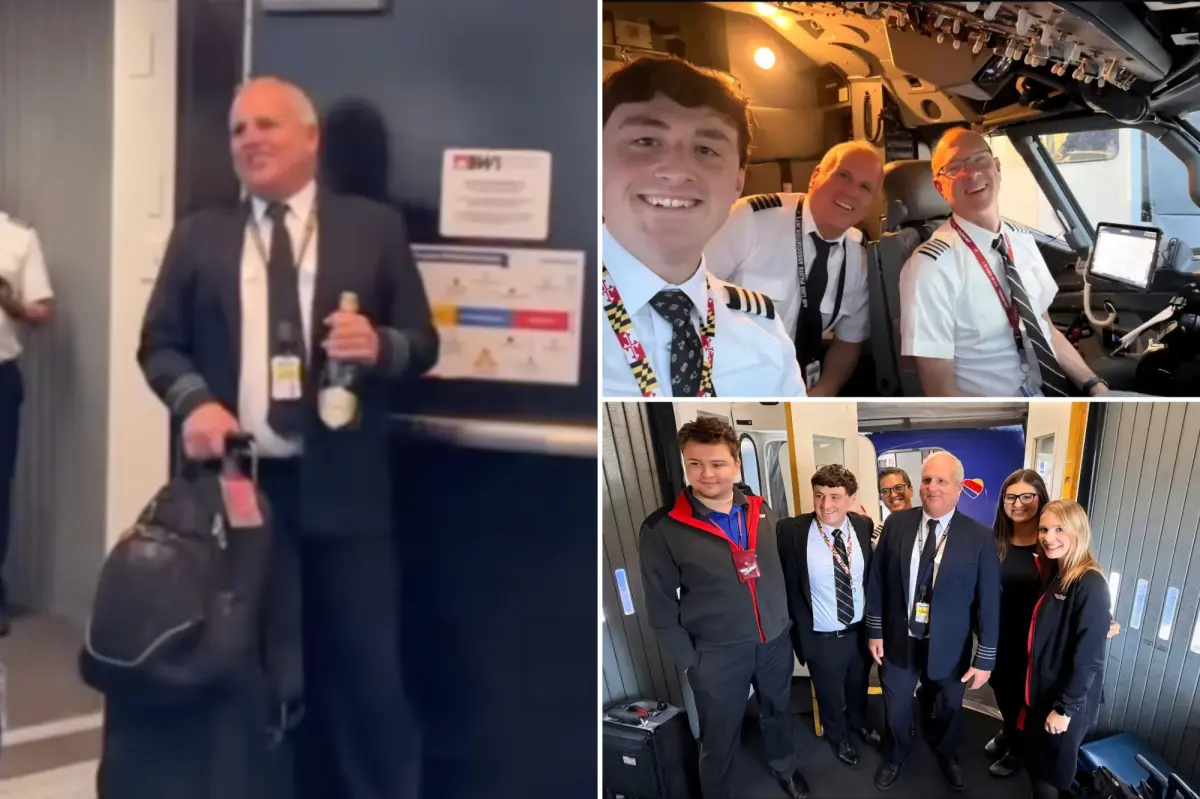
Upon arrival at Baltimore-Washington International, the true magic of human connection unfolded, orchestrated by Southwest’s compassionate crew and Chris’s thoughtful coordination. The flight’s pilots, informed by Chris of his father’s planned retirement send-off, orchestrated a grand entrance. A dispatcher at the airport pulled strings with the fire department, arranging for two gleaming red firetrucks to await the plane. As the Southwest jet touched down and taxied to the gate, aeriel arches of water sprayed from the trucks’ cannons, misting the runway in a salute typically reserved for military feats or holiday events. It was a humble yet heartfelt nod to Jackson’s years of service. From the cockpit window, Chris grinned, sharing a silent high-five with his co-pilot. Jackson, peering out from the passenger cabin, felt his eyes well up—a far cry from the routine landings he was used to. Crowds of ground staff, travelers, and even curious onlookers gathered at the gates, smartphones raised to capture the moment. When the door opened and Jackson descended the stairs, a wave of applause erupted, warm and genuine. Gate agents, their vale uniforms fluttering in the breeze, waved him forward with smiles that spoke of admiration. “Ladies and gentlemen, Mr. Jon Jackson,” one announced over the intercom, her voice resonating through the terminal like a declaration of honor. She presented him with a chilled bottle of champagne, its label etched with “Congratulations, Captain.” Jackson, a stoic man not prone to public displays, blushed deeply, his hands steady from decades of handling controls now trembling with emotion. Hugging Chris tightly outside the aircraft, amid the cheers, Jackson whispered, “You did this, son,” his voice thick. The Southwest crew, a mix of seasoned veterans and eager rookies, posed for photos with him, arms slung around shoulders like old comrades. One first officer, reflecting later, said, “It’s about honoring the grind— the sleepless nights, the family misses. Guy’s a legend.” For Justin, a Southwest flight attendant on the plane, it was a reminder of why he loved the job: the chance to blend aviation with humanity.
In the terminal’s commotion, Jackson navigated a swirl of emotions, his retirement dreaming feeling both distant and achingly real. “Very overwhelming, I can’t thank you all enough,” he said to the crowd, his words simple yet profound. “As Spirit goes down, this is a sad day, and you guys made it incredible. Thank you so much.” Tears streaked his face, mirroring the joy and sorrow intermingling in the air. The applause swelled again, a chorus of kindness bridging rival airlines. He posed for group photos with Chris and the pilot team, laughing through sniffles as a young traveler asked for his autograph, excited by the spectacle. Jackson thought of his wife, Laura, back home, imagining her reaction when he shared the videos. “She’ll weep,” he chuckled inwardly, “but with pride.” Spirit’s closure stung—34 years of evangelical innovation gone, a model that had shaped budget travel but ultimately crumbled under financial strain. Yet, in this unexpected exodus, Jackson found solace in the industry’s capacity for empathy. Southwest’s statement later captured it: “A powerful reminder of the aviation community’s ability to show respect, compassion, and solidarity when it matters most.” For Chris, who had idolized his father since boyhood model airplanes, it was redemption. Their family dynamic—summers spent at air museums, debates over flight schools—had prepared him for this. “He inspired me to fly,” Chris said later. The champagne popped amidst cheers, bubbles symbolizing renewal. Jackson waved goodbye to the crowd, entering a new chapter with optimism, knowing that while airlines like Spirit might vanish, the bonds forged in the sky endured. It was more than a send-off; it was a celebration of resilience.
The broader fallout of Spirit’s demise underscored the fragile ecosystem of American aviation, where passenger empathy intersects with logistical nightmares. Stranded flyers, once jubilant travelers, now grappled with indignities—rushed rebookings, lost luggage, and the sting of betrayal. Airlines scrambled to absorb the overflow, their systems overloaded as they honored capped fares for Spirit passengers. One Delta pilot, reworking routes, shared his frustration yet resolve: “We can’t let people suffer just because competition fell.” Duffy’s program, a testament to inter-agency collaboration, ensured routes stayed open, preventing fare hikes that could exploit the chaos. For employees, it was raw transition time—résumé tweaks, interviews, and downsizing. Jackson’s path felt emblematic; after photos and farewells, he drove home with Chris, planning next steps. “Maybe consulting,” he joked, “or flying drones.” The moment honored not just Jackson, but every aviator’s quiet heroism. As Southwest posted on Instagram, it was about “honoring a fellow aviator. Congratulations, and thank you for your service in the skies, Capt. Jackson.” Families reunited, jobs adapted, and the skies cleared for new horizons, proving aviation’s heartbeat: connection over codeshare.
In reflecting on this tale of triumph amid tragedy, one sees how human stories elevate institutional collapses, transforming losses into legacies. Jackson’s send-off wasn’t confined to airports; it rippled through social media, inspiring anecdotes from pilots worldwide. A veteran from American Airlines messaged Chris, praising the gesture. Laura, upon hearing, beamed: “That’s my Jon.” Spirit’s end closed a chapter on budget innovation, but Jackson’s journey opened new wings—freedom to travel unburdened, time for hobbies, deepened family bonds. As he settled into retirement, surrounded by mementos like his old hat and logbooks, he embodied aviation’s enduring spirit: respect in the face of turmoil. The industry’s response, from firetruck salutes to fare caps, affirmed compassion as its core. In a world of mergers and bankruptcies, this felt like hope aloft.