


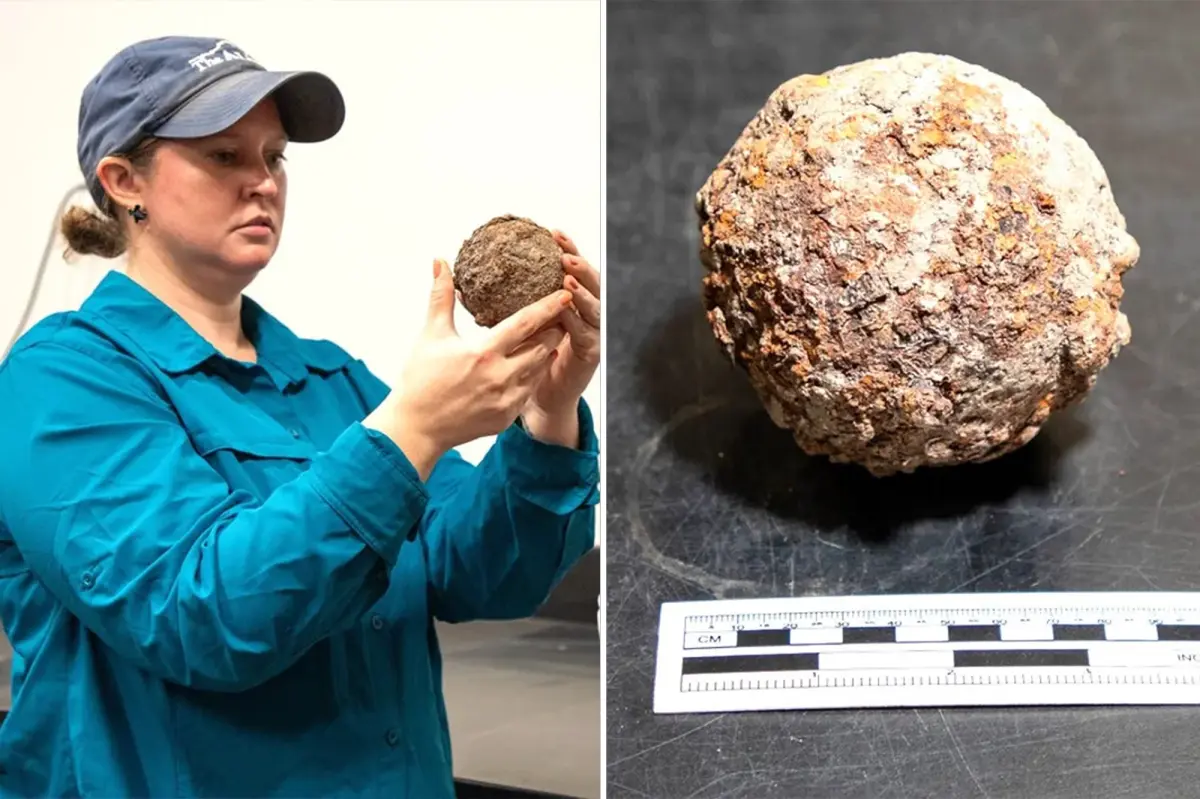
For history enthusiasts and archaeologists alike, the grounds of the Alamo in San Antonio, Texas, have always held a sacred, almost mythical status. Recently, this ground yielded yet another incredible piece of the past, connecting modern researchers directly to the legendary 1836 battle. On June 2, archaeologists working at the site uncovered a rusted iron cannonball. Remarkably, this find comes just three months after a similar rare discovery on the property, adding a thrilling new chapter to the ongoing efforts to understand one of America’s most famous military conflicts.
The Alamo Trust, the nonprofit organization dedicated to preserving the historic mission, shared the exciting news on June 16. Excavators found the heavy, orange-brown iron projectile just outside the northeast corner of the famous Alamo Church. Remarkably, this second cannonball was resting in an excavation unit adjacent to where a solid bronze cannonball was unearthed back in March. Because both artifacts were buried at roughly the exact same depth, researchers are confident that they have slept undisturbed in the Texas soil for nearly 190 years, likely since they were first fired or dropped during the chaos of the 1836 siege.
This incredible timeline brings us back to the legendary Battle of the Alamo, a pivotal 13-day conflict fought between Texian rebels and the Mexican army from February 23 to March 6, 1836. A small but fiercely determined garrison of Texian defenders—including legendary figures like Davy Crockett and William B. Travis—bravely held off a massive Mexican force led by General Antonio López de Santa Anna. Though the siege ultimately ended in tragedy with the deaths of almost all the defenders, their sacrifice became a powerful rallying cry that fueled the Texian victory at the Battle of San Jacinto just a few weeks later.
Finding these intact weapons of war is incredibly rare, especially given how much the landscape has changed over the generations. Tiffany Lindley, the director of archaeology at the Alamo, expressed genuine surprise at the discovery. Over the last two centuries, the site has been heavily altered by active military use—most notably by the U.S. Army Quartermaster in the mid-19th century—as well as extensive commercial development in downtown San Antonio. Given this constant disruption, many experts assumed that most buried relics from the 1836 battle had been destroyed, lost, or paved over long ago.
While the bronze ball found in March was exceptionally well-preserved, this newly recovered iron cannonball has suffered a bit more from its long slumber in the earth, showing significant rust and corrosion due to the nature of the metal. Despite this wear and tear, both items remain in remarkably good condition and are slated to be sent to a conservation lab for professional treatment and stabilization. Once preserved, they will serve as powerful, tangible connections to the desperate artillery duels that echoed across the plaza during the standard 19th-century siege operations.
While the twin cannonballs have captured the public’s imagination, Lindley emphasizes that they are just a small part of a much larger, ongoing story. Every day, the archaeological team uncovers dozens of everyday items, from discarded nails and fragments of brick to broken household goods left behind by the site’s various inhabitants over the centuries. Once the digging ends, analyzing all these humble pieces together will paint a rich, humanized portrait of daily life at the Alamo, helping us understand not just how these people died, but how they actually lived.