




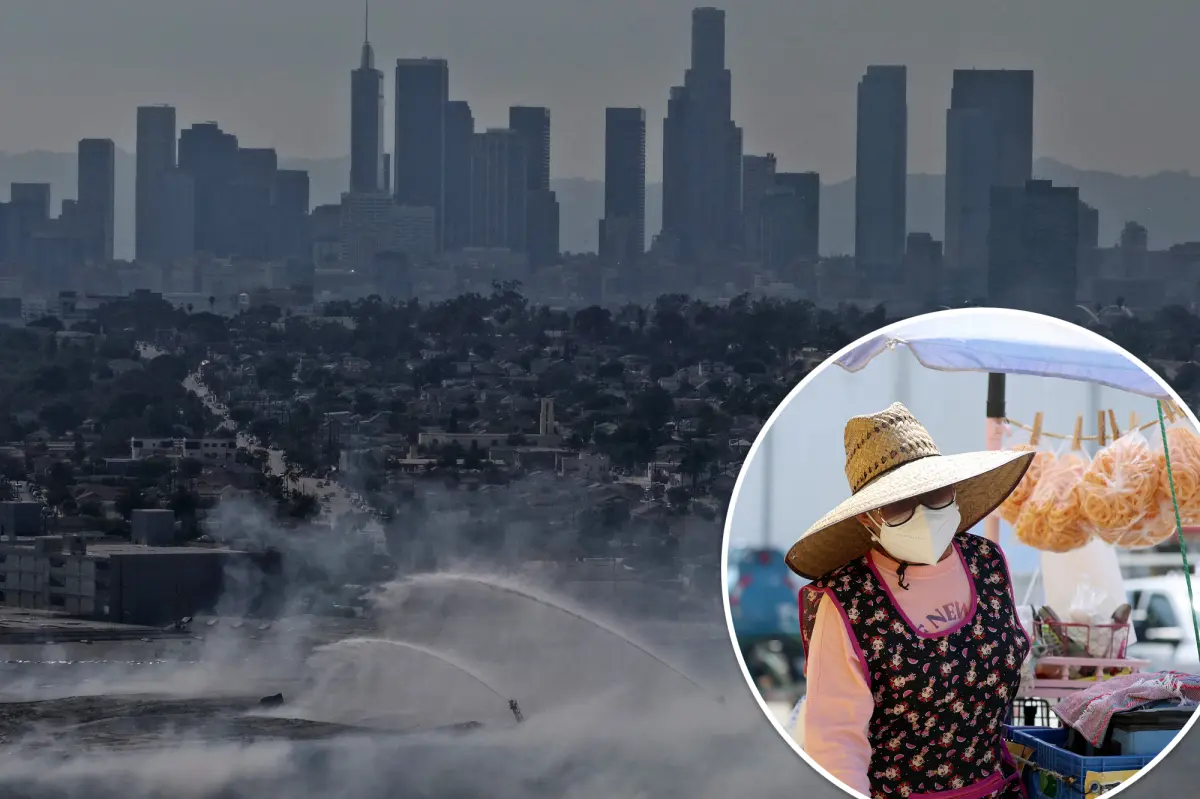
Boyle Heights, a historic and culturally vibrant neighborhood nestled in the heart of East Los Angeles, has long been celebrated for its rich tapestry of community life, colorful murals, and the comforting aromas of authentic street food wafting through its bustling corridors. However, for nearly two agonizing months, this lively urban sanctuary has been subjected to an invisible, suffocating siege that has completely transformed the daily lives of its residents. The source of this misery is a massive, blackened carcass of a cold-storage warehouse owned by Lineage Logistics, which was gutted by a catastrophic fire that left millions of pounds of meat trapped inside. Without electricity to power the industrial refrigeration systems, this unimaginable mountain of pork, beef, and poultry rapidly began to decompose, baking under the relentless, merciless heat of the Southern California summer sun. What resulted was an olfactory disaster of historic proportions—a dense, sickening stench of advanced decay that settled over the neighborhood like a toxic fog. This is not a mere unpleasant odor that one can simply ignore; residents describe it as a heavy, greasy, and highly invasive physical force that penetrates the sturdiest of walls, clings stubbornly to clothing and furniture, and leaves a persistent, foul taste in the back of the throat. For the thousands of families who call Boyle Heights home, the simple, instinctual act of taking a deep breath has been replaced by a constant state of anxiety and dread, forcing them to live as hostages inside their own homes while a biological nightmare unfolds just beyond their doorsteps.
The physical and psychological toll of this environmental catastrophe on the people of Boyle Heights is both devastating and deeply personal, illustrating a public health crisis that is actively eroding the community’s quality of life. In a recent survey conducted by the Los Angeles County Department of Public Health, an overwhelming ninety percent of local residents reported that the foul, rancid odors are a constant, inescapable presence in their lives. For individuals like Alicia Naranjo, the daily reality is a grueling gauntlet of physical suffering; the toxic air has invaded her home, triggering severe respiratory distress, relentless headaches, sinus congestion, chronic coughing, and raw throat pain that makes speaking difficult. The horror extends to the most vulnerable members of the community, as described by resident Lissett Navarrete, who watched in terror as the putrid air stripped away her family’s appetite and caused her mother-in-law to suffer from sudden, violent bouts of vomiting and dizziness that ultimately required emergency medical intervention at a local clinic. This suffering is further compounded by the brutal summer heatwaves, which trap residents in a cruel and unbearable paradox. People like Carla Martinez are forced to keep their windows and doors tightly sealed to lock out the overwhelming stench, turning their homes into sweltering, un-air-conditioned ovens. Martinez notes that the resulting migraines have completely disrupted her ability to perform basic daily activities, preventing her from going to work, shopping for groceries, or simply resting, while leaving her with skyrocketing electricity bills from running multiple air purifiers in a desperate attempt to create a single room of breathable air.
Beyond the immediate health hazards, the lingering stench has dealt a catastrophic blow to the economic heartbeat of Boyle Heights, threatening the very survival of the small, family-owned businesses that form the backbone of this working-class enclave. In a community where economic security is already a delicate balancing act, the prolonged closure of surrounding streets and the repulsive environment have driven customers away, leaving local merchants to face ruin. Juan Canil, who has proudly operated an auto repair shop directly across from the ruined warehouse for years, now stands in a silent garage surrounded by idle tools. Because the streets are blocked off and the air is thick with the smell of decay, he has lost a significant portion of his clientele, representing a devastating loss of income that threatens his ability to provide for his family. Similarly, Alexis Sicairos, the owner of a nearby coffee stand that once served as a warm gathering spot for neighbors, has watched her daily foot traffic vanish. Her regular customers have fled, unwilling to subject themselves to the suffocating mix of lingering smoke, foul odors, and swarms of flies that now plague the area. Sicairos poignantly points out that while she fully understands why people are staying away, her financial obligations have not paused; the rent, utilities, and business bills must still be paid, forcing her to stand in the toxic air day after day, waiting for a recovery that feels painfully distant.
In the face of mounting public fury and intense scrutiny, the corporate response from Lineage Logistics has been criticized as a drop of water on a raging wildfire, highlighting the immense gap between corporate damage control and actual human relief. In a public update, the multinational corporation announced that cleanup crews working around the clock had successfully removed approximately eighty-five percent of the rotting meat, with hopes of completing the bulk of the waste removal shortly. To demonstrate their commitment to the community, the company highlighted that they had distributed $207,000 in cash assistance cards, six hundred air purifiers, six hundred and fifty air conditioning units, and hundreds of cases of bottled water to affected households. However, to the residents who have spent two months breathing in the fumes of decaying flesh, these figures feel like a sterile, inadequate public relations gesture rather than genuine accountability. A one-time cash card or a basic air purifier does little to offset the long-term health risks, the loss of business revenue, or the psychological trauma of having one’s home transformed into a hazardous waste zone. Lineage Logistics has defended the slow pace of the cleanup by describing the site as a “highly complex operation” that requires careful structural dismantling alongside the biohazard extraction, but for a suffering community, these corporate explanations offer no comfort and only serve to prolong their daily agonizing wait for clean air.
This stark disparity between corporate excuses and human suffering has ignited a powerful wave of political outrage, transforming the Boyle Heights disaster into a flashpoint for environmental justice in Los Angeles. Mayor Karen Bass did not mince words when she publicly condemned Lineage Logistics, accusing the corporation of doing the absolute “bare minimum” and showing a shocking lack of urgency in addressing a crisis of their own making. In a passionate video message, Mayor Bass declared that the company should not even think about returning to rebuild the warehouse, emphasizing that every single day the site remains uncleaned is another day that innocent families are forced to suffer the consequences of corporate irresponsibility. The mayor’s fierce rhetoric resonates deeply with a community that has historically been marginalized and treated as an industrial dumping ground. For decades, the predominantly Latino residents of East Los Angeles have had to fight against systemic environmental racism, enduring the encroachment of polluting factories, hazardous waste facilities, and major freeways that carve up their neighborhoods. The warehouse fire is seen by many as yet another chapter in this painful history, a stark reminder that low-income communities of color are often forced to bear the heaviest environmental burdens while the corporations responsible escape with minimal consequences.
As the agonizingly slow cleanup process drags into another week, the psychological horror of the stench has escalated into a terrifying biological threat that looms over the future of the neighborhood. A chilling public health report obtained by local media revealed that the rotting mountain of meat has become a breeding ground for a massive infestation of green bottle flies, raising the alarming risk of myiasis—a horrific, potentially fatal disease that occurs when these flies lay their eggs in the open wounds of humans or animals, where the larvae then feed on living tissue. This grotesque revelation has transformed a neighborhood nuisance into an active, terrifying biohazard, leaving parents terrified to let their children play outside and turning every minor scratch or insect bite into a source of panic. The threat of myiasis serves as a visceral, haunting metaphor for the way corporate neglect can literally eat away at the safety and dignity of a community from the inside out. Yet, even in the face of this biohazard, the spirit of Boyle Heights remains unyielding. The residents’ demands at recent town halls are not merely for temporary financial handouts or air filters, but for a fundamental restoration of their human dignity, their safety, and their right to live without fear in their own homes. The true resolution of this disaster will not be achieved when the last pound of rotting meat is finally cleared away, but only when systemic changes are made to ensure that no community is ever again forced to hold its breath in the name of corporate profit.