







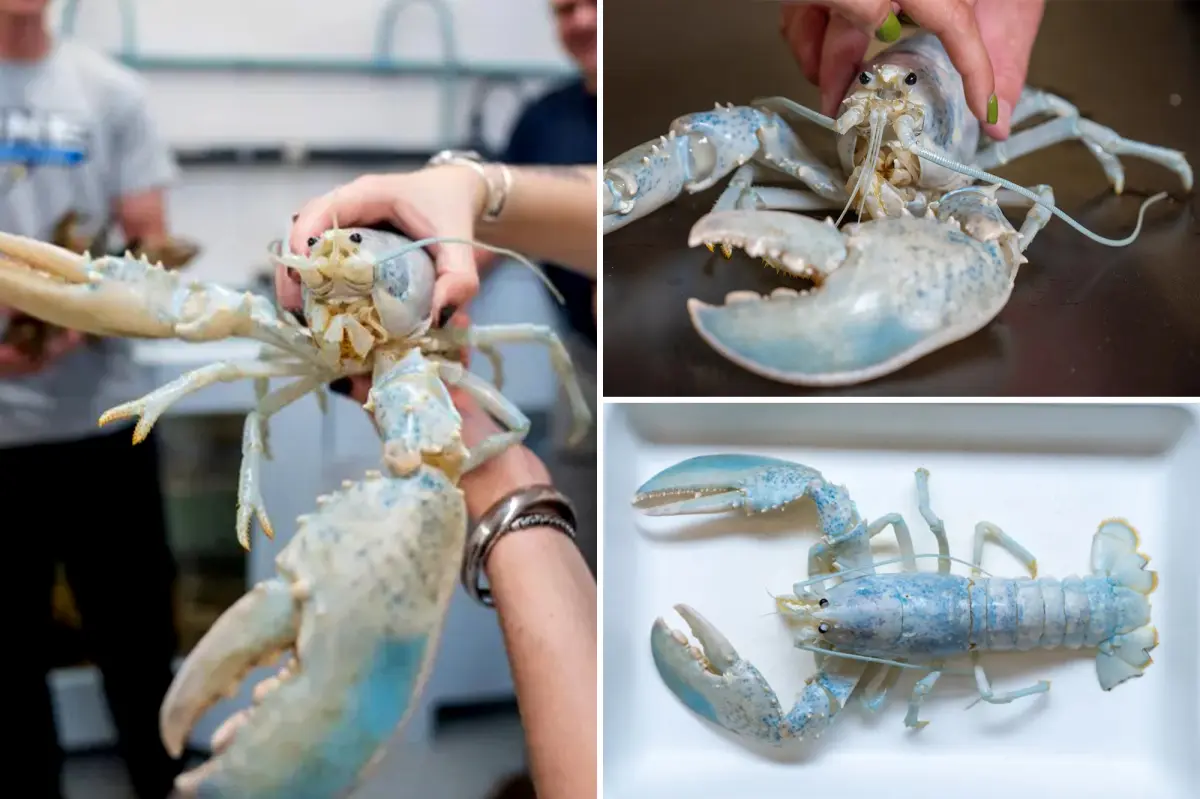
Imagine pulling up a lobster trap off the cold, rocky coast of Maine and finding something that looks less like dinner and more like a ghost from the deep. That is exactly the kind of wonder that has settled over the University of New England in Biddeford, where a creature named Casper has become the latest celebrity of the sea. Casper is an exceptionally rare white lobster, sometimes called a “ghost lobster,” and he was recently donated by the Maine State Aquarium to help scientists study lobster genetics and pigment patterns along the Eastern Seaboard. At first glance, he looks like something from a fantasy novel: a shell so pale it seems almost translucent, with delicate icy blue dots tracing his body. One researcher joked that he is like Elsa from Frozen if she had chosen to live as a crustacean. But Casper’s beauty is matched by his improbability. According to UNE scientists, the odds of finding such a creature in the wild are roughly one in a hundred million. That makes him not just a lovely oddity, but a biological treasure chest waiting to be opened. Casper’s presence on campus has turned heads, sparked conversations, and reminded us that the ocean still holds secrets beyond our wildest imagination.
What makes Casper so visually striking is also what makes him scientifically fascinating. Most lobsters are actually a muddy blue-brown color in the wild, and they only turn the familiar bright red after being boiled. That transformation happens because heat breaks down certain proteins in the shell, releasing pigments that were always there but hidden. Casper, however, is different. His see-through white shell comes from a lack of pigment-producing proteins altogether, which means he does not get the usual color change even when cooked. In fact, albino lobsters like him remain white no matter what happens to them in a pot. But Casper will never have to worry about being someone’s dinner. Instead of heading to a restaurant platter, he now floats calmly in a research tank at UNE, where scientists are studying him alongside a whole collection of other rare and colorful lobsters. Some of those lobsters are orange, some are blue, some are yellow, and others are purple, calico, or split-colored, with different shades on each side of their bodies. Together, this rainbow of crustaceans gives researchers an extraordinary chance to ask questions about how color is inherited, how pigment works at the molecular level, and why such rare variations appear in nature at all. For a creature so closely associated with everyday seafood, Casper and his colorful companions are quietly helping scientists unlock some of the deepest mysteries of marine biology.
The research project that Casper has joined did not begin with him. In 2024, the University of New England received a batch of unusually colored lobsters, including an orange female they lovingly named Peaches. Peaches turned out to be an excellent scientific ambassador. She eventually produced a brood of lobster babies that looked perfectly ordinary, with the typical reddish-brown shells of the species. That unexpected outcome gave researchers a valuable clue: rare color traits do not always pass directly to offspring, and the mechanisms behind them are far more complex than a simple genetic switch. To understand what was happening, the team began analyzing genetic samples from the juvenile lobsters, eventually examining more than 15,000 genes related to lobster coloration. It is painstaking work, but it is exactly the kind of investigation that can reveal how nature creates such striking variations. Every colorful lobster that arrives in the lab is a new question mark, and Casper’s ghostly appearance adds another layer to that puzzle. Does his lack of pigment come from the same genetic pathway as Peaches’ orange shell? Are there different kinds of albinism in lobsters? How do these extremely rare mutations survive in the wild, where bright colors would seem to make an animal more visible to predators? These are the questions that keep the researchers curious and the science moving forward.
Dr. Markus Frederich, a professor of marine science and the director of UNE’s Invertebrate Physiology Lab, has been leading the effort to understand these extraordinary animals. He admits that creatures like Casper capture public attention because they are so rare and beautiful. It is easy to see why people stop and stare at a lobster that looks like it was carved from ice and moonlight. But for Frederich and his team, the real value goes deeper than appearance. “For us, they provide an amazing opportunity to ask fundamental biological questions,” he said. That is what makes the project so satisfying, he explained, especially because so many undergraduate students have been able to get involved. Working directly with living animals, handling rare specimens, and learning how to study genetics in a real laboratory setting is an experience that cannot be found in any textbook. The students are not just spectators; they are active participants in groundbreaking research. And importantly, none of the lobsters are harmed during the process. Frederich and his team use non-invasive methods to observe and study the shellfish, meaning Casper and his colorful neighbors can live out their lives in peace while still contributing to science. There is something quietly beautiful in that arrangement: a creature so rare that it would likely not survive long in the wild, now thriving in a lab while helping young scientists learn about the ocean and its fragile wonders.
Casper’s arrival is part of a larger moment of oceanic discovery that has captured the imagination of people around the world. In June, for example, an expedition off the coast of Brazil turned up an astonishing 31 new sea creatures, including ghostly gossamer sea worms and glittering jellyfish that looked almost too delicate to be real. These discoveries remind us that the ocean is still an unknown frontier. Even in an age of advanced technology and detailed maps, new species surface all the time, often in places where no one thought to look. The same spirit of exploration that drives deep-sea expeditions also drives the study of a single white lobster in a Maine laboratory. Every unusual creature is a window into a hidden world, and every color variation is a clue about how life adapts, mutates, and survives. Casper may be small and quiet, but his existence speaks to the immense diversity of life beneath the waves. He is a reminder that beauty in nature does not have to be practical to be meaningful, and that even an animal bred for the dinner table can hold mysteries beyond the seafood counter. The more we learn about creatures like him, the more we understand how little we truly know about the ocean and all that lives within it.
In the end, Casper is more than just a scientific specimen or a social media sensation. He is a symbol of the joy and humility that comes from discovering something unexpected. For the students at UNE, he is a teacher who will never speak a word. For the researchers, he is a puzzle that may help answer age-old questions about genetics and inheritance. And for the rest of us, he is a quiet reminder that wonder is still possible in the world, if only we take the time to look. The ocean has been here long before us, and it will be here long after we are gone. Every rare creature it offers up, whether a ghostly white lobster or a glowing jellyfish, is an invitation to pay attention, to care, and to protect the fragile ecosystems that make such miracles possible. Casper will not be served at Red Lobster, and that is precisely the point. He is not meant to be eaten, commodified, or used up. He is meant to be studied, admired, and protected. In his pale, icy shell, he carries the mystery of the deep blue sea, and as long as he floats in his tank in Maine, he will continue to inspire curiosity in everyone who meets him. That is a fate far better than dinner, and a story far more worth telling.