






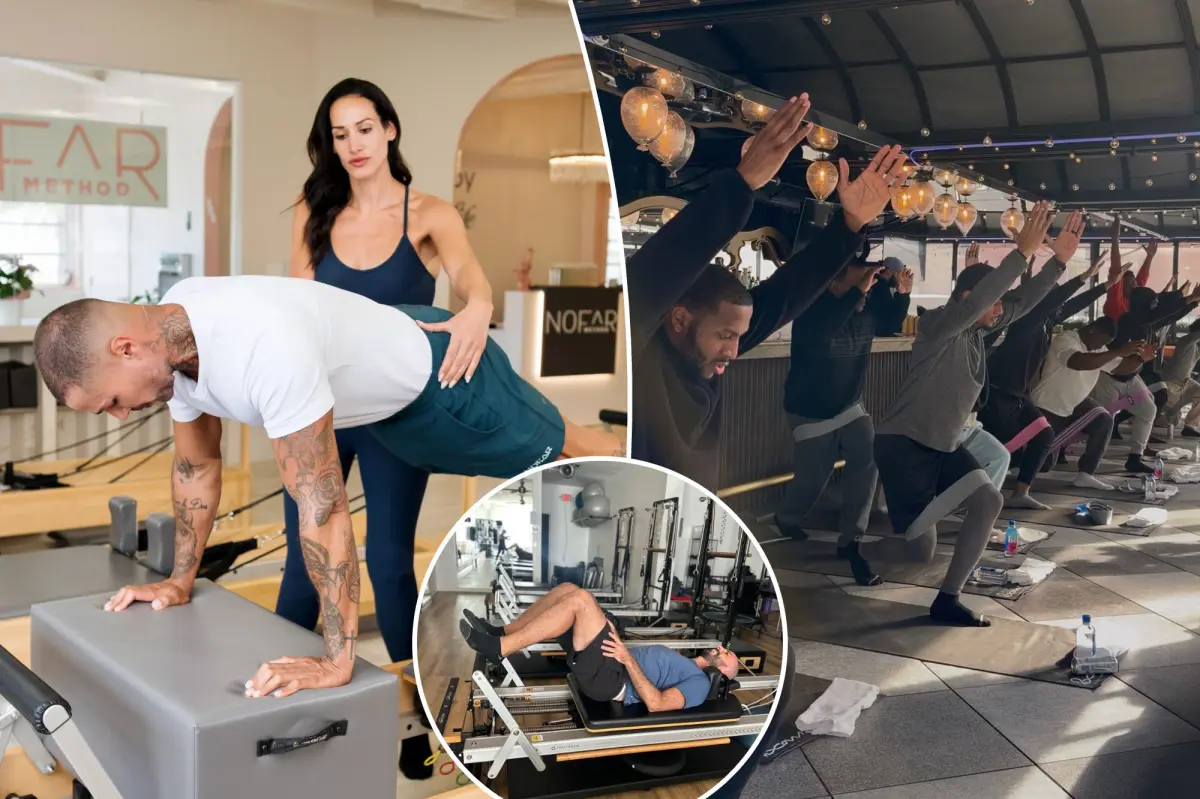
Picture a Pilates studio: soft light, neatly rolled mats, the rhythmic hiss of reformers, and a row of women in matching Alo leggings, ponytails swinging as they move through a hundred tiny pulses. Now picture six guys in sweatpants and T-shirts, cracking jokes between sets, high-fiving after a particularly brutal ab sequence, and laughing when their legs start shaking on the reformer. This is the world of “bro-lates”—men-only Pilates classes where the women are left at the door, and the only lip gloss in sight is the sweat on their upper lips. For men like Matt Goldschmidt, a 41-year-old chiropractor from Long Island, the appeal is simple. “All in all, it’s better being with six other guys than six other women and you,” he says. He’s been attending the bro-lates class at Pure Pilates in Merrick, New York, for eight months, and he’s not alone in his enthusiasm. Mark Reiss, a 72-year-old grandfather and avid tennis player, joined the same class after his wife and daughters suggested he try Pilates. He and his friends, all in their sixties and seventies, made a pact: they’d only try it if the class was men-only. That’s how they became the founding group of the studio’s bro-lates class in 2023. “It’s good camaraderie among us, and it doesn’t have the same kind of competitive nature that you find in a gym,” Reiss says. They’re all in decent shape and stay active outside class, but Pilates helps them work muscles they never knew they had. For these men, the class is less about fitting in and more about finding a space that feels like theirs—a place where they can be beginners together, without the pressure of being watched or compared.
There’s a delicious irony in the fact that Pilates, now seen by many as a woman’s workout, was invented by a man. Joseph Pilates developed his method in the early twentieth century as a way to heal his own body and to strengthen wounded soldiers during World War I. He probably didn’t imagine that his low-impact, spring-resistance system would one day be associated with ballet dancers, fitness influencers, and brunch-loving women in designer activewear. But that’s exactly the stereotype that has kept many men away. Matt Goldschmidt, before ever trying Pilates himself, used to recommend it to his patients. “Most men would laugh at me, so I started educating myself about it, and I found that it was actually started by a man—but it still has a stereotype around it,” he says. For him, the men-only class made the whole idea more palatable. “It’s always more comfortable to be with your own sex when doing any out-of-the-box kind of exercise or movements,” he explains. That comfort is key. When you’re a grown man who has never touched a reformer, the last thing you want is to be the only guy in a room full of women who seem to have been born knowing exactly how to engage their core. A bro-lates class removes that anxiety. It allows men to be clumsy, to ask questions, to grunt, to sweat, and to fail without feeling like they’re performing for anyone. It also gives them permission to embrace a workout that, for all its feminine branding, is brutally difficult. The men who walk into these classes expecting a gentle stretch often leave humbled, sore, and strangely grateful.
The instructors who run these classes have seen it all. Kristine Schanstra, owner of Pure Pilates, says many men arrive with a false sense of confidence. “Men would come to a class and immediately think that Pilates is for girls so it must be easy, or think they are too advanced for it as they lift weights or work out regularly—but boy, would they get humbled really quickly!” she says. Naimah Jackman, who teaches monthly bro-lates classes called Men’s Pilates NYC at The Moxy Hotel in Times Square, sees the same thing happen with her bodybuilder clients. On the reformer—a bed-like wooden or metal frame with adjustable springs, pulleys, and straps—they’re given two-pound weights. It sounds laughably light. “But to their surprise, they can hardly lift their arms and are shaking,” Jackman says. The reformer doesn’t care how much you can bench press. It targets small stabilizing muscles that most men ignore in favor of mirror muscles like the chest and biceps. The result is a wake-up call. Jackman also notices a telling difference between her male and female students: “The women don’t ask for a water break, but the guys always do! They are shell-shocked that they have to seamlessly move into the next movement.” There’s something almost endearing about that shock. It’s the moment when a man realizes that Pilates isn’t just stretching—it’s a full-body workout that demands control, breath, and mental focus. And once they get past the initial humiliation, many of them become devoted converts. They start to understand that being strong isn’t just about lifting heavy weights; it’s about moving well, staying balanced, and listening to your body.
Why do men want an all-male class in the first place? It’s not just about avoiding lip gloss and lattes, though that’s part of the joke. Schanstra is sympathetic to the discomfort some men feel in mixed classes. “Women can be chatty and more easily form bonds and friendships, so it’s natural for a man to feel left out—not to mention that they can be easily intimidated by the six-foot model with skinny legs in a perfect matching outfit,” she says. In a bro-lates class, that dynamic disappears. There’s no one to impress, no one to feel inferior to, and no one who seems to have been born doing Pilates. Instead, there’s a sense of shared struggle. Adam Widener, a 40-year-old realtor in Manhattan, had never tried Pilates before stepping into a bro-lates class at The Nofar Method. Now he’s hooked. He often brings his boyfriend, his friends, and even clients to class. “We sometimes have the all-male classes filled with just my friends! It’s a mix of gay, straight, athletic, and inexperienced,” he says. That mix is part of the magic. In a bro-lates class, you might be sweating next to a retired grandfather, a bodybuilder, a real estate agent, and a yoga instructor. The usual social barriers melt away. Schanstra has noticed that her bro-lates group is harder to wrangle than her female classes. “They always seem to be laughing and just having fun. I’ve seen the class foster a lot of friendships,” she says. There’s a little bit of horseplay, a lot of teasing, and an underlying warmth that surprises even the participants. When you’re holding a plank and your whole body is trembling, it helps to look over and see another guy grimacing right next to you. Misery loves company, but so does growth.
At the core of the bro-lates movement, even more than the physical workout, is connection. Schanstra puts it beautifully: “When they’re holding a position and they’re ready to start crying, they really bond over that.” That vulnerability is rare for men in our culture. Men are taught to be tough, to push through pain, to never show weakness. But in a Pilates studio, stripped of their usual armor, something shifts. Jackman has seen it happen again and again. “A lot of the guys would say, ‘I was having a bad day, I needed this,’” she says. “I realized maybe they just needed a safe space to not feel alone.” She points out that women often have built-in social structures around exercise—they go to classes together, they grab brunch afterward, they talk about their lives. Men, on the other hand, tend to only get together for sports or other competitive activities. Bro-lates gives them something different: a chance to be together without having to win. Nofar Hagag, owner of The Nofar Method, which has studios in Manhattan and Miami, has seen men hanging out after class and exchanging numbers. “The men also find it easier to talk freely about their ailments or injuries, and are not embarrassed to admit if they hurt,” she says. “It’s a beautiful thing to share and be vulnerable and human, and you don’t see this with men as much. Life is easier when we can put our ego aside.” Quincy France Sr., a 53-year-old certified yoga instructor who takes classes at The Nofar Method, loves that combination of fitness and connection. “I’m 53, I’m no spring chicken, so it makes me feel good that I can keep improving in this,” he says. “And this class was really the pipeline to getting all of these men to express themselves more.” There’s something powerful about a room full of men who are allowed to be soft, to struggle, to ask for help, and to admit that something is hard. It’s not therapy, but it can feel therapeutic. It’s not a support group, but it offers support. And it’s not just about getting a good workout—it’s about feeling seen, heard, and less alone.
The tides are slowly changing, and Hagag is hopeful. Her clients have included Brooke Shields, Karlie Kloss, Blake Lively, and Carey Mulligan and her husband, but she’s just as passionate about getting men into the studio. “I understood the reason why you only saw women in class, especially with the way it was presented when I was first starting to teach back in 2008,” she says. The key, she believes, is helping men realize that top athletes have been using Pilates for years to improve balance, flexibility, and injury prevention. LeBron James, Dwyane Wade, David Beckham, and Andy Murray are all fans. Wade put it perfectly in a 2012 interview with The Wall Street Journal: “I really felt the Pilates loosen up my muscles. I recall making a move, and the basketball ended up on my foot and I almost did a split on the ball. Normally, that’s a groin pull, but I bounced back.” That kind of testimonial matters. It reframes Pilates not as a “girly” workout but as a serious training tool for serious athletes. And for men who are curious about trying bro-lates for themselves, there’s one piece of advice that comes from experience. Matt Goldschmidt, the chiropractor who now swears by his men-only class, has a warning for first-timers: “Men are more exposed if they wear shorts on the reformer—your legs are one way and the other way. So I make a conscious decision to wear sweatpants.” It’s a small, practical tip, but it says a lot about the bro-lates experience. It’s not about being graceful or looking good. It’s about showing up, working hard, laughing at yourself, and leaving with a little more strength and a little more connection than you had before. In a world that often tells men to handle everything alone, bro-lates offers a rare invitation: come as you are, sweat with your brothers, and don’t take yourself too seriously. That’s a workout worth showing up for.