


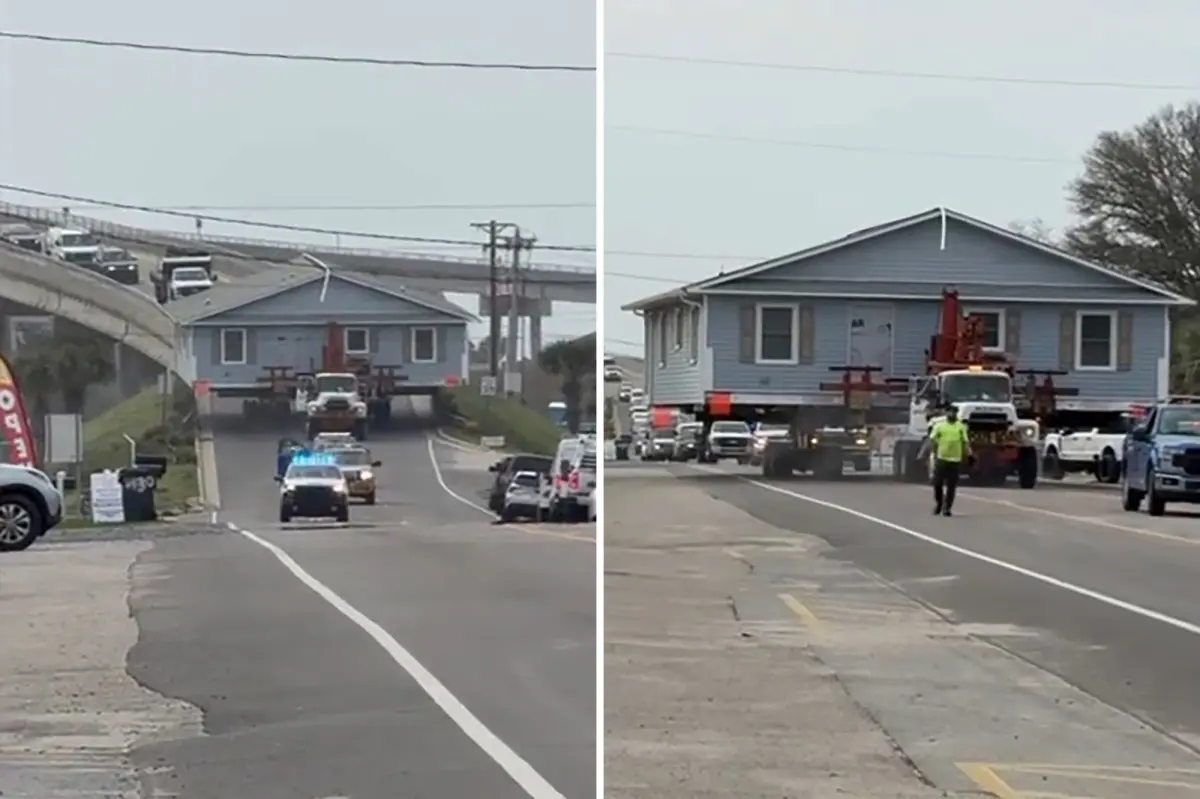
Imagine stumbling upon a scene straight out of a quirky hometown festival: a whole entire house, uprooted like some giant snail, slowly inching its way across a narrow bridge on the North Carolina coast. Last week, this bizarre spectacle unfolded on Holden Beach, where a modest home was strapped onto a flatbed truck, embarking on an unusual road trip inland. It was no ordinary move; the place was a “wide load,” demanding special handling as it lumbered across the Holden Beach Bridge—a spindly connector between the barrier island and the mainland. Passersby couldn’t help but pause and pull out their phones to capture the oddity, turning what should have been a routine relocation into a viral moment of waterfront whimsy.
Picture the bridge itself: just wide enough for a couple of cars to squeeze past each other on a good day, but with this oversized cargo in tow, traffic ground to a crawl like a reluctant parade. Cars lined up behind, their drivers craning necks or honking impatiently, while diligent road crews waved flags and barked instructions to clear the path. The house, precariously balanced yet steadily rolling forward, seemed almost alive in its slow motion—like it was waving goodbye to the salty breeze and whispering promises of a quieter life elsewhere. It was the kind of everyday drama that reminds you how vulnerable life can be near the ocean, where the tides don’t just kiss the shore but sometimes demand respect through such dramatic departures.
Enter Rosslyn Fanning, the sharp-eyed witness who turned observer into storyteller. She shared the video with news outlet Storyful and recalled the vibe: “It was like watching a family heirloom bidding farewell,” she laughed, though her tone carried a hint of coastal resignation. The house was heading 14 miles inland to Supply, North Carolina—a spot far from the relentless Atlantic waves—and Fanning filled in the local wisdom. Holden Beach, she explained, is a place where tradition meets inevitability; older, salvageable homes aren’t just bulldozed but given second chances, uprooted and replanted in safer soil. The real estate game played a role too, she noted, as these lots get transformed into shiny new million-dollar properties, blending sentiment with savvy economics.
This wasn’t just a one-off curiosity; it reflected a broader story unfolding on these fragile shores. For years, the folks of Holden Beach have been grappling with the sea’s unyielding appetite—erosion chipping away at foundations, floods testing resolve. Rosslyn Fanning’s insight hinted at a community philosophy: cherish what you can, rebuild what you must. It’s a human response to nature’s untamed side, where homes aren’t just buildings but vessels of memories, now floating toward dry land. You can almost feel the melancholy in it, imagining the families who’ve lingered on porches watching sunsets, only to pack up and start anew, their footprints washed away behind them.
Digging deeper, this move ties into larger efforts to understand and combat the coastal squeeze. Back in July 2024, the Army Corps of Engineers kicked off a comprehensive beach review for Holden Beach, a methodical appraisal to gauge just how much trouble erosion and flooding are brewing. Picture a team of experts poring over maps and data, like coastal detectives piecing together clues from the sand. Their goal is crystal clear: quantify the risks, from gradual nibbles at the shoreline to sudden surges that could swallow properties whole. The final report is slated for this May, a hopeful beacon amid the uncertainty, offering insights that might guide protective measures or even strategic retreats.
As if on cue, the hurricanes of 2025 underscored the urgency, with storms like Erin, Humberto, and Imelda ramping up to Category 5 fury, their giant waves slamming into the coast and accelerating erosion like an angry ocean’s tantrum. But Holden Beach isn’t alone in this coastal chorus; venturing north to the Outer Banks, the Cape Hatteras National Seashore has seen a heartbreaking tally—31 homes collapsing into the Atlantic since 2020, devoured by the same relentless forces. It’s a sobering reality check, where human ingenuity meets the humbling might of Mother Nature. In these stories—the transported house, the eroding dunes—we see resilience wrapped in reflection, a testament to communities that bend but don’t break, forever dancing with the edges of the sea.