





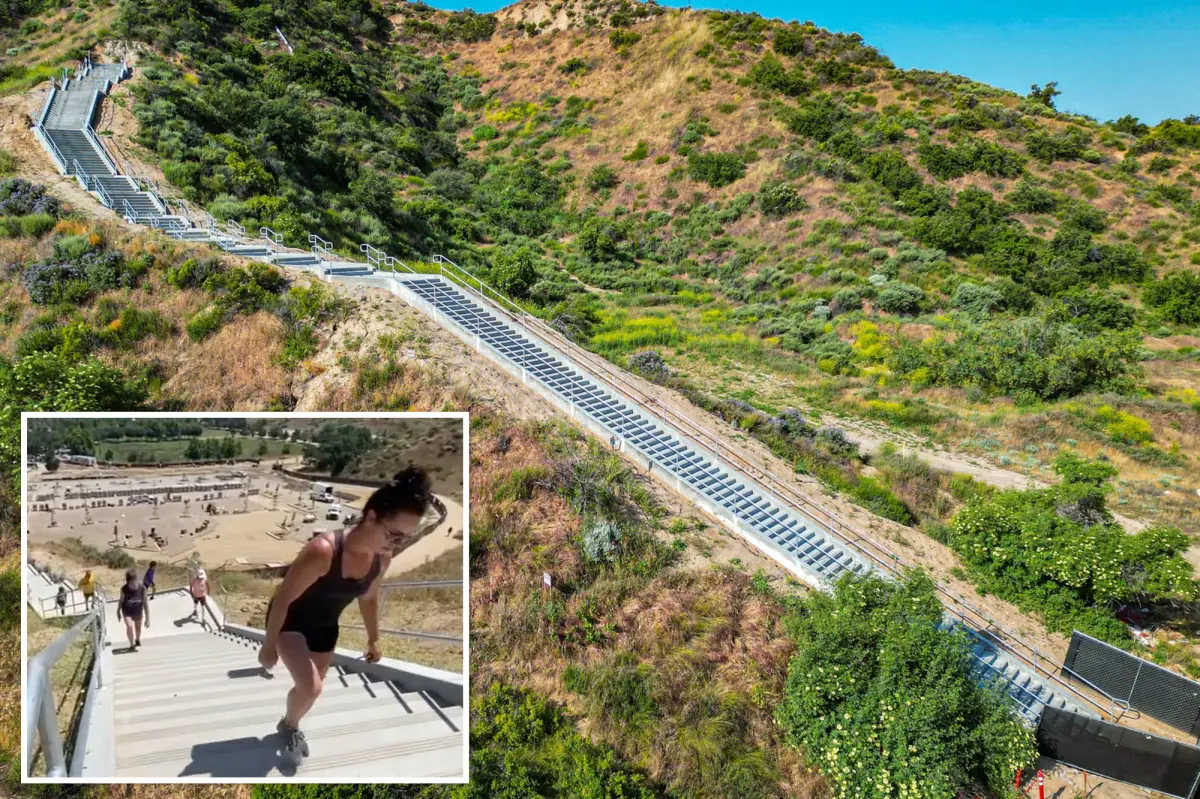
Humans are strange and deeply contradictory creatures; we build machines to save ourselves from labor, then build massive concrete staircases to nowhere just to voluntarily exhaust our bodies. In the sunny, health-conscious suburban valley of Santa Clarita, California, this human paradox has found its newest monument. Rising above the landscape is a brand-new, 116-step outdoor exercise staircase that ascends to a scenic hillside overlook, offering nothing at the top but fresh air, a panoramic view, and the self-satisfied glow of a completed cardiovascular challenge. While average people look at an extra flight of stairs with a heavy sigh of dread, the active residents of this vibrant enclave are greeting this vertical concrete monolith with the absolute fervor usually reserved for life-altering events. It is a fascinating testament to the modern human drive for self-actualization through physical exertion, an outdoor playground built around the shared pursuit of longevity and daily steps. Rather than viewing the grueling climb as a chore, local fitness enthusiasts see it as the ultimate playground for their lungs and legs, an entirely democratic fitness machine that costs nothing to use but demands everything you have to give. By converting a simple architectural element into a collective challenge, Santa Clarita is tapping into a profound human desire to conquer physical obstacles, transform our limits, and connect with the natural landscape. This staircase does not need to lead to a building or a transit station to have a purpose; its purpose is written in the determination of the people who climb it, making the rigorous journey itself the entire destination and proving that sometimes, the best way to move forward in our lives is simply to go up, turn around, and do it all over again. In a world where comfort is easily bought, this simple outdoor installation reminds us that we feel most alive when we are actively striving against gravity. Ultimately, the climb becomes our own quiet, shared triumph, proving that true progress is always measured step by painful step.
Behind this modern temple of physical health and aesthetic design lies a deeply human story of sacrifice, service, and memory that anchors the entire project to the very heart of the local community. The staircase stands as the crowning jewel of the newly expanded David March Park, a sanctuary of recreation and peace named in honor of Los Angeles County Sheriff’s Deputy David March, who was tragically killed in the line of duty during what should have been a routine traffic stop back in 2002. For over two decades, Deputy March’s legacy of brave and selfless service has lingered in the gentle breeze that sweeps across this valley, serving as a quiet and powerful reminder that the safety, comfort, and peace of suburban life are often bought at a tremendous personal price. By naming and dedicating this expansive park after him, the city of Santa Clarita has ensured that his ultimate sacrifice is never relegated to the dusty pages of history, seamlessly weaving his memory into the daily lives, play, and joy of the residents. When children run the bases, athletes shoot hoops under the lights, or individuals push their bodies to the absolute limit on the new concrete staircase, they do so in a space dedicated to a man who gave everything to protect their right to live peacefully and play freely. This deliberate transformation of a community’s grief into a vibrant, living tribute represents the absolute best of what public urban spaces can achieve. It creates a seamless bridge between the past and the present, transforming an old act of tragedy into an enduring fountain of community vitality, health, and cross-generational connection. As residents ascend the hillside step by step, they are physically elevated above the daily grind of their lives, carried upward by the silent, enduring legacy of a fallen hometown hero. His brave name remains synonymous with courage, and this beautiful park now stands as a living testament to the simple fact that real heroes are never truly forgotten.
The grand expansion of David March Park is the culmination of an ambitious, multi-year civic vision that first broke ground with heavy machinery back in 2024 and temporarily hid behind construction fences in August 2025 to undergo its final, breathtaking eight-acre transformation. The city did not just build a staircase; they carefully and thoroughly reimagined what a suburban park could be, creating a highly functional and beautiful recreational wonderland designed to cater to every age group, interest, and athletic ability. Visitors returning to the site will find a beautifully manicured landscape featuring a state-of-the-art, illuminated basketball court ready for late-night pickup games under the stars, a pristine baseball field with beautifully designed shaded stands where parents can comfortably cheer on their little leaguers, two expansive new parking lots to easily accommodate the inevitable influx of weekend visitors, and a picturesque picnic pavilion perfect for lazy Sunday birthday parties and family reunions. To elevate the park’s physical beauty alongside its functional sporting upgrades, the city integrated a stunning, colorful public art installation made of Dalle de Verre glass—a thick, faceted stained glass technique that spectacularly captures and refracts California’s legendary golden sunlight, casting vibrant, shifting prisms of color across the grass throughout the course of the day. This elegant fusion of utility, beauty, and open-air recreation ensures that the park is not merely a collection of isolated sports facilities, but a living, breathing work of art where nature, community, and human ingenuity harmoniously coexist. Whether you are a child playing catch under the afternoon sun, an artist admiring the play of light through stained glass, or an athlete winding down after an intense workout, the park offers a sensory-rich environment that nurtures the body, feeds the soul, and brings a new level of aesthetic sophistication to the local neighborhood. It stands as a testament to the idea that public places should be both highly functional and deeply inspiring, elevating our daily suburban experiences into something truly memorable and lasting for everyone who steps inside it.
Long before the safety fences were dismantled, the digital world was already buzzing with high-energy anticipation as drone footage, sneak-peek photographs, and social media teasers began circulating online, triggering an absolute avalanche of excitement among Santa Clarita’s highly connected and health-conscious population. Instagram feeds and community Facebook groups lit up with eagerly shared posts, with locals immediately declaring the new staircase their ultimate fitness destiny and mapping out their future morning workout routines. “New way to get my steps,” wrote one enthusiastic resident, expressing an optimistic sentiment shared by hundreds of neighbors who are constantly looking for creative, outdoor alternatives to the monotony of indoor gym treadmills and elliptical machines. Yet, alongside the chorus of unbridled physical excitement, a wave of lighthearted concern and humorous sympathy emerged for the homeowners whose properties sit immediately adjacent to the revamped park, highlighting the cozy, sometimes messy reality of suburban neighborhood development. “All I got to say is I feel sorry for the people who live right next to that park,” noted one observant local on social media, pointing out that the city may not have fully anticipated just how intensely popular, crowded, and noisy a 116-step exercise attraction would become. Between the soft thudding of sneakers at sunrise, the heavy panting of determined fitness enthusiasts, the chatter of social groups, and the inevitable car doors slamming open and shut in the early morning fog, those neighboring streets are bound to experience a profound transformation of their own. It is a wonderfully human dynamic—the perpetual suburban push-and-pull between a community’s collective hunger for exciting public amenities and the quiet, peaceful sanctuary of our private homes, reminding us that every major progress in step count comes with a side of neighborly negotiation and shared tolerance. This gentle, ongoing tension between communal progress and domestic tranquility serves as a profound reminder that building a truly shared society requires not just concrete and glass, but a continuous, patient willingness to appreciate each other’s diverse lifestyles and daily personal routines.
This intense local enthusiasm for vertical exhaustion is not an isolated anomaly, but rather a proven cultural phenomenon modeled after the wild, undeniable success of the nearby 172-step staircase at Central Park, which has long served as a bustling social and physical hub for the region. On virtually any given day, from the chilly pre-dawn hours of the morning to the balmy desert evenings, the Central Park steps are teeming with a diverse cross-section of humanity, with marathon runners training for their next major race, high school athletes building explosion, parents carrying weighted vests, and casual walkers simply trying to keep their hearts healthy. “There are people using them all day long,” wrote a glowing Yelp reviewer of those steps, marveling at how a simple concrete structure could foster such a positive, energetic, and highly addictive atmosphere of collective self-improvement. By introducing this second, slightly shorter 116-step staircase at David March Park, city planners did not just stumble into a smart piece of public design; they deliberately listened to the desires of their residents and doubled down on a physical formula that beautifully connects people through shared physical effort. There is something deeply democratic, humbling, and bonding about climbing stairs together; social barriers melt away when everyone is gasping for air, sweating under the same sun, and silently encouraging one another to push through the final, burning stretch of the climb. It proves that in an era increasingly dominated by virtual screens and isolating sedentary lifestyles, people are profoundly hungry for physical touchpoints that pull them out of their living rooms and into the fresh air, transforming a painful physical challenge into a joyous, daily ritual of community connection and mutual inspiration. This shared experience reminds us that fitness is not merely an individual journey, but a powerful communal force that breaks down social boundaries, encourages daily interaction, and ultimately unites absolute strangers under a mutual goal of bettering themselves one step at a time, creating a healthier society for us all.
The long wait for this magnificent suburban playground is finally coming to an end, with the city officially scheduling the highly anticipated ribbon-cutting ceremony for June 1st at precisely 10 a.m., marking a triumphant milestone in Santa Clarita’s historic civic journey. After months of being entirely sealed off from the public, the fences will slide open, the ribbons will be joyfully cut by city officials, and the sound of laughter, bouncing basketballs, and the synchronized rhythm of climbing footsteps will once more echo across David March Park. This grand opening is more than just a victory for local fitness buffs looking to conquer 116 steps; it is a celebration of what can be achieved when a local government listens to its people, honors its history, and invests in spaces that foster joy, health, and togetherness. In our increasingly digital, fractured world where real-world spaces can sometimes feel like an afterthought, the expansion of this park stands as a beautiful, tangible reminder that the heartbeat of any community is found in its shared physical spaces. It is a place where we can sweat out our anxieties, teach our children the joys of a well-played game, bask in the kaleidoscopic patterns of glass illuminated by the sun, and quietly remember those who gave their lives to keep us safe. As families, athletes, neighbors, and visitors gather together this June to take their first collective steps up that daunting concrete incline, they will not merely be climbing toward the top of a hill; they will be climbing toward a healthier, more connected, and deeply vibrant future, where every step upward is a shared celebration of life, movement, and community. It stands as a testament to the community’s heart, honoring a hero’s enduring legacy while preparing a path for future generations to grow stronger together, proving that every long climb is worth the effort, and that sometimes, a simple staircase to nowhere can lead us directly to the very best parts of ourselves and our shared neighborhood community.