



The transatlantic bond between France and the United States has never been forged merely through formal treaties or economic trade; rather, it has been woven together by a quiet, persistent love affair of creative exchange, visual poetry, and shared aesthetic dreams. This spring, this invisible but deeply felt connection takes physical, breathtaking form at The Shed in New York City, where the Comité Colbert presents its mesmerizing exhibition, “Hidden Treasures: 250 Years of Franco-American Luxury Stories.” Running through May 31, with tickets priced accessibly at $35, this curated showcase is far more than an exhibition of expensive glass, rare fabrics, or polished metals. It is a living testament to a centuries-old dialogue. Under the passionate leadership of Bénédicte Épinay, the President and CEO of the Comité Colbert—a prestigious collective comprising ninety-six French luxury brands, seventeen cultural institutions, and six European luxury houses across fourteen distinct trades—the show unearths the deeply human stories behind objects of immense beauty. Developed in a warm spirit of collaboration alongside esteemed partners such as the Villa Albertine, Lizzie and Jonathan Tisch, JCDecaux, and the ISG Luxury Program, the exhibition brings together sixty-five legendary French luxury maisons and cultural institutions. From the crystal artisans of Baccarat to the legendary design rooms of Chanel, Hermès, Louis Vuitton, and Van Cleef & Arpels, and even the timeless structural romance of the Eiffel Tower, the show invites visitors on an emotional architectural tour of our shared history, illustrating how two vastly different cultures have spent generations inspiring, comforting, and elevating one another.
Nothing captures the sheer, cosmic wonder of this Franco-American creative romance quite like the glittering tribute that awaits visitors near the heart of the exhibit: an astonishingly detailed, 5.9-inch-tall replica of the Apollo 11 Lunar Excursion Module, rendered entirely in shimmering 18-karat solid gold by the legendary house of Cartier. The year was 1969, an epoch when humanity first left its bootprints on the ancient dust of the moon, and the entire world held its collective breath in awe of American engineering. While NASA’s triumph belonged to the United States, the joy of that singular step forward was genuinely universal. Seeking a way to express the profound admiration of the French populace, the historic Paris newspaper Le Figaro took an extraordinary, democratic step: rather than relying on corporate sponsorship, they invited their everyday readers to fund a tribute. Tens of thousands of passionate French citizens contributed their own francs to commission Cartier to craft three of these golden miniature spacecraft, one for each of the Apollo 11 astronauts. When Neil Armstrong, Buzz Aldrin, and Michael Collins arrived in the French capital during their whirlwind “Giant Step” goodwill world tour, they were presented with these glittering pieces of public love. The model on display at The Shed—the very one gifted to command module pilot Michael Collins—stands as a magnificent monument to a time when French artistic mastery met the pinnacle of American pioneering spirit, reminding us that even the cold frontier of space can be warmed by the touch of human craftsmanship.
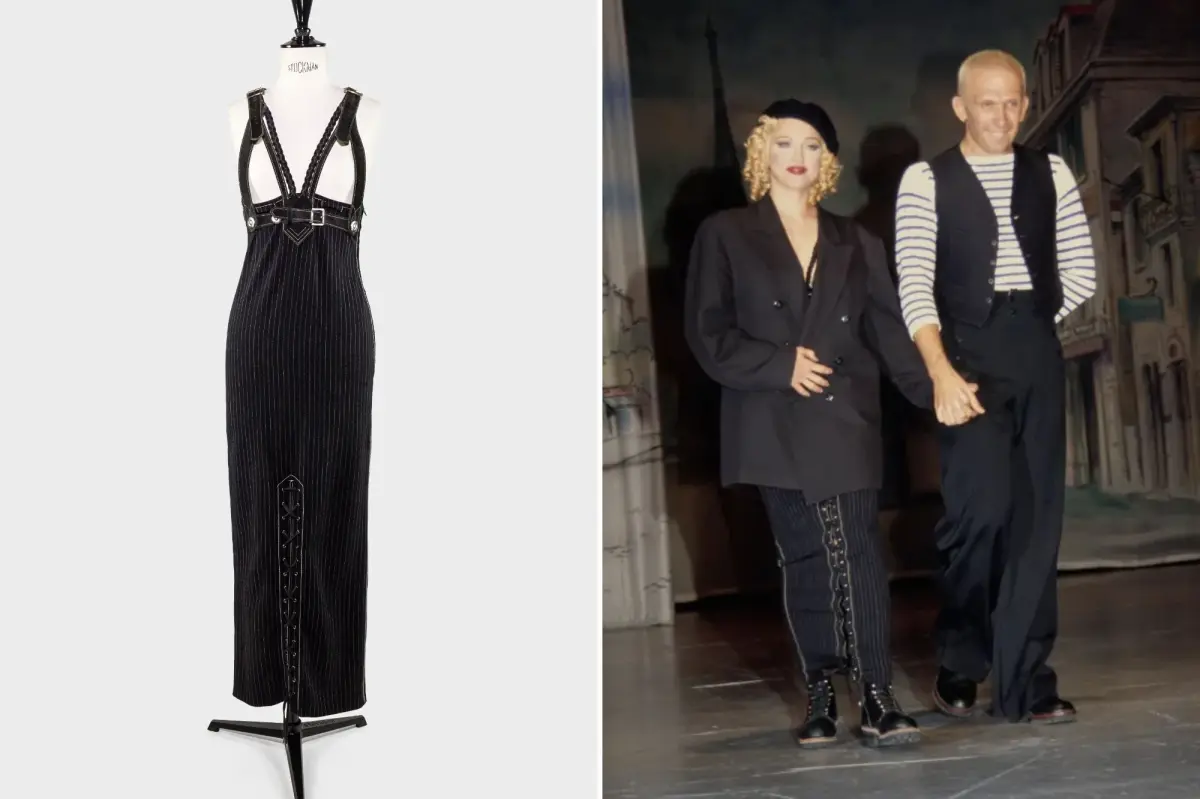
As the exhibition flows from the stars down to the vibrant, rule-breaking streets of late twentieth-century pop culture, it reveals how French high fashion has repeatedly served as the medium through which American icons have asserted their raw individuality and challenged societal norms. Perhaps no object in the gallery crackles with quite as much rebellious energy as Jean-Paul Gaultier’s infamous breast-baring pinstripe dress from 1992. When Gaultier first sent this avant-garde creation down the Parisian runway, it was styled with a touch of theatrical modesty, featuring star-shaped pasties and a delicately draped scarf. But when the garment crossed the Atlantic and met the fierce spirit of Madonna, modesty was joyfully cast aside in favor of pure, unfiltered artistic expression. At a star-studded amfAR charity gala in Los Angeles, the “Material Girl” stepped onto the stage, dramatically shed her jacket, and walked the runway with the nipple-freeing frock on full display. The reaction from the audience was an electric mixture of shock, delight, and uproarious applause, creating an instant landmark in fashion history. More than just a scandalous pop-culture moment, this daring act of bodily autonomy served a deeply compassionate human purpose, helping to raise nearly $700,000 in a single evening for vital AIDS research during a dark era when the epidemic was devastating communities worldwide, proving that high fashion has always possessed the power to heal as well as to provoke.
The galleries also offer an intimate window into how French design became the armor of elegance for the most influential women in American history, shaping their public identities and shielding their personal lives. Visitors can marvel at a stunning heritage reproduction of the pastel-pink Givenchy couture coat worn by First Lady Jacqueline Kennedy during her historic 1961 state visit to France—a diplomatic tour so wildly successful that President John F. Kennedy famously introduced himself to the Parisian press as “the man who accompanied Jacqueline Kennedy to Paris.” Nearby rests a timeless artifact of Hollywood-turned-European royalty: a classic black Hermès Kelly bag from around 1950, identical to the very one that Grace Kelly, the movie sweetheart who became the Princess of Monaco, famously clutched to her torso to shield her early pregnancy from the invasive lenses of the paparazzi. These pieces illustrate a profound dialogue of mutual adoration, where American women found their voice in French high fashion, and French creators found their ultimate muses in American grace. This symbiotic relationship is further illuminated by Christian Dior’s silk satin Athena evening gown, an ethereal masterpiece that was part of the pioneering “New York” collection established by the maison in 1948. Recognizing the immense influence and sophisticated taste of his American clientele, Monsieur Dior did not merely export Parisian designs; he created a dedicated line specifically tailored for the lifestyle of modern American women, distributed through elite department stores across the nation and from his own flagship boutique on Fifth Avenue, forever intertwining the romance of Parisian couture with the fast-paced energy of Manhattan high society.
Beyond the dresses and handbags, “Hidden Treasures” dives deep into the sparkling history of the silver screen, proving that the golden age of Hollywood was heavily dressed by the ateliers of Paris. This cinematic romance is vividly captured in the exhibition’s display of a contemporary haute heritage ensemble, including an intricately woven tweed coat and skirt inspired directly by the vintage movie poster for the 1931 romantic comedy Tonight or Never. The film starred the legendary Gloria Swanson, an actress whose magnetic screen presence and impeccable personal style captivated millions of moviegoers. Behind her unforgettable onscreen wardrobe was none other than Gabrielle “Coco” Chanel, the fiercely independent founder of the House of Chanel, who had been handpicked and personally courted by Hollywood moguls to bring an authentic touch of Parisian chic to the American film industry. From printed jumpsuits to dramatic, strappy black evening gowns, Chanel’s designs for Swanson revolutionized how American women viewed fashion on the big screen, seamlessly translating the relaxed, sporty elegance of French resort wear into the aspirational vocabulary of American cinema. By showcasing these modern interpretations of those historic silver screen costumes, the exhibition honors a century-old lineage of creative cross-pollination, reminding us that the dream world of American cinema and the meticulous craftsmanship of French haute couture have always been twin engines of the global imagination, constantly reinventing one another to match the changing rhythms of the modern woman’s life.
Finally, the exhibition beautifully anchors itself in the literal instruments of this historic transatlantic journey: the iconic trunks of Louis Vuitton, which have transported the dreams, wardrobe, and treasures of globetrotters for generations. Representing this legacy of travel are two extraordinary pieces of luggage that perfectly bracket a century of creative evolution and friendship. The first is a magnificent 1907 cabin trunk wrapped in the classic Monogram canvas, once owned by the legendary American stained-glass artist Louis Comfort Tiffany—the brilliant son of the founder of Tiffany & Co.—whose own artistic philosophy of capturing nature’s light perfectly mirrored the French Art Nouveau movement. Standing in stark, thrilling contrast is a 2001 Bisten suitcase designed by Marc Jacobs during his revolutionary tenure at Louis Vuitton, featuring the vibrant, rebellious Monogram Graffiti canvas created in collaboration with the radical American artist Stephen Sprouse. This juxtaposition of the refined, turn-of-the-century Tiffany trunk with the raw, street-art-infused energy of the Sprouse suitcase beautifully encapsulates the entire spirit of “Hidden Treasures.” It is a vivid physical demonstration of how the dialogue between French luxury and American creativity is never static; it is a living, breathing voyage that continually evolves, packing centuries of history, glamour, and human connection into every single stitch, clasp, and canvas. Visitors leaving The Shed before the exhibition closes on May 31 will carry away not just a memory of glittering wealth, but a profound appreciation for the enduring human relationships, artistic courage, and shared dreams that continue to unite these two great nations across the open seas.