


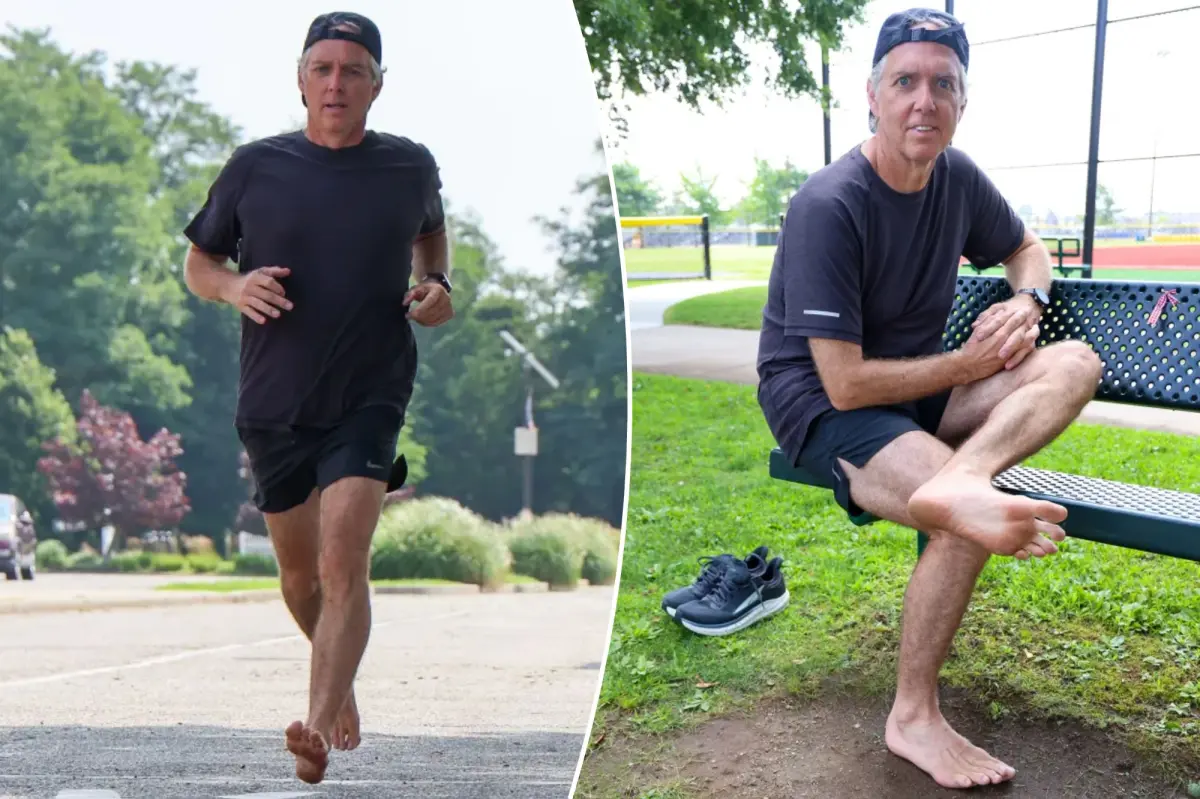
John Mazzei, a 57-year-old ballroom-dance instructor from Lindenhurst, Long Island, has spent more than a decade doing something that makes most people wince: running on bare feet. Not just a quick jog down a sandy beach, not a few laps around a grass track, but six full marathons, including four New York City Marathons, on the unforgiving asphalt of some of the country’s toughest courses. He is, in many ways, a shoeless sensation. And he does not know the meaning of de-feet. His feet have grown tough, weathered, and leathery, but they are not invincible. “I do get, periodically, a little shard of glass or something in my foot,” Mazzei says with a laugh, “and what I say is that that’s what the bib pins are for.” For the uninitiated, bib pins are the little safety pins used to attach a race number to a runner’s shirt; for Mazzei, they double as a field-expedient surgical kit. “I could perform minor surgery on my feet now,” he quips. The joke captures the spirit of a runner who has learned to treat his body and the road with a kind of wry respect. He is not trying to be a hero or a spectacle, even if he often becomes one. He is simply convinced that his feet are designed to do exactly what they are doing. The pavement has taught him to be careful, but it has also taught him to trust. The dancer’s posture remains, the shoulders back, the gaze steady, and the bare, dark-soled feet slapping the ground with each stride while cars pass and pedestrians stare. “It keeps him on his toes,” as the saying goes—except for Mazzei, this is literally true.
His training runs are not quiet affairs. Mazzei is used to getting looks, especially on the bustling streets of Long Island, where he stomps over jagged roadside pebbles and whatever debris the wind has tossed onto the pavement. During marathon season, his barefoot figure has also become a familiar sight in Central Park. Once, while training for the New York City Marathon, he was pulled over by a police officer. “I guess they thought I robbed somebody,” Mazzei recalls, “but I said, ‘Actually, I was doing an 8-minute mile.’” The officer, presumably, had no immediate response to that. It is not the only time his appearance has caused confusion. Drivers honk from their cars, not in anger but in disbelief. Marathon spectators do double-takes. One memorably leaned out of a fire escape and yelled, “Barefoot John!” as he ran past. The nickname stuck, and over the years it has become a badge of honor. He has also developed a standard answer to the inevitable comment “Hey! You forgot your shoes!” Mazzei delivers his punchline with a mischievous smile: “I just forgot to tie them and ran right out of them.” The line is so perfect that it sounds rehearsed, but he makes it feel spontaneous. He has heard every joke, every warning, every worried suggestion that he should see a podiatrist. Yet he keeps going, barefoot and calm. This year, however, he will not be lining up for the New York City Marathon. That is not a sign of retreat. He is working to qualify for the Boston Marathon, the oldest and most prestigious marathon in the world, and he is willing to skip his hometown race in order to chase that goal. It is the same stubbornness, the same quiet certainty, that has carried him through six marathons without shoes.
His path to this point is not the story of someone who grew up racing barefoot through the fields. Mazzei did not start running until he was about 43, and when he did, he wore the standard gear: socks and sneakers. For the first few months, everything felt normal enough. But soon, the sneakers began to betray him. The cushioning and support, supposedly designed to protect his body, were actually causing pain in his knees. The irony was not lost on him. Barefoot running, for all its apparent harshness, has never given him that kind of pain. Frustrated, he gave up running entirely for a few years. Then he came across Christopher McDougall’s “Born to Run,” a book that explores the sports science behind barefoot running and argues that modern running shoes may actually contribute to many of the injuries they claim to prevent. It was a revelation. As a ballroom-dance instructor, Mazzei had spent years obsessing over technique, alignment, and the way the body moves through space. The idea of applying that same attention to running fascinated him. “I think because I’m a dancer, I love teaching technique,” he says. “I love the concentration, studying the technique of barefoot running.” So he gave it another crack, this time without shoes and without socks. He started with baby steps outside his house, literally walking and then jogging just a few yards before turning back. Then a little farther. Then a 5K. Then greater distances. Each outing conditioned his feet, thickened the skin, and taught his brain to read the ground beneath him. It was not easy. The body has to relearn a lifetime of habitual motion, and the mind has to make peace with the fact that every step is a negotiation with the surface. But he has not had any issues with his knees since.
His feet have not escaped unscathed. “The hardest thing to run on is gravel,” Mazzei says. Yet he has done trail running and trail half marathons barefoot, navigating rocks, roots, and steep terrain with nothing but his own skin against the earth. The hazards of pavement are usually minor—small glass, loose stones, unexpected litter—but he remembers one scorching day on a track when he suffered blood blisters on the balls of his feet. “That laid me up for a month or so,” he says. The scars are part of the story. His first New York City Marathon, in the early 2010s, was a tribute to his uncle, Thomas Stone, who had been diagnosed with ALS. Mazzei finished in 3 hours and 48 minutes—a remarkable time for a first marathon, let alone one run on bare feet. He learned the geography of the course in an intimate way. The center of the road, he discovered, is cleaner; the edges collect glass and debris. “When I’m doing the New York City Marathon, running in the center of the road is a lot cleaner anyway,” he says. But some neighborhoods are rougher than others. Queens, he says, was “the gnarliest,” with jaggedly filled potholes and uneven patches that tested his focus and his soles. Still, he never felt any real danger. “I’m not feeling anything adverse on my feet or anything,” he insists. “I just keep going.” He has also run the Long Island Marathon, navigating its hills and headwinds with the same stubborn calm. Each race has become a lesson in resilience. The blood blisters, the gravel, the potholes—they all fade into the larger rhythm of the run. What remains is the sensation of total contact with the ground, a feeling that no shoe can replicate.
Mazzei’s years of progress have taken him to unexpected places. In upstate Goshen, he once decided on the spur of the moment to enter a marathon, simply because he felt like it. The organizers were bewildered. “They were surprised I signed up that day. ‘Oh, you’re signing up for a marathon today?’ Did you know you were going to do this marathon? I said I didn’t really,” he recalls. Somewhere along the way, he had become a legend in the running world. At an expo, Meb Keflezighi—the 2009 New York City Marathon winner—signed Mazzei’s foot for good luck. Keflezighi wrote “Run to win” across the top of his bare foot. For a professional athlete to acknowledge an amateur runner in such a personal way was, for Mazzei, a reminder that running is ultimately a community. “I’d say the people you meet definitely are the most rewarding part,” he says. He has met countless strangers on the course, some who cheer, some who question, some who just shake their heads. The fire-escape fan who shouted “Barefoot John!” is part of a gallery of characters that has grown with every race. The running world is full of people chasing arbitrary goals, and Mazzei fits right in. He is not chasing fame or a podium spot. He is chasing a feeling, a rhythm, a connection. And if that means standing at a registration table with no shoes and surprising everyone, so be it. The impromptu Goshen marathon was just another example of his philosophy: if the body is ready, the distance does not matter, and the shoes do not matter either.
Now his sights are set on Boston. The New York City Marathon will have to do without him this year, but his absence is only a detour, not a farewell. He continues to train on the same streets where he has been stopped by police, cheered by strangers, and offered more unsolicited advice than he can count. He still gets “those looks,” as he calls them—the raised eyebrows, the double-takes, the concern etched on the faces of people who cannot understand how anyone would voluntarily run without shoes. But Mazzei has made peace with that. “I do get those looks like I’m crazy or whatever,” he says. “But it works for me.” That is the heart of his story. He is not trying to convince anyone to throw away their sneakers or run a marathon in their bare feet. He is simply telling the truth about what has worked for him. The ballroom-dance instructor who spent his life studying how bodies move through space now glides across the pavement with the same attention to detail, feeling every crack, every stone, every subtle change in texture. It is not a protest or a publicity stunt. It is a dance. And at 57, with six barefoot marathons behind him and Boston on the horizon, John Mazzei is proof that the best way to run is the way that makes you feel most alive. The shards of glass, the gnarled potholes of Queens, the police officers who mistake him for a fugitive—they are all part of the dance. Barefoot John would not have it any other way.