




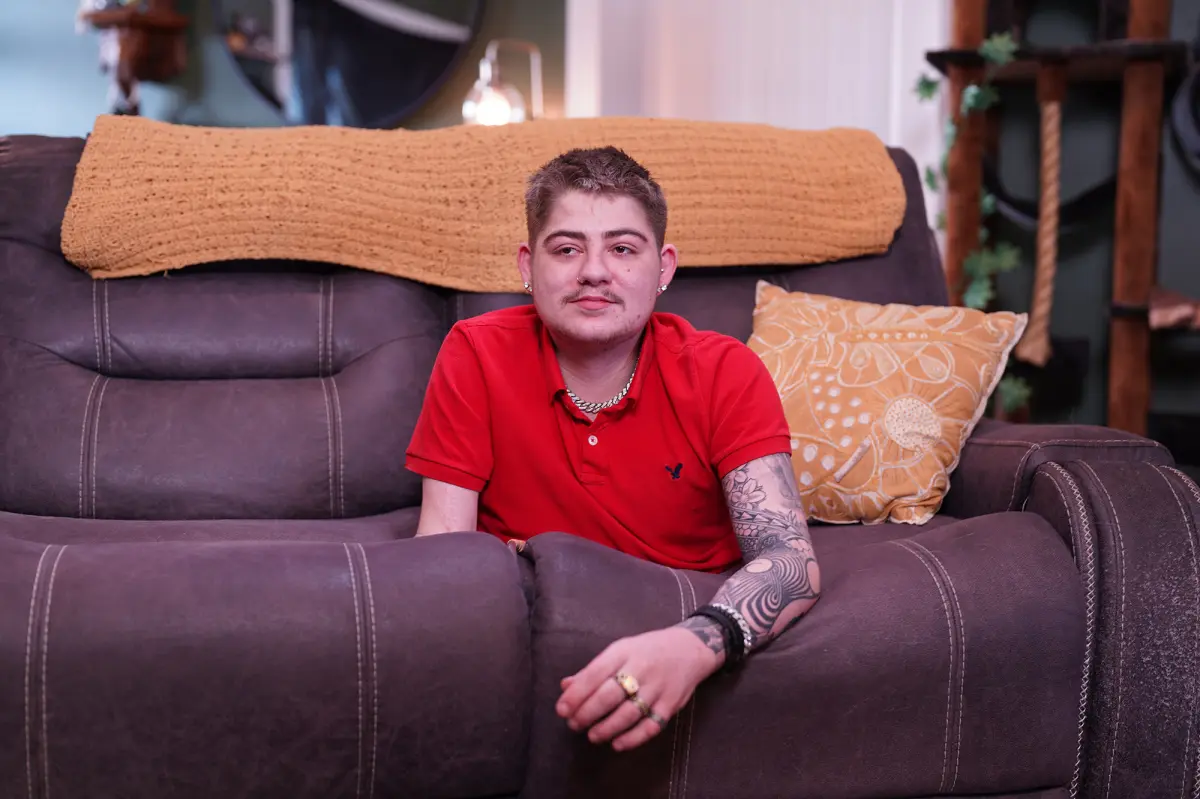
Loren Schauers awoke on that fateful day in 2019 feeling like any ordinary 18-year-old, thrilled to be working in construction—a job that gave him purpose and a steady income. At nearly six feet tall and full of life, he never imagined a simple forklift task to reposition a water barrier would shatter his world. He climbed into the machine with confidence, only to feel it tip dangerously over a 50-foot hill. The forklift plummeted, rolling downward before slamming into him. But Loren didn’t die—he landed at the bottom, crushed under the weight for what felt like an eternity. Thirty minutes pinned in agony, his body broken beyond recognition, he blacked out and awoke in a hospital nightmare. Doctors performed a hemicorporectomy, a radical surgery amputating everything below his waist, removing his pelvis, legs, right forearm, even his genitalia, leaving him just two feet eight inches tall and weighing around 90 pounds. In those first bewildered moments, pain wasn’t his biggest foe; it was the dawning horror of a new reality he couldn’t yet comprehend.
The recovery was grueling, a maze of procedures that rewired his entire being. Surgeons had to excavate his lower body, relocating his intestines from the hip area upward, which now pressed uncomfortably against his stomach, lungs, and heart. They installed a colostomy bag for waste and a urostomy for urine, since his bladder was gone, turning routine bodily functions into daily battles. Family nurse practitioner Brandon Hawk, who has been a pillar in understanding the family’s struggles, explained the body’s chaos: nothing was where it should be, making every breath a reminder of the body’s fragility. Loren, now 24, emerged transformed not just physically but emotionally, grappling with the loss of his old self. “I was happy and fulfilled before,” he recalls, his voice carrying the weight of grief. Yet, he decided to share his story on TLC’s “One Day in My Body,” airing on Wednesdays at 9 p.m., hoping to inspire others facing similar traumas. “It’s important to show the good and bad of life with a disability,” he says, humanizing the unseen struggles. In interviews, Loren speaks vulnerably, not as a victim but as a survivor determined to prove resilience isn’t just surviving—it’s thriving against the odds.
Before the accident, Loren’s life was anchored by love. He’d been dating Sabia Reiche for about 15 months, sharing a home where everyday joys like cooking together or lazy evenings felt like endless possibilities. Sabia, just 20 at the time, received a frantic call about the forklift crash, racing to the hospital where she entered Loren’s room expecting her healthy boyfriend. Instead, she found him shrunken, his amputated form barely filling the bed—it looked like a child’s space, jolting her into disbelief. “I thought we were in the wrong room,” Sabia recalls, her voice trembling with the memory of that initial shock. Yet, amid the uncertainty, her heart made space for this new chapter. “It wasn’t a decision; it was just our life now,” she says. At 27, Sabia has become Loren’s 24/7 caregiver—preparing meals, managing ostomy changes, bathing him with a tenderness born of deep commitment. Carrying him in a turtle-shell-like seat that supports his spine, she embodies quiet strength, her love a lifeline in the storm. Their bond deepened not from choice, but from necessity, proving that love can adapt and flourish even in the face of unimaginable loss.
Returning home four months post-accident marked another harrowing shift. Adjusting to his wheelchair and specialized seating apparatus took time, but within six months, Loren reclaimed scraps of independence. By 8 or 9 a.m., he’d empty his pee bag, brush his teeth, and ready himself before Sabia stirred, a small victory in a life of unrelenting challenges. They married in 2021, capturing their journey on social media to connect with others. Fans often ask about intimacy, a topic Loren addresses with honesty. “We’re not different from any couple,” he shares, emphasizing that while parts of his body are gone, affection flows freely—embraces, whispers, touches that reaffirm their bond. Infertility hit hardest; learning he couldn’t father children drew tears not shed for lost limbs. “That was the toughest,” he admits, the grief raw. Together, they navigate these emotional terrains, finding solace in shared laughter, like stolen moments of joy that remind them they’re not defined by what they’ve lost.
Health battles continue to test them. Kidney infections plague Loren, each flare-up raising fears of resistance to antibiotics and potential kidney failure, casting shadows on his life expectancy. “Hopefully we’ll live to 80,” he jokes darkly, a mix of hope and realism. Sabia worries aloud about the toll, her protective instincts on high alert. But through it all, they’ve built a resilient rhythm, their home a sanctuary of creativity and connection. Sabia carries Loren effortlessly, her arms a safe harbor, while he pursues independence with prosthetics on the horizon. Filming “One Day in My Body” was cathartic, allowing them to externalize the unspoken— the constant adjustments, the quiet fears, the unyielding spirit. Loren’s voice softens when he describes their doped-up nights post-op, laughing at absurdities, or the simple thrill of outdoor adventures, wheelchair in tow. It’s a life stitched with pain but amplified by love, a testament that even after earth-shaking change, the human heart can mend and move forward.
As they look ahead, Loren and Sabia dream of greater autonomy. New prosthetics promise more mobility, reducing Sabia’s burden. Social media followers cheer their authenticity, offering community in isolation. Loren reflects on his 18-year-old self, overwhelmed but unbroken by the hilltop near-miss. “It’s a miracle I lived,” he says, gratitude shadowing the sorrow. Yet, his narrative shifts: from victim to advocate, he urges others to embrace life’s imperfections. Sabia’s evolution mirrors his—she went from shocked girlfriend to devoted wife, her sacrifices a love story in action. Parenting, once a hope, remains a poignant what-if, but they pour energy into their partnership, finding fulfillment in mutual support. Ongoing health scares loom, like ticking clocks, but so does optimism. Therapy and routines anchor them, turning bewildering loss into purposeful living. In sharing their tale, they humanize disability, showing it’s not a sentence but a canvas for courage. Loren’s forklift tale evolves from tragedy to triumph, a reminder that even crushed beneath impossible weights, one can rise, love fiercely, and live fully.
The accident altered everything, yet amid the wreckage, a profound narrative emerges—of survival, not surrender. Loren’s journey, from that sinking forklift to a life redefined, highlights human adaptability. Sabia’s unwavering presence transforms caregiving into companionship, their love a bridge over the abyss. Physically stunted, emotionally expansive, they document highs and lows, inviting viewers into vulnerability. Kidney threats bite at hope, yet they laugh through it, faith in medical advances fueling resolve. By humanizing their experience—tears over infertility, victories in self-care—they inspire, proving pain doesn’t preclude passion. Looking back, that 50-foot drop wasn’t an end; it was a rebirth, where love and resilience proved mightier than tragedy. “You can still live a full life,” Loren affirms, his words echoing for anyone grappling with the unknown.