





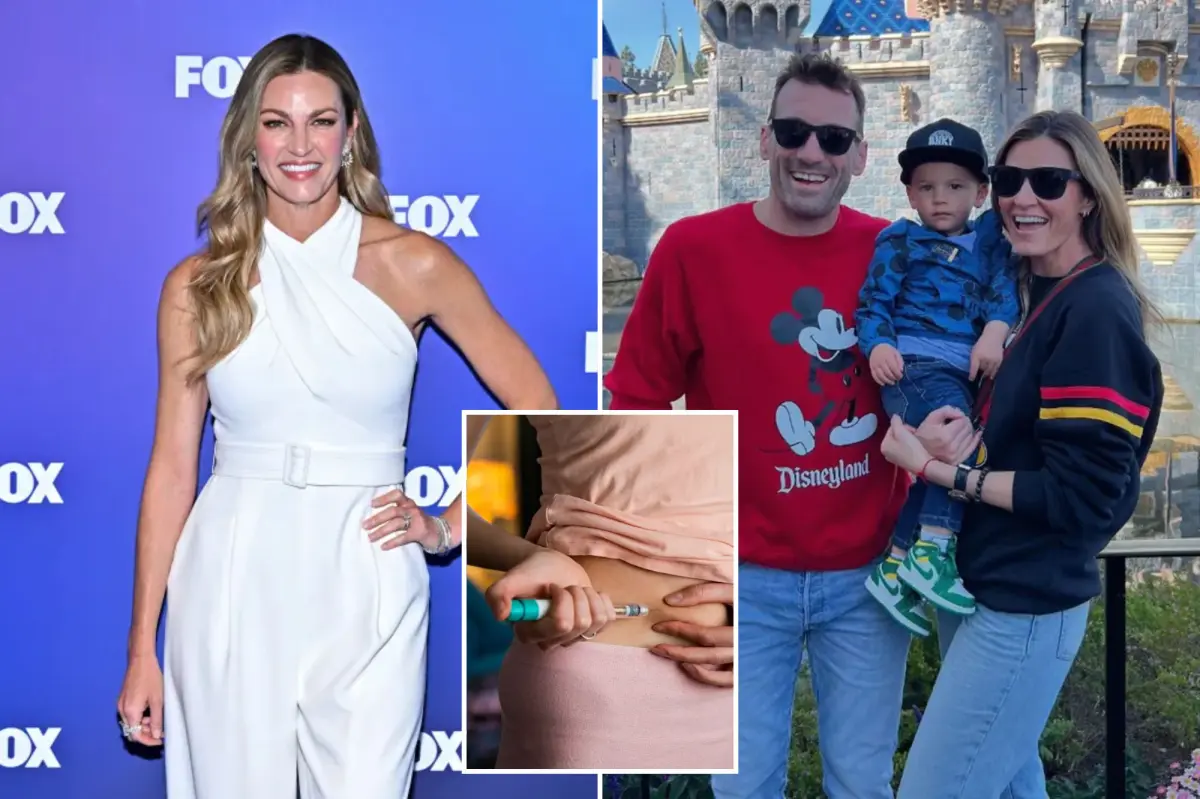
Erin Andrews is stepping back into the spotlight, not on the sidelines of a football game, but in the deeply personal arena of her own life, as she chases the dream of baby number two at 47. You know that fierce determination she’s always shown as an NFL sideline reporter? Well, it’s shining through here in a whole new way. This week, she opened up on her podcast “Calm Down with Erin and Charissa,” telling co-host Charissa Thompson how she’s diving headfirst into another round of IVF. “I am crazy, and I am with a doctor that said, ‘Listen, we’ll call it when it’s time.’ But I, I am psychotic right now,” she confessed, her voice carrying that raw mix of hope and desperation that so many women can relate to. It’s not just about wanting another child; it’s about defying the odds stacked against her. She believes in her body, even as statistics whisper otherwise. At her age, egg quality and quantity aren’t on her side, but Andrews is no quitter. She’s battled through challenges before, on and off the field, and this feels like yet another hurdle she’s determined to clear.
Erin Andrews is no stranger to life’s curveballs, and her journey toward motherhood has been anything but straightforward. Back in 2016, she faced a terrifying diagnosis of cervical cancer, a moment that could have shattered her dreams of having biological children. But showing the resilience that defines her, she and her husband, former hockey pro Jarret Stoll, made the proactive choice to freeze embryos long before pregnancy became an urgent goal. After surgeries to remove all traces of the disease, Andrews endured multiple unsuccessful rounds of IVF, each attempt a rollercoaster of hope and heartbreak. Yet, in 2023, joy broke through when they welcomed their son, Mack, via surrogate. That triumph wasn’t the end; it fueled her desire for a sibling for her little boy. Even though the first IVF shot at this new chapter didn’t work, Andrews isn’t backing down. “There’s just some s—t in me that I’m like, ‘Wait, watch — watch me do it,’” she said, evoking that unyielding spirit that makes her story so inspiring. It’s a reminder that motherhood paths aren’t linear, and for many women, the fight involves embracing all available options, from freezing embryos to surrogates, turning setbacks into stepping stones.
As Andrews embarks on this IVF journey, it’s worth pausing to understand menopause, that natural “change of life” phase that marks the end of reproductive years. Officially, menopause is reached after 12 consecutive months without a period, typically around age 52 in the US, per the Cleveland Clinic. But it doesn’t arrive out of nowhere; it’s preceded by perimenopause, a transitional period that can start eight to 10 years earlier, often in a woman’s 40s. During this time, estrogen levels decline gradually, bringing symptoms like hot flashes, night sweats, mood swings, and sleep disruptions. Imagine your body slowly shifting gears, hormones recalibrating after decades of fueling fertility. For many, it’s a confusing, uncomfortable phase—perhaps feeling more emotional, having irregular periods, or dealing with that sudden heat rising up. Yet, understanding it helps frame the bigger picture of aging and reproduction. It’s not something to fear but a normal progression, and for women like Andrews pushing for more time in their fertile window, it underscores why planning ahead, like freezing embryos, becomes so crucial. Life doesn’t stop at perimenopause; it’s just entering a new chapter, one where women can still thrive.
Now, here’s a key myth-buster: Can you get pregnant right up until menopause? The short answer, as explained by Dr. Jaime Knopman, a reproductive endocrinologist at CCRM Fertility of New York, is no. It’s a common misunderstanding—seeing periods continue doesn’t mean fertility is intact. “Just because you get your period does not mean you can still have a baby,” she notes. Fertility actually peaks in your 20s and starts declining in your 30s, winding down long before periods stop. Women often keep menstruating even when egg quality has dipped so low that conception is rare. Think of it as your body going through the motions without the biological backup. For Andrews, at 47, this reality intensifies the stakes, but it also highlights why she’s leaning into IVF and frozen embryos from her younger days. It’s relatable for anyone who assumed their cycle meant options, only to realize biology tells a different story. Embracing assisted tech like IVF can be empowering, turning a misconception into motivation.
Speaking of chances, what are the real odds of getting pregnant over 40? Dr. Knopman paints a vivid picture: like skiing down a slope that gets progressively tougher. Starting at 35, you’re on a blue run; by 40, it’s black diamond territory; and at 43, “we are calling ski patrol because there are very few who can get down that hill.” Egg quality and quantity plummet with age, making healthy embryos scarce. Yet, pregnancy isn’t impossible—thanks to tools like IVF, which can boost success rates. The gold standard is transferring a chromosomally normal embryo (with 46 chromosomes), increasing implantation chances. Without frozen embryos, Andrews’ odds would be “pretty slim,” Knopman says, with success rates as low as 2% at her age. Still, flexibility in care plans reminds us it’s not a cutoff. Many women in their 40s see success through perseverance, and for those without frozen options, donor eggs or alternatives like adoption offer paths to parenthood. Andrews’ use of her preserved fertility is a smart strategy, showing that informed choices can open doors. It’s hopeful to know that while the hill is steep, the right support—like advanced embryo screening—can help you make it to the bottom.
Of course, pursuing pregnancy later in life comes with added considerations. If a healthy embryo takes hold, both mother and baby face higher risks compared to younger pregnancies, Dr. Knopman warns. Conditions like gestational diabetes, high blood pressure, and preterm delivery become more likely for moms, while babies might encounter issues such as premature birth or low birth weight. These aren’t certainties, but they’re underscored by age-related changes in the uterus and overall health. However, proactive care can mitigate much of this—consistent prenatal monitoring from specialists who understand these dynamics is key. For women over 42, Knopman recommends preconception counseling with a high-risk obstetrician to map out risks and establish early care. Think of it as building a safety net, ensuring regular checkups, lifestyle adjustments, and close watch during gestation. Andrews, with her history of cancer and surgeries, knows the value of vigilant health management, and her determination reflects a broader truth: many women in their 40s and beyond navigate these challenges successfully, aided by maternal instinct and medical expertise. It’s about weighing the “what-ifs” against the joy of expanding a family, embracing the extra TLC needed to make it happen safely.
As Erin Andrews cites her podcast, her journey is a testament to grit and unwavering belief in possibilities. While she isn’t discussing specifics beyond IVF and her refractory push, her story invites reflection on our own narratives—be it freezing embryos, exploring surrogacy, or shifting to adoption. Menopause and late-in-life fertility are personal crossroads, rife with emotional highs and lows, yet empowering through education and choice. Andrews’ “psychotic” intensity isn’t delusion; it’s the fuel of hope, reminding us that age is just a number when heart and science align. For anyone in similar shoes, her openness normalizes seeking help, defying norms, and turning “improbable” into possible. It’s human to dream big, and in sharing her truths, she champions a world where fertility’s limits don’t define a woman’s path.