





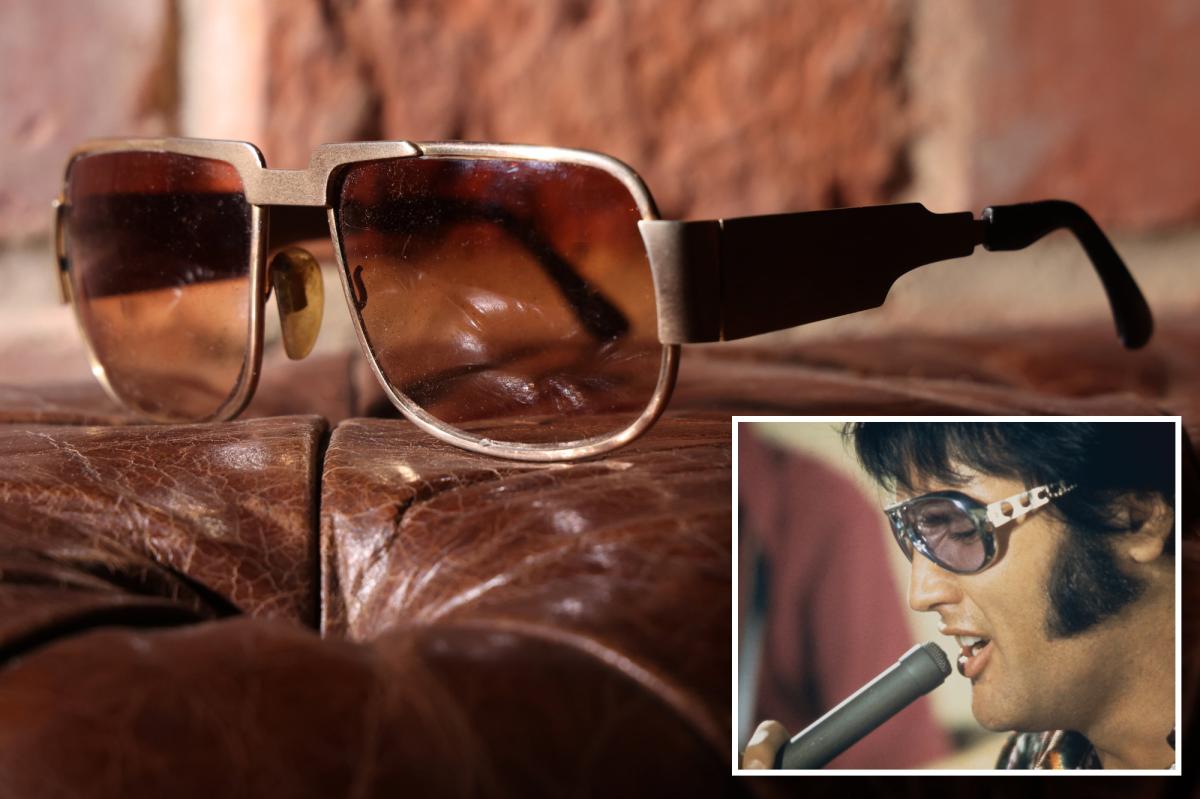
It begins with a pair of dark glasses, the kind that catches the light and turns a face into a silhouette, a man into a myth. When Elvis Presley stepped onto a stage, into a crowd, or even just out of a car, his sunglasses were never merely practical. They were armor, mystery, and style all at once—a way to hide the exhaustion in his eyes from the world that refused to stop screaming for him. Now, one of those iconic pairs is about to cross the auction block, and it carries with it a story far deeper than rhinestones and spotlights. In London this week, Propstore’s Music Live Auction will offer a pair of Neostyle sunglasses once worn by the King, with an estimate that has caught the imagination of fans and collectors alike. The expected final price, $26,542 at the upper end, might seem like just another number in the world of celebrity memorabilia, but the real value lies in the hands through which these sunglasses passed—and the intimate, trusting relationships they represent. This is not just a piece of fashion history. It is a tangible fragment of Elvis’s private world, a world where loyalty meant everything and the people closest to him carried the weight of his secrets, his laughter, and his loneliest nights.
To understand why these sunglasses matter so much, you have to meet the men who held them. Elvis gave them to Red West, a man whose name appears throughout the inner circle of Graceland with an almost legendary frequency. Red West was not just an employee or a hired guard; he was a close friend, a confidant, a bodyguard who would have thrown himself in front of danger without a second thought, and a martial arts sparring partner who shared with Elvis the kind of rough, physical camaraderie that the singer could not always find in the polished world of music executives. Their friendship was born in the raw early days of Elvis’s fame, when being around the King meant navigating swarms of fans and the constant press of human need. Red was part of the infamous Memphis Mafia, the loose crew of protectors, fixers, and companions who surrounded Elvis for decades. Giving Red his own pair of sunglasses was not a casual gift. For Elvis, who had learned early that trust was scarcer than gold, sharing such a personal item was a signal of deep affection. The moment carried the unspoken language of brotherhood: what I use to face the world, I want you to have, because you helped me survive it. In those frames, you can almost see the late nights at Graceland, the early morning drives, the laughter and the arguments, the unshakable bond between a global icon and the man who stood beside him when the cameras stopped rolling.
But the story does not end with Red West. At some point, Red passed the sunglasses along to Charlie Hodge, another figure whose place in Elvis’s life is saturated with intimacy and quiet devotion. Charlie Hodge was a friend, a musician, and a constant presence at Graceland—so much so that he lived there for years, becoming something like family in the most practical sense. He would sit with Elvis, play guitar, sing harmony, talk through the small hours, and provide the kind of steady companionship that fame made nearly impossible to find elsewhere. Charlie was one of the few people allowed to see Elvis without the costume, without the crown, without the carefully constructed walls. For Charlie, these sunglasses were not simply a memento from a star; they were a reminder of a man he had known and loved in the everyday rhythms of life. He kept them in his personal collection for 25 years, which says something profound about the way he valued both the object and the memory it carried. We often imagine celebrities as distant figures, but objects like these dissolve the distance. When Charlie looked at those sunglasses, he saw his friend. He saw the man who sang him songs late at night, who could be vulnerable and goofy and tired and brilliant all in the same hour. The 25 years he held onto them were not about monetary worth. They were about holding onto a connection—a way to keep Elvis close even after the world had moved on.
Eventually, these sunglasses found their way into the collection of a man with a remarkable, complicated connection to the Presley legacy: Elvis Aaron Presley, Jr. This is where the story becomes more human still, and perhaps a little bittersweet. Presley, Jr. was a performer who spent much of his life claiming to be the illegitimate son of Elvis Presley. Whether or not that claim was ever proven matters less to the emotional core of his journey than the fact that he devoted more than 35 years to preserving and sharing Elvis’s memory. He collected memorabilia with a passion that bordered on the sacred, and he displayed it at The Elvis Presley Museum in Niagara Falls, Canada, creating a space where fans could stand close to the artifacts of their hero’s life. For Presley, Jr., these sunglasses were not just an investment or a conversation piece. They were a thread connecting him to a lineage he felt in his heart, a way of walking through the world under the shadow of the King and trying to make something meaningful of that inheritance. There is something deeply human about this kind of devotion—the need to be close to greatness, to prove a connection, to keep a flame burning. We can wonder about his claims, but we cannot deny his dedication. He spent decades turning his obsession into an act of preservation, and by offering these sunglasses to the public, he is passing along not just an artifact but an entire atmosphere of longing, admiration, and identity.
The professionals behind the auction recognize that this object carries more than just provenance. Mark Hochman, Propstore’s Music Specialist, puts it into words that resonate beyond the realm of collecting. He notes that few accessories are as instantly recognizable as Elvis’s sunglasses, and that what makes this particular pair especially compelling is its personal history—the way it moved from Elvis to Red West, and then spent 25 years in Charlie Hodge’s collection. Hochman is not just talking about a chain of custody. He is telling us a story about intimacy and trust. At Propstore, there is an understanding that collectors are not merely buying things; they are buying moments, relationships, and feelings. Presley, Jr. echoes this sentiment in his own words, saying that people recognize the style immediately, but the story of this particular pair goes much deeper. He hopes the next owner will value the personal history behind these sunglasses as much as their connection to the King. That is a generous wish, and it reveals the true spirit behind the auction. Yes, there is money involved, and yes, there is fame attached to the name Elvis. But beneath the estimates and the bidding paddles is a simpler, more profound desire: to hold something that was once worn by someone who meant so much to so many, to feel for a moment that the distance between legend and life has collapsed.
The auction itself is set to take place in London this week, with the sunglasses estimated at between $13,271 and $26,542. The final price could fluctuate, but the real significance will never be measured in dollars. For the fan who wins this piece, the value will live in the moment they hold the frames up to the light and wonder about all the places those lenses once looked. Did Elvis wear them while driving through the gates of Graceland? Did he slip them on before stepping into a sea of flashbulbs? Did he hand them to Red West with a grin and a joke, or with a quiet moment of gratitude? Objects have a strange power to make the past feel present. These sunglasses, with their unmistakable shape and their long journey through the hands of people who genuinely loved Elvis, are like a key to a room that closed decades ago. They remind us that the King of Rock and Roll was not just an icon but a human being who wore sunglasses to hide his tired eyes, who gave gifts to the people who made him feel safe, and who left behind not only music and movies but a trail of personal objects that continue to tell his story. In an age when everything feels increasingly digital and distant, the sale of a small pair of glasses in a London auction room offers something rare: a chance to reach through time and touch a life that still illuminates ours.