
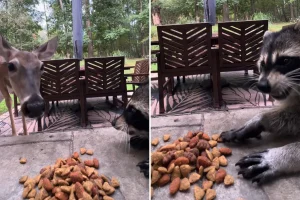


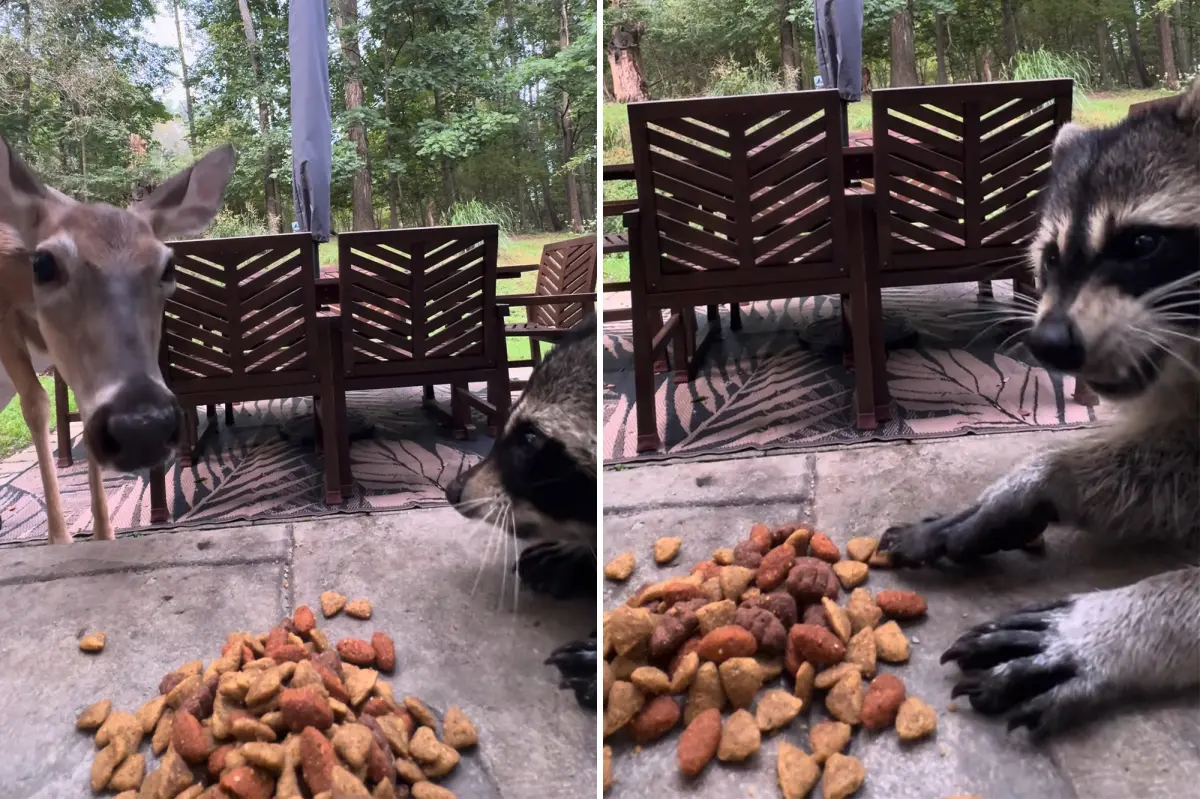
It began like so many quiet suburban evenings do—the soft hum of a house settling, the last glow of daylight fading over a Pennsylvania neighborhood, and a woman going about her business in the warmth of her own kitchen. Jenny Macbeth wasn’t expecting company. She certainly wasn’t expecting the kind of company that would soon have the internet laughing, gasping, and nodding in recognition. But then came the sound: a scratch at the back door. Not the polite, tentative scratch of a stray cat looking for shelter, nor the deliberate knock of a neighbor stopping by. This was the insistent, rhythmic scratching of a creature that had learned exactly how to get what it wanted. When Jenny turned to look, she found herself face-to-face with a wide-eyed raccoon, standing upright on its hind legs, its tiny front paws spread open in a gesture so universally pleading that it might as well have been holding a little sign. It looked less like a wild animal and more like a child who had just dropped a cookie and was hoping someone would offer another. The raccoon’s bright, glassy eyes seemed to say everything: I’m hungry, I’m tired, and I know you have something good in there. It was impossible to ignore, impossible to scold, and impossible not to feel a small tug of compassion. In that moment, the line between human and wild animal blurred, and Jenny did what any softhearted person might do—she decided to help.
Her first instinct was not to shoo the creature away or to close the blinds and pretend she hadn’t seen it. Instead, Jenny found herself reaching for a bag of kibble, the kind of food she probably kept for her own pets or for the occasional visiting animal. She filled a bowl, opened the back door just enough to set it outside, and stepped back to watch. The raccoon’s reaction was immediate and deeply satisfying. It dropped its theatrical begging pose and dove into the food with the kind of pure, unselfconscious joy that adults rarely get to express. There was something almost meditative about watching the animal eat—the steady crunch of kibble breaking between its teeth, the way its small black paws braced the bowl to keep it from sliding, the occasional glance upward to make sure the food source hadn’t vanished. For a few tranquil moments, the world was simple. The raccoon had food. The human had the pleasure of watching a hungry creature find relief. It was the kind of small, quiet encounter that most people might forget by morning. But then the evening took a turn no one saw coming. Out of the shadows at the edge of the yard came a deer, moving with the cautious, graceful steps of a creature that knows it is always being watched. The deer’s ears swiveled, its nose twitched, and its eyes fixed on the bowl of kibble with unmistakable curiosity. Perhaps it was not truly hungry for kibble, but something about the sight of a small animal eating so contentedly made the deer want a taste of its own. It began to walk slowly toward the scene, head low, body tense, as if asking permission with every step. The raccoon, still chewing, paused. The air changed.
What happened next was a standoff that could have been scripted for television. The deer, seemingly unaware of the danger, kept advancing. It got close enough that its long nose hovered just above the bowl, close enough to smell the dry, meaty scent of the kibble, close enough to think that maybe, just maybe, it could share in the unexpected feast. But the raccoon had other ideas. In an instant, the adorable, wide-eyed beggar transformed. The soft posture stiffened. The gentle, pleading face hardened. The small, open paws that had once reached for sympathy now planted themselves firmly on the ground, ready for battle. This was no longer a cute raccoon asking for a snack; this was a mother protecting her meal, and by extension, her future. The deer must have realized its mistake a split second too late. With a motion faster than anyone could fully process, the raccoon lunged forward and snapped—a sharp, furious, lightning-fast strike aimed directly at the deer’s face. There was no warning, no growl, no hesitation. The deer flinched and leaped backward as if it had been struck, its composure completely shattered. For a moment, it seemed almost offended, as if it couldn’t quite believe that such a small, fluffy creature had dared to challenge it. But the message was clear: this bowl was not up for negotiation. The deer, wisely deciding that a bit of kibble wasn’t worth a fight, turned and trotted back toward the safety of its herd, leaving the raccoon victorious on the battlefield of the backyard.
Jenny Macbeth later explained the behavior with a knowing smile, and her words added a whole new layer of depth to the comical scene. “The animals usually get along well,” she told Storyful, “but this raccoon had a kit late in the season, so she was definitely ‘hangry’ and protective of her food.” That single sentence reframed everything. The fierce, explosive reaction wasn’t just about a raccoon being greedy or territorial. It was about motherhood. This was a mother who had given birth late in the season, who was likely exhausted, who was still nursing or caring for a baby somewhere in the shadows, and who had learned the hard way that food is never guaranteed. Every bite she took was a bite for two. Every meal was a resource to be defended, not for pleasure but for survival. The “hangry” label was both humorous and heartbreakingly true. Hunger has a way of stripping away pretense, and for a wild animal, hunger is not an inconvenience—it’s a constant, gnawing presence. The raccoon’s outburst wasn’t cruelty; it was necessity. She had no way of explaining to the deer that she needed this food more, no way to negotiate or ask for space. All she had was the raw instinct to protect what was hers. And in that moment, the cute little creature with the pleading eyes became something else entirely: a warrior, a provider, a survivor. It was a reminder that every animal we see, no matter how adorable, carries the weight of its own struggles.
Once the deer had retreated to the edge of the yard and the immediate threat was gone, the raccoon’s demeanor shifted again, almost as quickly as it had changed before. She turned back to the bowl, lowered her head, and resumed eating with a renewed sense of urgency. The kibble disappeared in a matter of minutes, every last piece accounted for. But the meal wasn’t over. Jenny, perhaps feeling that the raccoon had earned a reward for successfully defending her dinner, had another treat waiting: a small bowl of green grapes. The raccoon approached these with the same cautious intensity, sniffing them carefully before biting into one. The contrast was almost comical. Moments earlier, she had been a fierce predator, snapping at a deer many times her size. Now she was sitting in the twilight, delicately eating grapes, her tiny paws working with surprising precision, looking for all the world like a guest at a fancy dinner party savoring dessert. The transition from ferocious to gentle was seamless, and it captured something deeply true about wild animals: they are not simply one thing. They can be soft and fierce, playful and deadly, desperate and content, all within the span of a few minutes. As she finished her grapes and licked her paws clean, the raccoon seemed to relax for the first time all evening. She had won. She had eaten. She had defended her baby’s future for one more night. Then, with the quiet dignity of a creature that knows its business is done, she slipped away into the darkness, leaving behind only an empty bowl and an unforgettable memory.
The entire encounter, captured on video and shared online, quickly became one of those viral moments that people can’t help but share with friends. Part of its appeal is pure comedy—a tough-looking deer being scared off by a chubby raccoon is objectively funny. But there is also something deeper at play. The video reminds us that we are not the only ones living complex, demanding, emotionally rich lives. The animals in our backyards have their own stories, their own families, their own battles. They feel hunger and exhaustion, love and fear. They make decisions in fractions of a second, driven by instincts honed over thousands of years. When we watch a video like this, we are not just watching entertainment; we are catching a glimpse of a world that exists alongside ours, often unnoticed. Jenny’s decision to feed the raccoon, and her later explanation of the animal’s behavior, shows a gentle empathy that many of us share. We want to help the creatures that come to our doors. We want to believe that a bowl of kibble can make a difference, and sometimes it can. But we also need to remember that wild animals are not pets or cartoon characters. They are capable of startling ferocity, and their needs are not always simple. The line between cute and dangerous can dissolve in an instant, as that deer learned the hard way. In the end, the raccoon walked away with a full stomach, the deer walked away with its pride slightly wounded, and the rest of us were left with a story that made us laugh, think, and feel a little more connected to the wild world just beyond our doors. It was a tiny, perfect moment—a snack standoff that became a lesson in empathy, boundaries, and the surprising courage of a hungry mother. And somewhere in the Pennsylvania night, a raccoon and her kit were just a little bit safer, thanks to one kind woman who chose to open her heart, and her back door, to a stranger with open paws.