



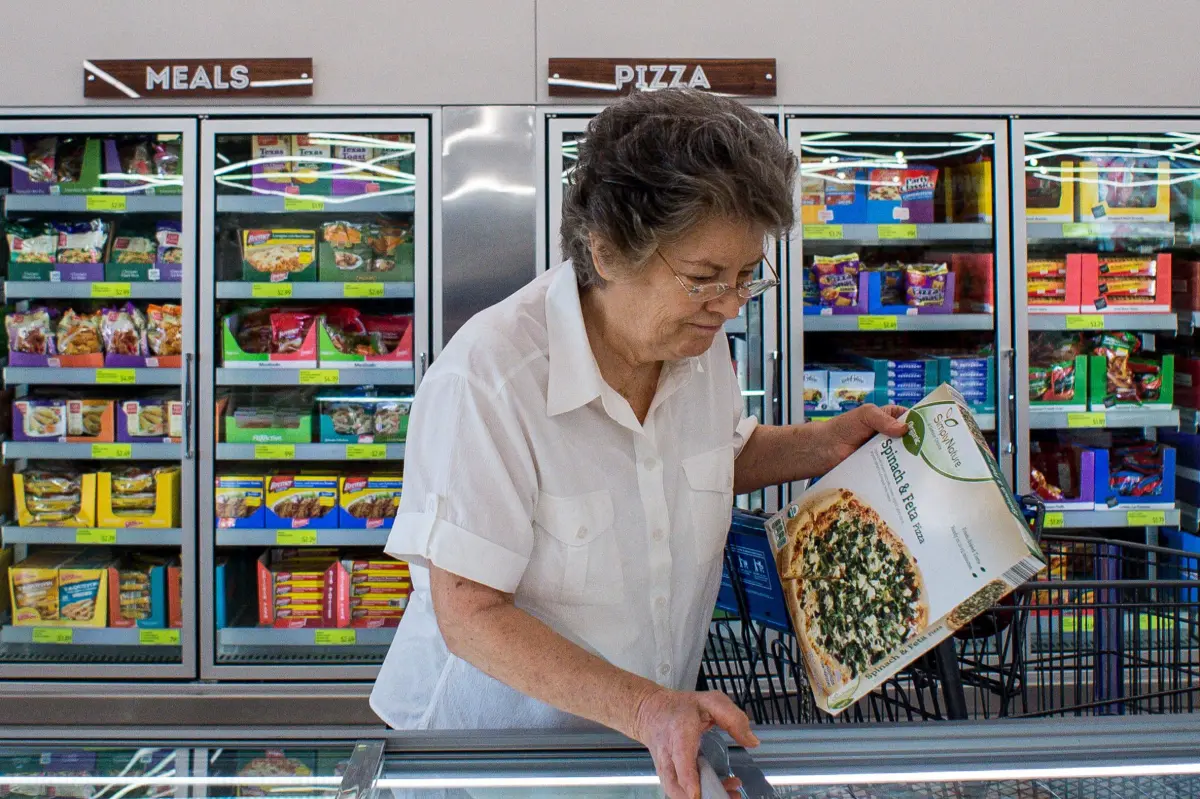
Here’s the thing about grocery shopping: it’s never just about groceries. It’s about time, money, memory, convenience, and the small, quiet rituals we build around feeding ourselves and the people we love. And right now, according to a fresh wave of data from YouGov, those rituals are splitting along generational lines in a way that has made its way all the way down to the frozen food aisle. The study found that California-born Trader Joe’s is the most popular grocery chain among older shoppers—specifically Baby Boomers—with a popularity score of 69%. That doesn’t mean Boomers are loading up their carts there every single week, though. “Popularity,” in this context, simply means the percentage of people who hold a positive opinion of the store. It’s a warm feeling, not necessarily a weekly commitment. But that warm feeling matters. It says something about how Boomers experience the brands they trust, and it says something about what they expect when they walk through the sliding glass doors of a supermarket. Meanwhile, Millennials are apparently more smitten with Aldi, the no-frills, wallet-friendly German chain that has become a modern favorite for younger shoppers. In the same analysis, Aldi scored a 70% popularity rating among Millennials. So while the generations may not agree on much these days, they definitely don’t agree on where to buy their frozen peas.
Let’s dig into the numbers, because they tell a story that’s more nuanced than a simple generational showdown. Aldi came out on top overall, with a popularity score of 65% among all adults. That’s a meaningful victory in a category crowded with familiar names, discount retailers, and regional darlings. Right behind Aldi was 7-Eleven, the convenience store behemoth that somehow manages to feel like a grocery store when you need a gallon of milk at midnight, scoring 63%. Trader Joe’s rounded out the top three overall at 60%. But the generational splits are where things get interesting. Among Generation X, Aldi absolutely dominated, with a popularity score of 77%. That’s a remarkable number, especially in an era when no brand can seem to please everyone. Millennials, meanwhile, gave Aldi a 70% score, while Boomers gave Trader Joe’s their highest marks at 69%. What makes this data so fascinating is that these scores don’t necessarily reflect where people actually shop most often. You can love a store for its vibe, its employees, its samples, or its unbeatable prices, but still do your weekly grocery run somewhere else out of habit, proximity, or necessity. YouGov’s popularity score is essentially a measure of affection, not action. And affection, as any marketer will tell you, is a much harder thing to win than a transaction. It’s built on experiences, memories, and subtle cultural cues that make you feel like a store “gets” you.
So why do Boomers love Trader Joe’s so much? The YouGov analysis doesn’t offer a specific reason, but anyone who has spent time in a Trader Joe’s can probably guess. The chain is famous for its remarkably friendly staff—so much so that there’s a long-standing rumor, half-joked about for years, that employees are trained to flirt with shoppers. That rumor has never been officially confirmed, of course, but the warmth is real. There’s no self-checkout lane, no giant wall of machines beeping at you, and almost no computers cluttering the experience. “It’s a place where actual human people are happy to help you, there’s no self-checkout, and almost no computers anywhere. Very old fashioned,” one Redditor wrote about the chain recently. The same commenter added something that feels like the perfect summary: “It’s a youthful vibe with a lot of trendy products that appeal to the influencers, but it’s super welcoming to the older crowd who like to shop the old fashioned way.” That’s a rare magic trick. Trader Joe’s has managed to be both trendy and nostalgic, high-energy and laid-back, crowded but somehow cozy. The stores are also notably smaller than the sprawling big-box supermarkets that dominate American suburbs. You can get in, find what you need, chat with a crew member about whether the new garlic sauce is worth trying, and get out before you feel overwhelmed. For older shoppers who grew up in an era when grocery shopping was a social, personal experience—when the butcher knew your name and the cashier asked about your weekend—Trader Joe’s feels like a time machine.
But what about Aldi’s appeal to Millennials and Gen Xers? The report doesn’t break down the reasons, but it doesn’t take a market researcher to figure it out. Aldi is the anti-supermarket. It’s lean, efficient, and ruthlessly focused on keeping prices low. You need a quarter to unlock a shopping cart, and you get it back when you return the cart—so there’s no pile of abandoned carts drifting across the parking lot. You bring your own bags, or you buy them at checkout. The selection is curated, not overwhelming. There aren’t forty different kinds of barbecue sauce fighting for your attention; there’s one good one at a great price. For younger generations who came of age during economic uncertainty, student loan debt, sky-high rent, and endless price increases, Aldi feels honest in a way that conventional grocery chains don’t. It doesn’t try to seduce you with mood lighting and artisan cheese displays. It says, “Here’s your food, here’s your savings, now go live your life.” And that’s exactly the kind of no-nonsense relationship many Millennials and Gen Xers want. Aldi also makes shopping feel like something of a treasure hunt. Weekly specials rotate quickly, and you never know what obscure seasonal chocolate or interesting snack may appear in the middle aisle. It’s low-key exciting, but without the fanfare. That combination of unpredictability and affordability is a powerful draw. And let’s not forget 7-Eleven’s second-place overall finish. The convenience store chain might not be the first thing you think of when you picture a grocery store, but for a huge number of Americans, it’s the place that saves the day when you run out of eggs, need a coffee, or realize you forgot the ice for a party. That kind of always-there-for-you relationship breeds appreciation, even if it’s not the main destination for a weekly haul.
As if to prove that Trader Joe’s isn’t resting on its laurels, the company is doubling down on its home territory. California—the state where Trader Joe’s first found its footing and built its cult-like following—is getting several new locations in the near future. According to the company’s website, hungry and hopeful fans will soon have more chances to stock up on everything from Mandarin orange chicken to Everything But The Bagel seasoning. The planned store in Clairemont, a neighborhood in San Diego, will be located at 3962 Clairemont Mesa Boulevard. Another is set for Leucadia, the beachy Encinitas community, at 1590 Leucadia Boulevard. And in the Central Valley, near Modesto, a new Riverbank location is planned for 2135 Claribel Road. Opening dates haven’t been announced yet, which means the speculation and anticipation are already building. In late July, the chain also opened a new store in Paso Robles at 2457 Golden Hill Road, bringing its signature combination of friendly staff, quirky private-label treats, and surprisingly good wine to a community that has likely been waiting with bated breath. When a new Trader Joe’s opens in California, it’s not just a store opening. It’s an event. Parking lots fill up. People post photos of their haul on social media. Neighborhood Facebook groups light up with tips about the best time to visit. Local news outlets show up. All of that enthusiasm is a reminder that Trader Joe’s has become more than a grocery store; it’s a cultural touchstone, especially in the Golden State, where the brand was born and where it remains a fixture of everyday life.
In the end, this YouGov report is less about winning and losing and more about the different ways generations define value. For Baby Boomers, Trader Joe’s offers something increasingly rare in modern retail: human connection. The friendly crew members, the lack of self-checkout, the smaller stores, the sense that someone is actually paying attention to you—these are not small things. In a world that feels more automated and impersonal every year, that old-fashioned warmth is worth something, and it’s clearly being noticed. For Millennials and Gen Xers, Aldi offers something equally important: control. Control over your budget, control over your time, control over the noise and clutter that fills so much of modern life. Both stores have figured out how to stand out in a brutally competitive industry, and both are being rewarded with genuine affection. And maybe the best part of all is that you don’t have to pick a side. You can love Trader Joe’s on a Sunday afternoon when you want to browse and chat, and you can love Aldi on a Tuesday night when you need to get in and out with a cart full of groceries for less than fifty dollars. The frozen aisle may be divided, but the real takeaway is that there’s no wrong answer. The best grocery store is the one that makes your life a little easier, your dinner a little better, and your day a little brighter—whether that’s a Hawaiian shirt and a free sample or a quarter-deposit cart and a spectacularly low checkout total.