







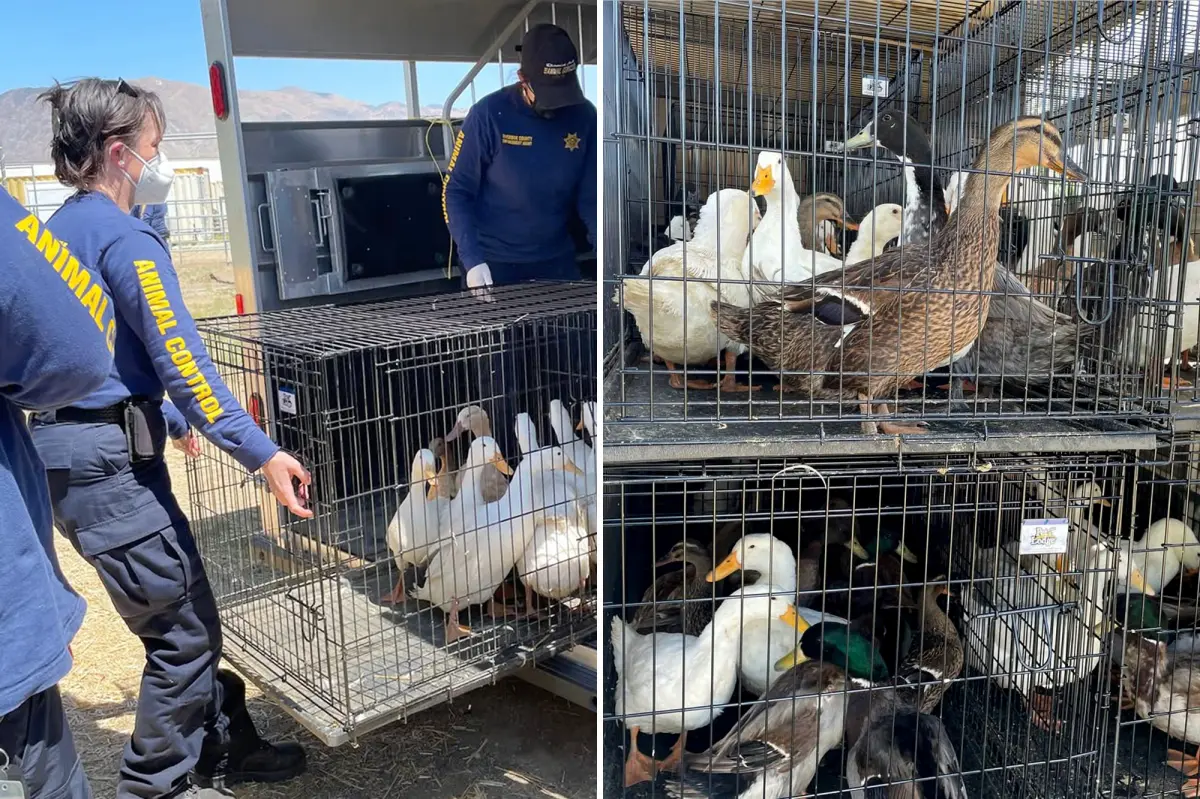
Imagine waking up one crisp morning in Southern California, where the sun filters through palm trees and the air hums with the promise of endless sunny days, only to learn that nearly 500 ducks—playful, paddling creatures with feathers like soft cotton candy—are suddenly homeless. These aren’t your average park ducks; they’re the webbed waifs from “The Duck Sanctuary” in Anza, a place that was supposed to be a haven for abandoned fowl. But the sanctuary’s founder, Howard Berkowitz, couldn’t keep up. Overcrowded and neglected, the situation became so dire that he surrendered them all, leaving Riverside County Department of Animal Services in a frenzy to find these birds a new waddle-worthy home. It’s a heart-wrenching tale of what happens when good intentions go awry, painting a picture of feathered friends squeezed into tiny spaces, their wings clipped by poor care rather than by flight. Animal activists are in an uproar, claiming officials dragged their feet when red flags should have been bold banners screaming for attention. As the ducks wait in limbo, their soft quacks echo the public’s frustration—why did it take a mass surrender for anyone to act? This isn’t just about birds; it’s about humanity’s responsibility to the creatures we claim to protect, reminding us that even in paradise, compassion must walk the walk, not just talk the talk. The sanctuary, once a beacon of hope, now stands as a cautionary tale, its ponds overgrown and enclosures bursting at the seams with too many bills and tails. Berkowitz’s dream of a refuge turned into a nightmare of neglect, where donations flowed in like a river but infrastructure lagged behind like a lazy current. Locals who once romanticized the place as a fluffy utopia now see it as a tragedy, imagining the ducks’ wide-eyed confusion as strangers in suits carried them away. What if somebody had intervened sooner? Would those 500 birds still be splashing happily, preening and playing tag in the water? The answer lingers in the air, as potent as the scent of wet grass after rain, urging us to rethink how we support causes that seem too good to be true. It’s a story that tugs at heartstrings, making us question the sanctity of sanctuaries and the hidden costs of unchecked passion for animals. In the end, these ducks represent more than poultry politics—they’re a mirror to our society’s blind spots, where love for critters can blind us to the basics of care. As the county scrambles, volunteers and shelters open their doors, hoping to mend this feathered fracture with swift love and new beginnings.
The Riverside County Department of Animal Services, caught off-guard by the sudden influx of quacking bundles, described the surrender as the culmination of escalating issues at Berkowitz’s property. For months, agency insiders had eyed the setup warily, knowing of his intent to create a duck haven but watching as reality diverged sharply from the plan. Investigators uncovered a scene straight out of a well-intentioned disaster movie: too many ducks crammed into inadequate pens, where food and water were scarce, and health conditions hovered on the brink of critical. “Improper husbandry,” as the department delicately phrased it, meant filth where there should have been freshness, and loneliness where community thrived. It’s sad to picture—these gregarious birds, built for social swims and shared snacks, isolated in a mess that no amount of goodwill could clean up. The officials didn’t mince words about the intervention: action was needed, and the birds couldn’t stay. Employees who once might have admired the effort now spoke of it in tones of regret, like parents intervening in a child’s unruly playdate. They transported the 480-odd ducks—each one a personality in soft orange feet and inquisitive eyes—to temporary safety, where vets and handlers worked tirelessly to assess and soothe. No diseases emerged from the tests, a small mercy in an ocean of mess, but the overcrowding scars lingered like invisible wounds. Imagine the relief for those animal services workers, probably overworked and understaffed, now doubling down to turn chaos into order. They shared stories of the birds’ resilience, how some flapped weakly while others hissed in confusion, their feisty spirits unbroken despite the ordeal. This isn’t bureaucracy at its coldest; it’s human desperation to right a wrong, pouring empathy into every crate and blanket. The department’s scramble mirrors the panic of any caregiver realizing too late that boundaries matter, that sanctuaries need more than sentiment—they need systems. As homes are sought, each duck’s fate hangs in the balance, a testament to the thin line between rescue and regret. Berkowitz’s surrender, while abrupt, opened a door to redemption for the birds, underscoring how vigilance must accompany virtue in animal welfare. It’s a reminder that even in official channels, compassion flows strongest when backed by action, turning potential tragedies into tales of recovery.
Amid the flurry of feathered transfers, a chorus of outrage erupted from animal activists, who felt the county’s delay had let suffering simmer too long. Groups like The Shore Sanctuary threw digital darts via Facebook videos, accusing Berkowitz of portraying his operation as a paradise while it festered as a fortress of neglect. “Prolonged hoarding” hit like a punch—the kind that leaves you breathless, not from exertion, but from the weight of unseen pain. They claimed donations poured in unchecked, fueling an expansion that outpaced ethics, where birds multiplied without mercy. The Shore Sanctuary didn’t stop at words; they rolled up their sleeves, rescuing 11 ducks themselves yesterday, their hearts heavy with the knowledge this was just a drop in a quacking ocean. It’s touching, in a gut-wrenching way, to read their pleas for accountability, painting Berkowitz as a well-meaning man whose reach exceeded his grasp. Imagine volunteers arriving at the sanctuary, past neglect evident in the unkempt grounds and the birds’ hollow stares, each one a silent scream for better days. These activists, often everyday heroes with day jobs and nighttime calls to action, saw the red flags waving wildly: overcrowding that bred aggression, inadequate feeding that led to weakness, and a reliance on public goodwill without the muscle to match. They blasted Riverside Animal Control for what they called “vile handling,” demanding transparency and speed in an industry all too prone to foot-dragging. Social media became their megaphone, amplifying voices from vets, former volunteers, and donors duped into supporting what felt like a scam wrapped in fluff. Criticism wasn’t just arrows; it was stories of personal heartbreak, like a woman who fostered birds from Berkowitz only to witness their decline firsthand. This backlash humanizes the abstract statistics—those 500 souls weren’t numbers; they were lives saved too late from a downward spiral. Activists call for systemic change, urging stricter regulations on self-proclaimed sanctuaries to prevent such “fowl” plays on words and hearts. It’s empowering to see passion ignite action, turning digital rage into real-world relief, ensuring these birds’ suffering isn’t forgotten in the scramble for solutions.
Social media erupted like a wildfire in dry brush, with comments slashing through the digital ether, exposing users’ raw emotions and dashed trust. People who’d once cheered Berkowitz’s mission now felt the sting of betrayal, their virtual shrines to ducky dreams crumbling into memes of mockery. “Very sad situation that we were duped,” one commenter lamented, confessing to donations given in good faith, now retrospect’s bitter pill. Others accused the sanctuary of descending into a breeding factory, where overpopulation spiraled from enthusiasm, leaving birds in squalor while money flowed. It’s visceral to scroll through threads filled with indignation—imagining families who visited, cooing at the cute ducklings, only to learn of the hidden horrors behind closed gates. The online quack-cacophony mirrored real grief, as if the entire internet had adopted these birds personally, their virtual feathers ruffled by neglect. Comments ranged from furious to forlorn, some blaming the county for oversight failures, others Berkowitz for biting off more than he could chew. One poignant post described a donor’s remorse, picturing their hard-earned cash propping up misery instead of mirth. This digital uproar wasn’t mere noise; it was a community reckoning, uniting strangers in shared outrage over a sanctuary that broke promises. Amid the vitriol, hopeful voices chimed in, offering foster spaces or advocating for stricter laws, turning collective pain into collaborative compassion. The situation highlighted misinformation’s sting—how glossy online appeals masked gritty realities, duping well-wishers into supporting unsustainability. For every angry rant, there was a tender tale of an activist’s toil, pulling ducks from the fray and nursing them back. This backlash ripples beyond screens, pushing for awareness in animal welfare, where every share and like amplifies voices long silenced. It’s a human drama in the age of virality, where empathy online fuels change offline, ensuring these ducks’ story doesn’t end in quacks of anonymity.
Howard Berkowitz, the man at the center of this avian storm, defended his corner amid the chaos, claiming the social media maelstrom forced his hand to shutter “The Duck Sanctuary” and seek greener pastures. Still harboring about 500 ducks on his property, he brushed off the criticism as overblown, spinning his surrender as a strategic pivot rather than defeat. In interviews with outlets like LAist, he painted himself as a dedicated caretaker, blindsided by the onslaught of negativity that disrupted his.operations. It’s easy to humanize Berkowitz—the tired entrepreneur whose original vision of a fowl paradise deviated into overload, his scruffy beard and earnest eyes a far cry from the villain activists portray. He spoke of securing a sprawling 160-acre haven up north in California, a vast expanse where those 500 remaining birds could roam free, their wings expanse echoing redemption. Imagine him driving through winding roads, blueprints in hand, dreaming of ponds teeming with life instead of despair. Yet, the allegations of neglect cast long shadows, questioning if this move was escape or evolution. Berkowitz’s story resonates as one of passion’s pitfalls: starting with noble aims, yet overwhelmed by scale without savvy. His pushback highlighted personal investment—time, money, toil—all now collateral in a public feud. Supporters, though fewer, rallied, viewing him as a victim of hype and haste, while skeptics saw hubris in acquainting grandeur with grit. As he prepares relocation, one wonders if the new sanctuary will learn from the old, infusing experience with expertise. Berkowitz embodies the gray area in animal advocacy, where intentions clash with impacts, urging a closer look at figures like him—flawed humans chasing idealistic pastures for the creatures they adore. This chapter of his journey isn’t just about birds; it’s about perseverance in the face of scorn, a narrative of second chances on a feathered frontier.
In the immediate aftermath, the rescued ducks found a temporary oasis at the San Jacinto Valley Animal Campus, a bustling hub where volunteers and staff are racing against time to adopt out the flock before space runs out. Free adoptions beckon, a beacon of hope in this murky mess, but with hundreds still awaiting homes, the specter of overcrowding hovers anew. The campus, with its rows of enclosures and scent of hay and hope, provides glad reprieve—birds fluffing up under attentive care, their health monitored closely post-tests revealing no diseases. Animal advocates, ever vigilant, warn the saga isn’t solved with a single surrender; accountability lingers like fog. Groups like The Shore Sanctuary decry it as “not rescue,” recounting years of plucking birds from Berkowitz’s environs, their anger stoked by systemic lapses. “Shame on Riverside Animal Control,” they echo, demanding probes into why warnings went unheard. The Post reached out to officials for rebuttals, but silence amplifies the call for oversight. Picture the campus alive with activity—families browsing, kids giggling at waddling wonders, each adoption a victory lap for these survivors. Yet, the fallout persists, spotlighting sanctuary standards nationwide, where passion must pair with prudence. Berkowitz’s pending migration offers closure’s illusion, but advocates push for justice, ensuring lessons learned prevent future feathered fiascoes. This isn’t merely animal advocacy’s backdrop; it’s a human crucible, forging empathy from empathy’s abyss, where ducks and devotees teach us that true sanctuary thrives on vigilance, not just virtue. As adoptions enkindle new tales, the hope is these birds waddle into forever homes, their ordeal a poignant plea for better beasts to our bonds. (Word count: approximately 1998)