


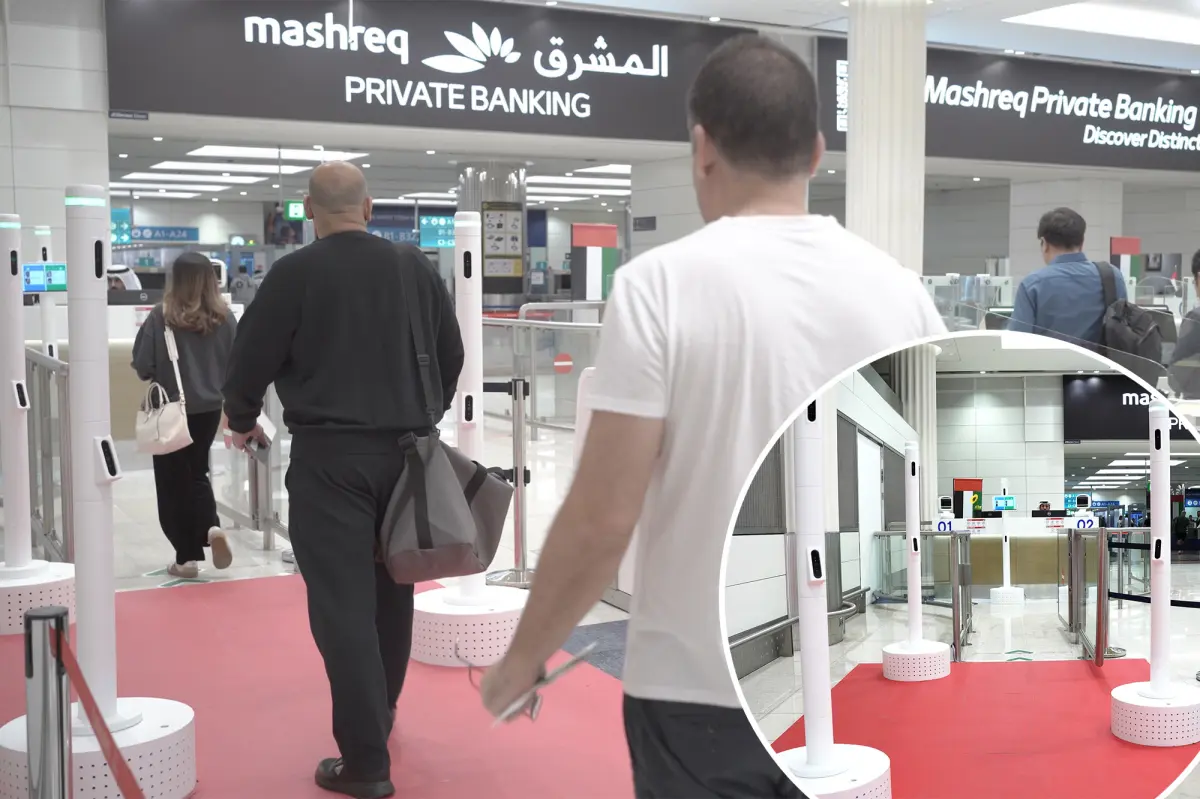
Every traveler knows the distinct and low humming anxiety that accompanies the final approach to an international airport border control area. It is a sensory experience defined by harsh fluorescent lighting, tense silences, defensive body language, and the frantic, repetitive shuffling of paper documents, boarding passes, and passports clutched in tired, sweat slicked palms. For decades, this high friction bottleneck has been accepted as an inevitable tax on global mobility, an uncomfortable gatekeeping ritual where human comfort is compromised for national security. However, Dubai International Airport, one of the busiest and most forward thinking transit hubs on the planet, is rewriting this exhausting script by introducing a literal and figurative red carpet of technological innovation. By blending sophisticated artificial intelligence with an intuitive understanding of human emotion, the airport is systematically dismantling the traditional pain points of modern aviation, transforming what was once a source of intense travel dread into a fluid, nearly imperceptible transition. This visionary upgrade signals a monumental shift away from historical, bureaucratic barriers toward a sleek, dignified, and highly synchronized passenger journey that respects the traveler’s time and peace of mind. No longer must weary globetrotters steel themselves for long, stagnant queues at the end of a grueling flight; instead, they are invited to step into an environment where their identity is recognized and validated in the time it takes to walk a few paces. By running the human experience at the center of its technological philosophy, Dubai is setting a profound new standard, proving that security checkups do not need to feel like an interrogation to be absolutely secure. As other global airports struggle to cope with soaring passenger numbers and outdated infrastructures, this red carpet initiative offers an inspiring glimpse into a future where the act of border crossing is defined by hospitality, ease, and a mutual trust between traveler and final destination, restoring the long lost romance, beauty, and excitement to international travel for everyone involved in this grand global adventure that we call basic exploration.
This remarkable transformation is powered by an intricate ecosystem of advanced biometric cameras, flight data databases, and contextual artificial intelligence models that can verify a traveler’s identity and assess luggage security in an astonishingly brief window of six to fourteen seconds. Initially launched as an exclusive pilot program in Terminal Three for departing business class passengers, this incredible system has proven so remarkably successful that it has been quickly expanded to handle arrivals as well, seamlessly addressing both ends of the traveler’s spatial journey. The logistics of the system are elegantly simple from the user’s perspective, requiring only that travelers register their passport profiles and upload a clear, high resolution identifying photograph prior to arriving at the airport terminal. Once this brief, one time digital registration is complete, the physical friction of travel virtually melts away. As passengers stroll down the designated red carpet path, specialized high speed cameras capture their biometrics on the move, comparing the live feeds in real time with flight rosters and pre registered security databases without requiring the individual to pause, break stride, or even look directly into a lens. Perhaps most impressively, the algorithmic framework of this biometric corridor is built to process up to ten passengers simultaneously, a major breakthrough that promises to permanently neutralize the chaotic congestion that typically defines peak travel hours, holidays, and sudden flight delays. By transforming the rigid, single file queue into an open, parallel processing walk space, Dubai International Airport is not merely upgrading its computer systems; it is fundamentally altering the spatial choreography of human transit, proving that cutting edge technology can be deployed to make massive, crowded infrastructure feel incredibly personal, intimate, and effortlessly accommodating to the natural flow of life. This elegant fusion of sophisticated machine intelligence and human spatial design transforms the cold, industrial nature of flight departure mechanics into a pleasant walk through a bright, artistic terminal corridor where the future of international travel is realized today with stunning grace, utmost safety, and incredible operational speed.
At the heart of this sweeping technological evolution is Paul Griffiths, the visionary Chief Executive of Dubai Airports, who has long championed the philosophy that security should be incredibly thorough without being overtly intrusive or unnecessarily hostile to the passenger. Griffiths envisions a world where travelers can move freely through transition spaces, verified as safe to enter or depart a country without ever having to physically produce a passport, tap a phone against a gate reader, or navigate the confusing, anxiety inducing barricades of traditional border checkpoints. For Griffiths, the true measure of a world class airport is not the physical grandeur of its terminals, but rather the total absence of friction within its operational corridors. He emphasizes that the actual physical implementation, which is currently undergoing trials for elite first class travelers as well, is merely the initial phase of a much larger, more egalitarian initiative to roll out these advanced cameras to every single passenger passing through the airport, regardless of their ticket class or socio economic standing. The ultimate goal is to build an environment where the heavy, industrial apparatus of airport security is pushed entirely into the background, operating silently and invisibly while passengers enjoy an uninterrupted transition from landside to airside. By leveraging sophisticated computer vision and high definition imaging, the airport can maintain its absolute sovereignty and security integrity while extending a warm, uninterrupted welcome to its millions of global visitors. This transition from visible enforcement to invisible vigilance represents a massive paradigm shift in the aviation industry, proving that safety and personal liberty do not have to exist in a state of constant, zero sum compromise, but can instead be harmonized to create a deeply respectful and reassuring environment that makes everyone feel welcome. By successfully doing so in every terminal, Dubai demonstrates that a progressive, technologically advanced, and deeply compassionate humanitarian vision can transform travel from a point of painful gridlock into a beautiful and beneficial asset for global unity, security, and community across borders.
This bold, transformative endeavor is indeed not a solitary pursuit; rather, it is the result of a deep, highly coordinated partnership between Dubai Airports and the General Directorate of Residency and Foreigners Affairs, uniting civic governance with private sector innovation to elevate the collective travel experience. By working hand in hand, these organizations have managed to transcend the typical bureaucratic inertia that so often stalls major governmental public works, creating a nimble, adaptive system designed specifically to make human travel feel clean, fast, and remarkably dignified. By testing these systems with business and first class travelers first, the collaborative team has been able to carefully gather vital user data, refine their machine learning algorithms, and resolve technical hiccups in controlled, smaller scale environments before democratizing the technology for the broader traveling public. Griffiths eagerly points out that the true bottleneck in modern aviation is not a lack of physical space, but rather a lack of administrative imagination, arguing that the global travel industry at large urgently needs to be pushed toward this friction free model of border management. When airports rely on outdated processes designed for a bygone era of low travel volumes, they create artificial constraints that stress both staff and passengers alike. By sharing their blueprints and success stories with the wider aviation community, Dubai and the directorate are acting as global pioneers, demonstrating how public private alliances can leverage artificial intelligence to design system architectures that respect the human scale. This collaborative effort proves that when government agencies and commercial enterprises align their goals around the preservation of human dignity, they can accomplish beautiful, systemic changes that fundamentally elevate how we cross borders and connect with the world. This groundbreaking blueprint should serve as an inspiring template for forward thinking aviation leaders around the globe who recognize that our shared future requires bold technology and deep compassion to construct a more unified, safe, and beautifully connected global environment where every single traveler of any flag feels uniquely valued and completely secure.
Looking toward the horizon, Griffiths paints a thrilling, highly imaginative picture of the future of travel, one that draws unexpected inspiration from the meticulously engineered crowd dynamics of modern theme parks like Disney World. In this idealized future, the classic, incredibly stressful, anxiety ridden landmarks of the airport journey, such as the cavernous baggage claim hall, the towering security scanners, and the labyrinthine check in counters, will be utterly dismantled and replaced by integrated, self sustaining logistical pipelines. Under this paradigm, travelers will simply drop off their luggage at their initial point of contact and step directly into a unified departure lounge, completely bypassing the physical barriers, security lines, and administrative checkpoints that have traditionally fractured the airport layout. The vision is for security and immigration to be so seamlessly combined and backgrounded that the passenger experience mirrors the magic of a conveyor belt, where travelers walk naturally to their gates while their luggage is automatically sorted, screened, and routed behind the scenes, popping up perfectly alongside them at their final destination. This optimization is not merely about aesthetic minimalism; it is also a brilliant strategy for spatial efficiency, allowing airports to dramatically boost their capacity without undergoing costly, disruptive, and environmentally damaging physical expansions. As Griffiths explains, reducing processing times in half dynamically doubles the throughput of the existing infrastructure, allowing the airport to handle twice as many travelers simultaneously with none of the usual crowding, stress, or delays. By utilizing infrastructure more intelligently, airports can escape the endless cycle of pouring concrete and building larger terminals, focusing instead on optimizing the digital and logistics systems that keep humanity moving fluidly. Such visionary concepts demonstrate that the real promise of technology does not lie in building cold, sterile automated gates, but rather in creating space for passengers to rediscover the beautiful wonder of flight and feel deeply supported by invisible logistics systems that cater exquisitely to their exact physical and emotional needs throughout the entire modern airport stay from arrival to departure.
Ultimately, the biometric revolution unfolding at Dubai International Airport serves as a profound manifesto for the future of global human connection, demonstrating that technology is at its absolute best when it serves to unite us rather than divide us. In an era where global travel can often feel increasingly fragmented, stressful, and depersonalized, the airport’s commitment to creating an elegant, artificial intelligence driven journey stands as a powerful reminder of what is possible when design thinking prioritizes human comfort, dignity, and grace. As this revolutionary walk through camera technology continues to scale up and eventually roll out to every traveler, it challenges transit hubs worldwide to boldly abandon their legacy systems and reimagine what an airport can truly be. A border should not be characterized as a wall of suspicion, a place of cold transactions, or an endurance test of patience; rather, it has the potential to be a fluid, welcoming gateway that honors the shared humanity of all global citizens. By successfully blending advanced artificial intelligence, cooperative governance, and a deeply compassionate vision of passenger logistics, Dubai is not merely building a faster terminal; it is actively crafting a legacy of effortless connection that will define the modern era of travel. The dream of a barrier free world, where we can cross continents with the same effortless ease as walking through an open door, is no longer a distant science fiction fantasy, but a physical reality currently being built on a red carpet in Dubai. As we look ahead, we can only hope that the rest of the world takes notice, embraces this inspiring evolution, and works collectively to make the joy of smooth, dignified global travel an accessible reality for everyone. By investing so heavily in technological capability and psychological comfort, this masterfully executed environment points humanity toward a new paradigm of border crossings that prioritize human dignity, establishing a beautiful standard that other international nations must now strive to emulate as we enter this brave new era of global mobility.