


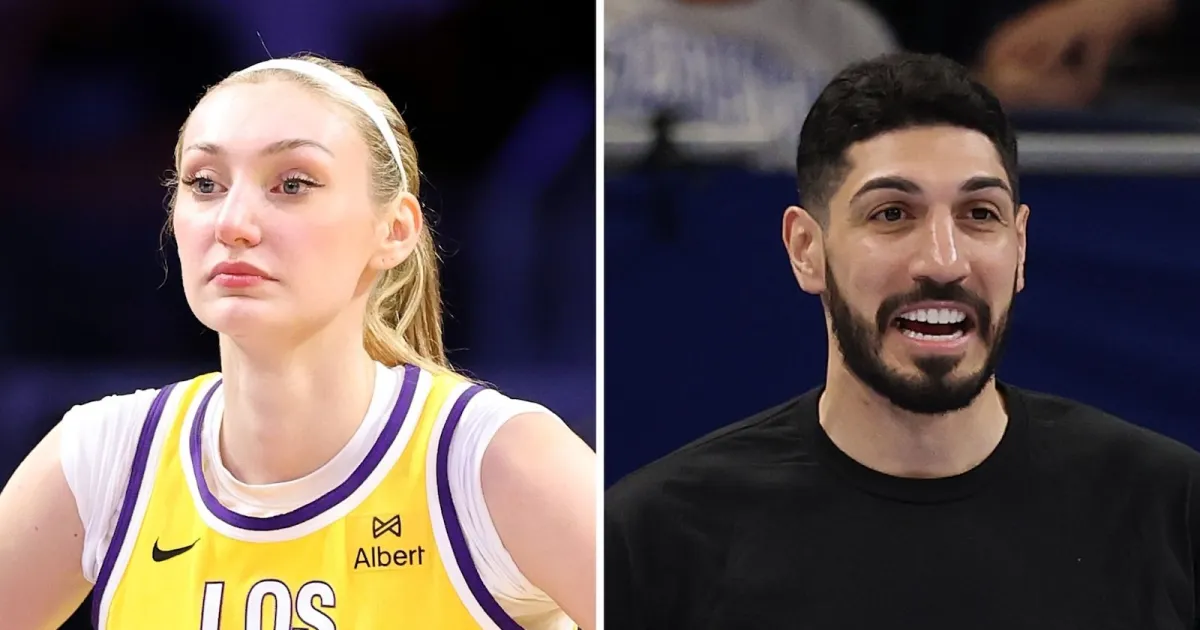
The scene unfolded with an eerie blend of absurdity and tension. It was a late-summer Sunday in Chicago, the kind of night when the arena lights turn everything on the court into a hyper-real drama. But the drama on the hardwood was momentarily hijacked by a figure sitting courtside, a former NBA center named Enes Kanter Freedom. He wasn’t there to scout talent or cheer for the Sky; he was there to make a political point, wearing a shirt that screamed a biological definition of womanhood—a slogan designed to bait, provoke, and capture a viral moment. When he clashed verbally with the Chicago Sky’s Natasha Cloud, the security presence moved in, and the self-appointed crusader was unceremoniously ejected from the building. To many watching, it was a stunt wrapped in a headline grab. To the players on the court, particularly to the young and rising star Cameron Brink of the Los Angeles Sparks, it was something far more vile: an unnecessary, targeted assault on an already vulnerable community, disguised as a defense of women’s sports. The entire incident felt less like a genuine conversation about fairness and more like a theatrical performance orchestrated by a man who, having lost his own NBA platform, was desperate to reclaim the spotlight by any means necessary.
The WNBA’s official response was a masterclass in strategic quietude. Rather than engaging in a war of words with a man who clearly thrives on conflict, the league issued a brief, pointed statement, categorizing Freedom’s actions as “publicity stunts” and declaring that it would not “give oxygen to efforts designed to mock the league or use this topic to demean and marginalize others.” For the league’s executives, this felt like the only sane choice. Engaging with Freedom would legitimize his absurd premise—that he, a man, was somehow the arbiter of who gets to play in a women’s professional league. The league knows its own reality: there are currently no trans athletes on WNBA rosters, nor any towering figures knocking at the door with eligibility questions. The entire controversy was a phantom, a ghost conjured up by clickbait algorithms. Yet, even in their refusal to “give oxygen,” the league found itself forced to respond to a letter from Freedom claiming unfair treatment, threatening legal and procedural questions about why he was removed. The league’s private sentiment, whispered among insiders, was one of pure exhaustion. They were tired of being used as an ideological battleground for a culture war that had little to do with the actual game, tired of having to defend their existence against men who had never played an ounce of women’s basketball, and tired of the constant need to translate their humanity into press releases.
Nowhere was that exhaustion more viscerally expressed than in Cameron Brink’s furious retort. In an interview with The Mirror, the 24-year-old Sparks forward didn’t mince words, delivering a profanity-laced dismissal of Freedom that perfectly encapsulated the generational shift in how younger athletes view these controversies. “I don’t even know what the f his name is,” she spat, before calling him a “stupid piece of s” and accusing him of clinging to relevance. Brink’s anger wasn’t just personal irritation; it was a calculated rejection of a man she views as a manipulator. She articulated a clear, compassionate stance on the underlying issue, arguing that the trans debate in sports is a “nonissue” being weaponized to target a marginalized community. She sees through the cynical machinations—the deliberate use of high-visibility platforms to generate views, likes, and clicks at the expense of trans individuals who simply want to live their lives. For Brink, and likely for many of her peers, Freedom’s shirt wasn’t a statement of biological fact; it was a dog whistle, a way to introduce hatred into a space that should be solely about athletic excellence. Her willingness to say what she feels, without the diplomatic hedging often expected of professional athletes, highlights a growing disconnect between older, politically rigid generations and a younger cohort that prioritizes inclusivity and sees through transparent attempts at provocation.
The larger context of this controversy requires a deep breath and a step back from the noise. The debate over trans athletes in sports is undeniably complex, touching on biology, fairness, and identity. But the specific reality of the WNBA is that this is a hypothetical battle. There is no trans player in the league, no trans player dominating college basketball with sights set on a WNBA contract, and no imminent policy change on the table. The WNBA’s collective bargaining agreement states that “only players who are women are eligible to play,” yet it deliberately fails to define the parameters of that term, leaving room for interpretation and, in the league’s view, for future conversations when—and if—they become necessary. What Freedom did was jump the gun, manufacturing a crisis that doesn’t exist to justify his own platform. He ignored the actual, real-world issues affecting women’s sports—the persistent pay disparity, the lack of media coverage, the constant fight for adequate facilities and marketing—in favor of a symbolic gesture that targets the most vulnerable members of the community. This is the human tragedy of the event: while real women were playing intense, physical, and beautiful basketball, their arena was invaded by a man who wanted to lecture them about what it means to be a woman, completely overshadowing their athletic achievement to scream into the algorithmic void.
Critics of Freedom are also quick to point out the irony of his self-appointed role as a savior of women’s sports. Freedom has a long history as a political agitator, often with legitimate causes regarding human rights in his native Turkey, but his methods have frequently veered into the theatrical and confrontational. By demanding to be drafted into the WNBA—a league with no history of drafting cisgender male athletes—he effectively mocked the very institution he claimed to protect. And his subsequent letter, arguing that his treatment was unfair and questioning whether his viewpoint played a role in his ejection, is a classic tactic of the persecution narrative: cast yourself as the victim, frame your disproportionate anger as a quest for justice, and demand institutional accountability for your own provocative actions. The WNBA players, women like Natasha Cloud who have faced real discrimination, real pay cuts, and real struggles for recognition, are not fooled. They see Freedom’s advocacy for what it is—a parasitic relationship with women’s sports, where he uses their platform to amplify his personal brand while offering nothing of substance in return. His letter represents the exhausting entitlement of someone who believes his voice is more important than the voices of the female athletes he claims to champion.
Ultimately, the dust settles on a path forward that is less about transgender policy and more about media literacy and resilience. The WNBA has continued on, playing its games, breaking viewership records, and solidifying its status as the most exciting product in American basketball, refusing to allow a single man in a provocative t-shirt to dictate their narrative. The league’s decision to review its eligibility rules quietly, behind closed doors, is a responsible stopgap, but the public stance against manufactured controversy is a defense of a broader principle: that sports should be a sanctuary from the daily political pettiness that plagues our feeds. For Cameron Brink and her peers, the lesson is to continue speaking out, to defend their communities against opportunistic attacks, and to challenge the false equivalence that a man’s opinion weighs as heavily as the lived experience of the athletes on the floor. The human story here is one of resilience against cynicism—a group of professional women, working harder than ever, who are forced to constantly deflect the bizarre attempts of external figures to center themselves in a conversation they know nothing about. In the end, Freedom might have gotten his name in the headlines, but he failed to change the game. The players remain, the sport remains, and the community remains stronger than the cheap, transactional stunt that tried to tear it down.