

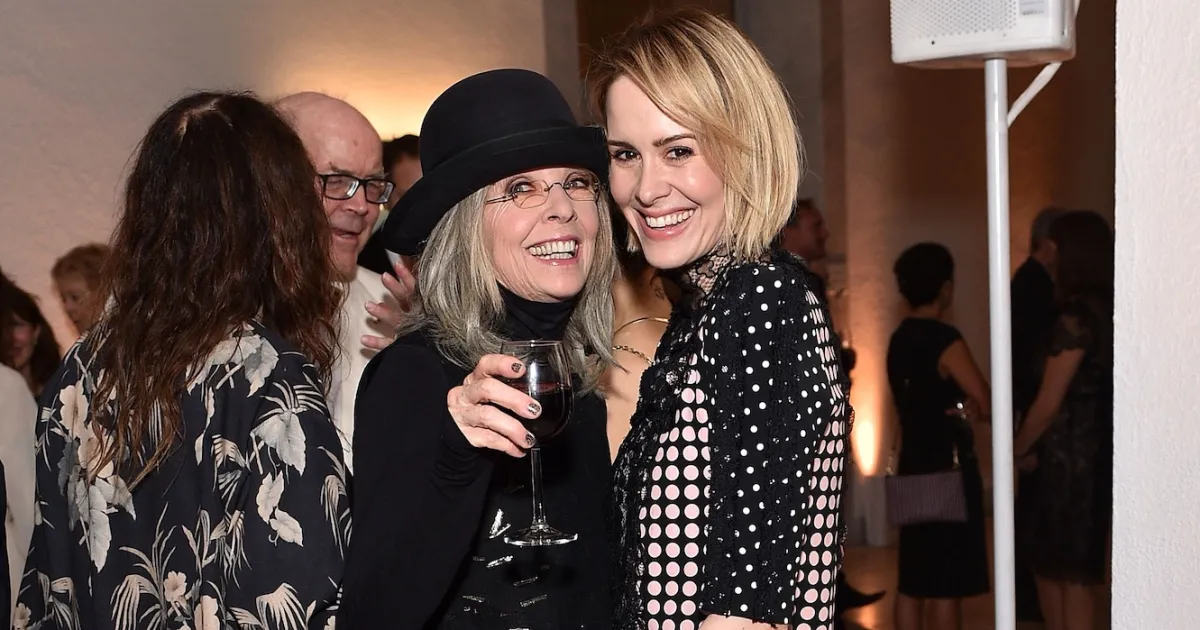
A year has passed, and for Sarah Paulson, the ache remains as present as the memory of a shared laugh. On Sunday, October 11, the Emmy-winning actress marked the first anniversary of Diane Keaton’s death with a tender Instagram tribute, one that said more in its brevity than a thousand words could. “One year. Impossible. Laughing with you will always be what I remember most,” Paulson, 51, wrote. “I love you.” The post was accompanied by a snapshot of the two women mid-laughter, hands raised above their heads, caught in one of those unguarded moments that only true friendship can produce. For Paulson, that image seemed to sum up everything Keaton meant to her: not the iconic filmography, the awards, or the singular on-screen presence, but the private joy, the silliness, the comfort of being with someone who made you laugh until you forgot the world. In the year since Keaton’s unexpected passing, Paulson has kept her friend close in ways both quiet and lasting. But this first anniversary was a moment to stop and let the world see that grief is not something you move through in a straight line. It circles back, especially on days when you are reminded that someone is no longer a phone call away. “I love you”—two small words, offered publicly, but with all the weight of a bond that had been built over years. The comment section filled with fans and fellow artists sharing their own Keaton memories, but Paulson’s tribute felt intentionally intimate, as if she were speaking not to the public but to Keaton herself. Sometimes the most human response to loss is simply to say out loud that you still love the person, and that you still miss the sound of their laughter. There is no way to make a year without someone feel real, especially when that person once filled rooms with so much warmth and mischief. And yet Paulson chose to meet the impossible with grace, honoring not the tragedy of the loss but the gift of having been there at all.
For Keaton’s daughter, Dexter, the first anniversary brought a different kind of sorrow, one written in the language of a child who still reaches for her mother’s hand. Dexter shared her own black-and-white photograph of the mother-daughter duo, a picture that seemed to hold an entire lifetime in its frame. “One year without you, mom 🤍,” she wrote. “It somehow feels like yesterday and forever ago all at once. I’m still trying to get used to a world where I can’t call you, have you there for a hug, or go on adventures with you.” Her words were simple, but they carried the weight of a grief that cannot be hurried or explained. She continued, “It’s the everyday moments that remind me just how much I wish you were still here. I love you and I miss you. Always. 🤍.” There is something about losing a mother that changes the texture of ordinary life. A phone call that will never come, a hug that will never arrive, an adventure that will remain just a memory. Dexter named that reality with heartbreaking clarity. In her tribute, she did not try to soften the truth or offer easy comfort. Instead, she let herself feel the contradiction of time itself: how one year can feel like both a lifetime and a single breath. The photo she chose was black-and-white, timeless, a memory made permanent. It showed the two of them together, just being themselves, and that was enough. Keaton was also the mother of a son, Duke, but on this anniversary it was Dexter who spoke for the family, giving voice to a love that still reaches forward into a world without her mother. Her words reminded everyone that grief is not something you get over; it is something you learn to carry. And sometimes, the kindest thing you can do is admit that you are still getting used to it.
The news of Keaton’s death had come suddenly and shockingly in October 2025, when it was reported that she had died after suffering a bacterial pneumonia infection at age 79. For those who had grown up watching her on screen, the loss felt like the end of an era. But for the friends who knew her best, the loss was far more personal. In the days immediately following Keaton’s death, Paulson tried to put words to what she was feeling, but grief is rarely articulate. Speaking at the premiere of All’s Fair, she described the moment as a “profoundly sad time.” She told The Hollywood Reporter, “I can’t talk about it in any way that’s articulate other than to say that for all you knew and loved about her as a performer, she was even more as a friend.” There was a rawness in that admission, a refusal to perform sadness for the cameras. Paulson was not trying to give a polished statement; she was simply a heartbroken friend trying to survive a press event while the world was missing someone she loved. Her honesty resonated deeply because it acknowledged something true about grief: that language often fails us when we need it most. Keaton was, of course, a legend—someone who had shaped American comedy and drama in ways too vast to measure. But in the private rooms of friendship, all of that fame fell away. What remained was a woman who showed up, who listened, who shared French fries and long conversations and moments of uncontrollable laughter. Paulson’s early grief was not about losing an icon. It was about losing a person she loved. And that is perhaps the most human response of all—to grieve not the public figure, but the friend who was yours alone, even while the whole world mourned.
As the first anniversary approached, Paulson had already found another way to keep Keaton close. On what would have been the late actress’s 80th birthday, January 5, Paulson honored her with a deeply personal post and a lasting tribute: a tattoo on her arm. “You would have been 80 today,” Paulson wrote on Instagram. “Too many deep feelings to put here … I was the luckiest person in the world to have traveled, laughed so hard we cried, watched a million and one movies, really cried, and eaten French fries with you. You. You. Wondrous, singular, YOU. I will miss you till the end of time.” The post was accompanied by a silhouette photo of Keaton and another image showing the tattoo itself, the initials “DK” inked on Paulson’s skin. It was a quiet, permanent gesture, the kind of thing you do when words are not enough. In the caption, Paulson added, “Thank you @winterstone for my forever reminder, of one of my forever people.” There is something almost sacred about memorial ink. It is a way of saying that the person you loved is still with you, not just in memory but in the physical world, in the body, in every glance at your own skin. Paulson chose to carry Diane Keaton with her in the most literal way possible. The tattoo was not flashy or performative. It was intimate and meaningful, a small mark for a woman who left an enormous imprint. And in her birthday tribute, Paulson revealed the texture of their friendship: travel, laughter, movies, tears, French fries. It was a list of small pleasures that added up to a beautiful life shared between two people. She called Keaton “wondrous, singular, YOU,” as if no other word could hold her. In a world that often rushes toward the next thing, Paulson stopped to remember, to honor, and to carry her friend forward.
The tattoo artist behind the memorial ink, known as @winterstone on Instagram, also shared a moment from the experience, giving fans a glimpse of the tenderness of that day. “@mssarahcatharinepaulson you are an incredible friend! What you did for your people in time of heavy grief was just Amazing! Happy I got to share that moment with you! Sending love!” the artist wrote. Alongside the message, a video appeared with the words, “Rest easy DK! And happy heavenly birthday! Sending love to all her people!” It was a small glimpse behind the curtain of celebrity, showing that even in moments of deep loss, there is room for care, for shared silence, for the presence of someone who understands what it means to create something lasting in honor of a loved one. The tattoo session was not just an appointment; it was a ritual. Paulson sat for the ink while grieving the woman who had meant so much to her, and the artist was clearly moved by the experience. Her words spoke to what so many people feel when they witness grief up close: admiration for the way someone carries their love into action. Paulson did not retreat into private sorrow. She turned her pain into a visible mark of devotion, a way of saying that even death could not end the friendship. The artist’s message also sent love to “all her people,” acknowledging that grief is shared, that Keaton’s children, friends, and fans were all part of a community bound by loss. In that one small interaction, there was a sense of collective mourning and collective love. The tattoo became a symbol not just of Paulson’s bond with Keaton, but of the way we all try to hold onto the people we have lost.
In the end, the first anniversary of Diane Keaton’s death is not just a date on a calendar. It is a moment of collective remembrance, a chance to reflect on what she gave us and what she meant to the people who loved her. Sarah Paulson’s tributes, first on the anniversary and earlier on Keaton’s birthday, paint a portrait of a friendship that was rich, playful, and deeply human. There were no grand proclamations, no exaggerated gestures. Instead, there were memories of laughter, travel, late-night movies, and the simple comfort of being known. That is what makes grief so complicated: we lose not just a person, but all the small moments we would have had with them. We lose the phone calls, the hugs, the spontaneity of adventure. Dexter’s tribute spoke to that, and so did Paulson’s. For everyone who loved Diane Keaton, the loss remains present. But so does the love. Keaton was a mother, a friend, an icon, a woman who made us laugh and cry and feel less alone in the world. And though she is gone, the marks she left remain—not only in the films she made, but in the tattoo on Paulson’s arm, in the memories her children carry, and in the hearts of everyone who ever felt a little brighter because of her. Grief, after a year, does not disappear. It softens, it changes shape, it becomes something you carry quietly. But the love stays loud. And on this anniversary, that love was the thing that spoke the loudest of all.