





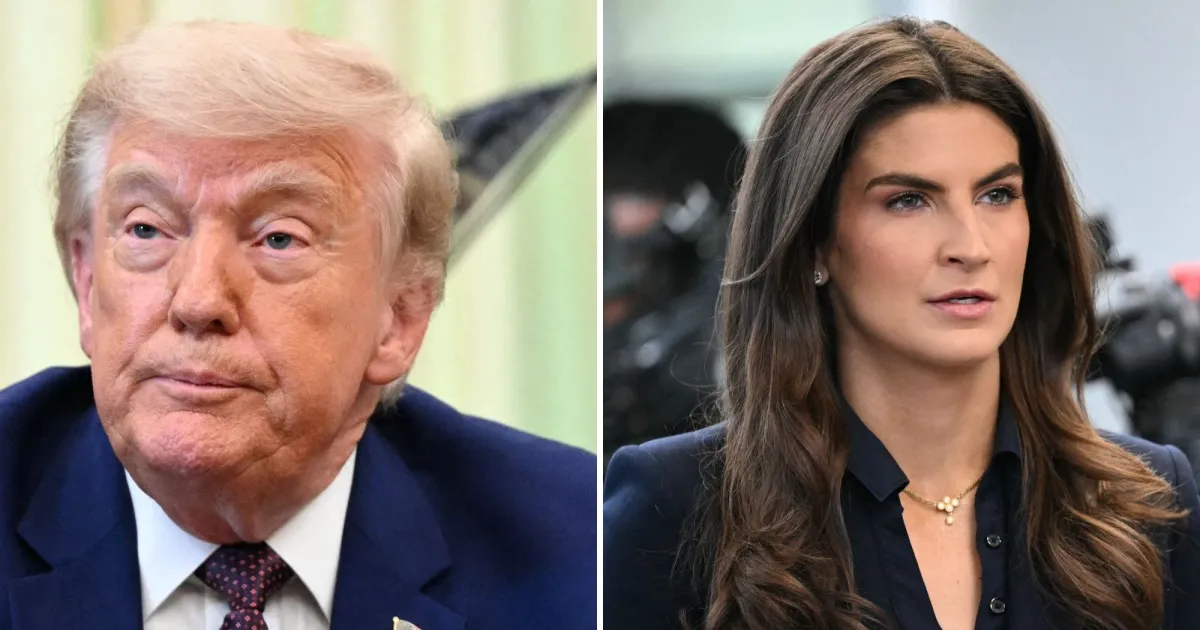
The air inside the historic, secure walls of the Oval Office has long been known to crackle with policy debates and political tension, but during a press briefing on Wednesday, June 3, the atmosphere shifted from standard diplomatic exchange to a deeply personal and televised confrontation. President Donald Trump, at 79 years old, seized the platform not merely to outline his administrative agenda, but to launch a highly directed, public offensive against CNN’s chief White House correspondent, Kaitlan Collins. Standing amidst a crowded press pool, the 34-year-old journalist suddenly found herself transformed from an observer of history into the primary target of executive frustration, as Trump openly attacked her network as a “very corrupt organization” before zeroing in on her personal demeanor. Pointing across the esteemed room directly at Collins, Trump delivered a highly unusual critique of her professional poise, famously describing her as a “corrupt reporter” who “never smiles.” In a performance that blurred the lines between official state business and personal grievance, Trump went on to remark on her physical appearance, calling her a “young beautiful woman” who, in his view, consistently carries a look of intense “hatred in her eyes.” To the president, her unyielding, serious expression was not the standard, disciplined focus of a seasoned journalist asking tough questions, but rather a symptom of partisan animosity and bitterness. He asserted that her lack of a smile stemmed from a deep-seated anger over his administration’s major milestones, suggesting she harbored resentment because of his strict border policies, his focus on a strong military, his passing of sweeping tax cuts, and his historic landslide victory in the electoral college. By framing a reporter’s objective, serious expression as visual proof of hatred, Trump set a dramatic, confrontational stage that highlighted how personal the relationship between the executive branch and the press corps has become, challenging the boundaries of traditional decorum in one of democracy’s most sacred communicative spaces where transparency should ideally reign supreme.
The heavy atmosphere in the room only intensified as the press conference transitioned from political grievance to the critical, demanding process of policy questioning, showcasing a raw clash of wills between rigorous journalistic scrutiny and defensive executive authority. Kaitlan Collins, remaining steadfast under the intense heat of the president’s gaze, pressed him on a developing, high-stakes story: reports indicating that the Department of Justice was actively scrapping a proposed $1.8 billion “anti-weaponization” fund designed to investigate federal agencies. Instead of providing a clear, structural explanation or an administrative defense of the fund’s status, Trump leveraged the moment to redirect the narrative, calling the fund a “beautiful thing” and arguing that its existence was justified because “people like you have abused our people so badly.” Clarifying his stance by grouping Collins with legacy institutions like CNN and The New York Times, he accused them of a perpetual cycle of abuse against the American public through what he deemed “fake news.” As Collins attempted to interject to ask a logical follow-up question and gain clarity on the timeline of the fund, the president cut her off entirely, ordering her to “be quiet” in a sharp, command tone that reverberated through the live broadcast. Trump then escalated the public reprimand by telling her she should be “ashamed” of herself, curiously invoking her personal background by pointing out that she was once a conservative from Alabama, as if her professional evolution into an objective, tough-questioning White House correspondent was a betrayal of her regional roots and personal history. This moment vividly illustrated the extraordinary psychological resilience required of modern journalists, who must maintain their poise and continue to seek the truth even when subjected to direct public shaming, silencing commands, and personal attacks from the highest office in the land, illustrating a tactical shift where policy conversations are replaced by deeply personal trials of character that try to break the reporter’s professional resolve.
Beyond the immediate, fiery exchange, Trump used his time in front of the cameras to broaden his campaign against legacy media institutions, framing the entire journalism industry as a broken, malicious force that is actively harmful to the American public. He targeted CNN and other mainstream outlets, describing them in highly dismissive terms and asserting that “it’s hard to straighten garbage out,” while making speculative references to the shifting media landscape, such as the rumored interest of Paramount Skydance in acquiring CNN’s parent company, Warner Bros. Discovery. In the wake of these harsh, sweeping characterizations, CNN refused to let the attacks go unanswered, quickly releasing an official statement to Deadline that served to humanize and defend their chief correspondent’s professional integrity. The network praised Collins as an “exceptional journalist” who constantly brings dynamic depth, intellectual honesty, and immense tenacity to her reporting from both the White House lawn and global fields of conflict. CNN underscored that this high standard of investigative rigor is precisely what she brings to the anchor chair and all of the network’s platforms every single day, establishing a baseline of truth that audiences around the world know they can genuinely trust. This institutional defense highlighted the vital role that news organizations play in protecting their staff, framing the conflict not as a simple, passing argument between two strong personalities, but as a defense of classical democratic norms against continuous efforts to erode the credibility of the fourth estate. By elevating Collins’ professionalism in contrast to the president’s dismissive terminology, the network sought to remind the public that behind the political theater lies a critical commitment to objective reporting that forms the backbone of an informed society, a commitment that remains essential even when the environment itself grows increasingly hostile, unpredictable, and personally combative for those working on the frontlines of truth.
This high-profile clash during the June press conference was far from a unique event; rather, it was the continuation of a decades-long history of intense professional friction and personal interactions between Donald Trump and Kaitlan Collins. The patterns of behavior on display—specifically the president criticizing Collins’ physical expressions and demanding she conform to an arbitrary standard of pleasantness—had played out in a strikingly similar fashion during an Oval Office briefing in February of the same year. In that earlier encounter, Trump had directed nearly identical remarks toward her, calling her a “young woman” and claiming that despite knowing her for over ten years, he had never once seen a smile grace her face. The context of that February exchange, however, made his insistence on a smile particularly jarring and socially problematic: Collins was actively pressing him for answers regarding the victims of convicted sex offender Jeffrey Epstein, a deeply serious topic demanding the utmost solemnity. Demanding that a female reporter adopt a cheerful, smiling demeanor while conducting a rigorous, sensitive inquiry into severe trauma and institutional failure highlights a troubling, gendered double standard that women in media must frequently navigate. This persistent expectation—that women in high-powered, professional spaces must continually soften their authority and modify their natural expressions to appear pleasing to men in power—adds a heavy layer of emotional labor to an already incredibly stressful career. By focusing on her lack of a smile during such a grave discussion, the president attempted to divert attention away from the uncomfortable substance of the inquiry, demonstrating how personal critiques can be used as a strategic tool of avoidance, forcing the journalist to carry the double burden of managing her public image while refusing to let the critical questions go unanswered underneath the harsh, scrutinizing glare of national television cameras.
To truly appreciate the deep human experience behind these viral political showdowns, one must turn to Kaitlan Collins’ own reflections, which she candidly shared during an appearance on Andy Cohen’s Watch What Happens Live on Tuesday, June 2. Reflecting on the intense moments when the president demanded she smile while discussing sexual assault victims, Collins offered a rare, insightful look into the complex psychological processing required of a reporter under fire. She recalled her immediate internal reaction during that February briefing, recognizing in real-time that the president’s comments would not be received well by the public, given the gravity of the subject matter she was pursuing. However, rather than allowing herself to be provoked or distracted by the personal nature of the critique, Collins maintained a steadfast commitment to her journalistic philosophy, arguing that a reporter’s primary duty is to never let themselves become the center of the story. She emphasized that a journalist’s objective must always remain focused entirely on the political figures and the substance of the questions being posed, rather than on their own personal feelings or public reactions. Yet, her simple, poignant reminder during the interview that “we’re people too” served as a powerful humanizing force, stripping away the polished armor of prime-time television to reveal the vulnerable human reality beneath. This admission highlights the emotional resilience needed to absorb public hostility, gendered dismissals, and direct verbal attacks on a regular basis, all while striving to perform a critical democratic function with grace, composure, and unwavering professional focus, showing that behind every sharp question is a person navigating the heavy weight of public duty, ethical responsibility, and personal exposure.
Ultimately, the recurring public battles between Donald Trump and Kaitlan Collins serve as a powerful microcosm of the deeply transformed and increasingly adversarial relationship between the American political establishment and the free press. When national leaders treat journalists not as representatives of an inquiring public, but as hostile combatants to be silenced, scolded, and personally demeaned, it fundamentally alters the quality of public discourse and threatens democratic accountability. Humanizing this conflict requires the public to look past the sensationalized headlines, the social media clips, and the partisan outrage to recognize the quiet, enduring dedication of individual reporters who face intense hostility just to do their jobs. These televised confrontations represent far more than dramatic television; they have real-world consequences for how society values truth, access, and the freedom to question power without fear of personal retribution or professional demolition. Collins’ steady determination, her refusal to compromise her professional demeanor to appease a politician, and her ability to remain focused on her questions stand as an inspiring example of journalistic integrity under extreme duress. As the media landscape continues to evolve through corporate restructurings, technological shifts, and intense political polarization, the human element of journalism remains its most vital and irreplaceable safeguard. At its core, the profession is defined not by corporate logos or political theater, but by the courage of individuals standing in a room, asking the difficult questions that keep a nation informed and its leaders accountable, reminding us that the integrity of our democratic institutions ultimately relies on the quiet, unyielding strength of those who refuse to be silenced by the demands of the powerful.