





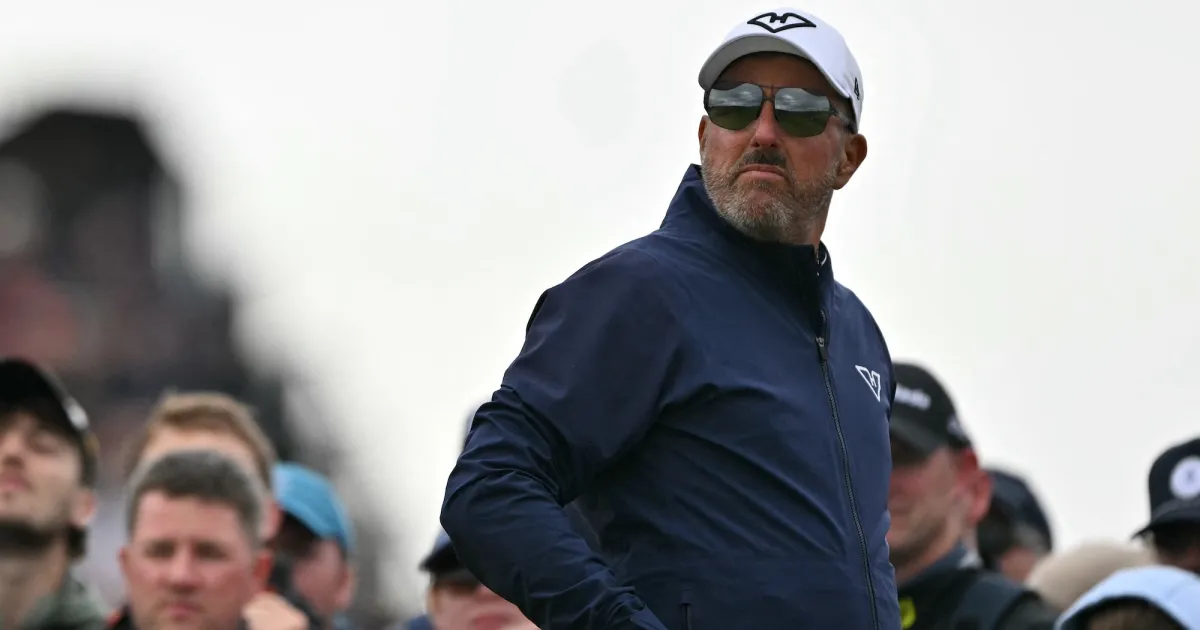
For nearly three decades, Phil Mickelson occupied a rarefied space in the American cultural landscape, celebrated not just as an extraordinarily gifted golfer who dared to challenge the dominance of Tiger Woods, but as the quintessential, wholesome family man. With his trademark thumbs-up, easygoing grin, and unshakeable charm, “Lefty” was the sporting world’s beloved golden boy, a man who seemed to have effortlessly unlocked the elusive secret of having it all. His marriage to his college sweetheart, Amy, in 1996, and the subsequent arrival of their three children—Amanda, Sophia, and Evan—became the emotional cornerstone of his public identity, portraying a life of domestic warmth that contrasted sharply with the often cold and solitary world of professional golf. When Amy was tragically diagnosed with breast cancer in 2009, Mickelson famously suspended his PGA Tour schedule to walk beside her through the grueling darkness of oncology wards and recovery rooms, cementing his status as a paragon of domestic devotion and deep-seated family values. Fans and sponsors alike dined out on this narrative of the heroic, self-sacrificing husband, projecting their own ideals of loyalty and virtue onto a man who wore the mantle of perfection with apparent ease. Yet, beneath this glossy, highly commodified surface lay the agonizingly human reality of a sports icon fighting to keep a fragile world from shattering. The profound weight of keeping up appearances while simultaneously managing the silent, exhausting trauma of a spouse’s life-threatening illness can warp even the strongest foundations. As the years hummed along and the initial crisis of cancer transitioned into a long, quiet road of recovery, the fault lines in Mickelson’s carefully curated life began to spiderweb, eventually causing his celebrated public image to fracture under the weight of unspoken grief, aging, and the isolating siren song of a life spent on the road.
According to veteran sports journalist Alan Shipnuck, the critical turning point in Mickelson’s life occurred around 2015, a period marked by profound, quiet shifts on his homefront that rippled into his behavior on the professional circuit. By this time, Amy’s health had thankfully stabilized, meaning she was no longer traveling with him from one grueling tournament to the next, while his three children had grown into busy, independent teenagers with active lives of their own. Suddenly, Mickelson found himself entering his mid-forties—a notoriously vulnerable time for any high-achieving individual—confronted with the stark, echoey reality of hotel rooms, long flights, and a deep sense of isolation. On the road, stripped of the comforting noise of family life and the grounding presence of his wife, Mickelson began to experience a profound restlessness that he seemed ill-equipped to handle. Multiple insiders close to the golfer revealed to Shipnuck that this was the moment the celebrated athlete began drinking heavily on the road, turning to alcohol and other risky behaviors to fill the void of his empty-nest solitude. For a man who had built his career on being the ultimate, steadfast patriarch, this slow descent into erratic behavior was a painful, jarring departure from the self-sacrificing figure the public thought they knew. It was a classic midlife unraveling, humanized by the tragic truth that even the most successful and adored figures are not immune to the existential dread of aging, loneliness, and the quiet loss of purpose that often comes when the children grow up and the spouse is no longer there to anchor them to the shore.
When Alan Shipnuck finally published his revealing and highly controversial exposé on Skratch Golf, it acted as a lightning rod, drawing massive public interest but also fierce criticism from fans who accused him of needlessly airing Mickelson’s dirty laundry for clicks. Defending his meticulous reporting on the “Dan on Golf” podcast, the 53-year-old journalist explained that his motivations transcended mere tabloid sensationalism, describing the article as a necessary and agonizing act of public service. He revealed that during his intensive investigative process, at least six different sources close to Mickelson had pleaded with him to write the story, expressing a desperate, frustrating hope that exposing the golfer’s destructive habits would finally force a reckoning and prevent further harm to those in his professional and personal orbit. To illustrate the danger of keeping silent in the face of a high-profile figure’s mounting misconduct, Shipnuck invoked the haunting specter of Jeffrey Epstein, pointing out how systemic enabling, collective denial, and a refusal to speak out allow powerful individuals to inflict immense damage on others for decades without consequence. While the comparison to such a notorious criminal was undoubtedly extreme and jarring, it highlighted the profound moral dilemma that sports journalists often face when the heroes we worship on television turn out to be deeply flawed, potentially destructive forces in their private lives. For Shipnuck, ignoring these behaviors was no longer an option; the risk of complicity through silence outweighed the comfortable convenience of maintaining a manufactured illusion of perfection for the golfing public.
The response from Mickelson’s inner circle was swift, fierce, and utterly unyielding, reflecting the immense anger of a family that felt deeply violated by the intrusion of the media into their private struggles. In an explosive statement delivered to Us Weekly, a spokesperson for the golfer labeled Shipnuck’s reporting as nothing short of an “anonymously-sourced drive-by shooting,” a calculated character assassination designed to maximize reputational damage while hiding behind the cowardly shield of unnamed informants. The statement fiercely criticized the journalist for attempting to position himself as the definitive authority on Mickelson’s life, arguing that the piece relied on lazy implication rather than concrete, on-the-record facts. Crucially, the defense centered heavily on the unfairness of dragging Amy into the sordid media spotlight, emphasizing that she was a private citizen who had never sought the spotlight, nor had she consented to having her marriage, her personal decisions, and her physical recovery from cancer analyzed by distant, gossip-mongering onlookers. By highlighting the cruelty of exposing a cancer survivor’s intimate family struggles to public scrutiny, Mickelson’s camp sought to shift the ethical narrative, framing the exposé not as an act of courageous journalism, but as a predatory violation of a family’s right to heal and navigate their personal struggles away from the cold, clinical eyes of the global internet economy.
In the wake of this aggressive counterattack, the editorial team at Skratch Golf stood resolutely behind their work, demonstrating the stubborn grit required of modern newsrooms when facing down high-powered public relations machinery. Ben Boskovich, the editor-in-chief of Skratch Golf, publicly dismissed the pushback from Mickelson’s representatives as “bizarre” and reaffirmed the absolute integrity of their investigative reporting. Boskovich revealed that far from launching a sneaky, bad-faith attack, the outlet had acted with complete professional transparency, presenting Mickelson’s team with a detailed overview of the allegations three full days prior to publication, specifically offering them an ample, formal window to comment, clarify, or refute the claims. By ignoring this timeline only to launch a vitriolic public attack after the story broke, Mickelson’s camp had chosen public relations theater over substantive dialogue, a tactic Boskovich sought to dismantle by standing firm on the facts. This standoff underscores the increasingly adversarial relationship between investigative sports journalists trying to pull back the curtain on the multi-million dollar industries of celebrity athletes, and the protective, highly defensive apparatuses designed to keep those curtains firmly shut. It represents a vital battle for editorial independence, proving that despite intense pressure and corporate intimidation, journalists must sometimes refuse to back down if they are to hold the powerful accountable to the truth of their actions.
Ultimately, the messy public feud surrounding Phil Mickelson, Alan Shipnuck, and the unraveling of a beloved sports icon serves as a poignant, sobering reminder of the complex, fragile humanity that exists behind our modern athletic deities. In our collective rush to either crown heroes or crucify them, we often forget that the transition from a celebrated, flawless legend to a struggling, middle-aged man is a deeply painful journey paved with very real psychological pitfalls. Mickelson’s alleged descent into restlessness, isolation, and self-destruction is not merely a sports tabloid story; it is a profoundly human tragedy about the cost of maintaining a double life, the vulnerability of aging under a microscope, and the collateral damage that occurs when the coping mechanisms of fame begin to fail. While accountability is vital to prevent harm and dismantle the toxic cultures of enabling that protect the rich and powerful, we must also grapple with the uncomfortable truth that behind every sensational headline lies a real family, with real children and a real spouse navigating the painful wreckage of public exposure. Finding the delicate balance between necessary investigative journalism and human empathy is perhaps the greatest challenge of our modern, media-saturated culture, urging us to look past the binary labels of villain and saint to see the deeply flawed, hurting human beings trying to find their way in the dark.