


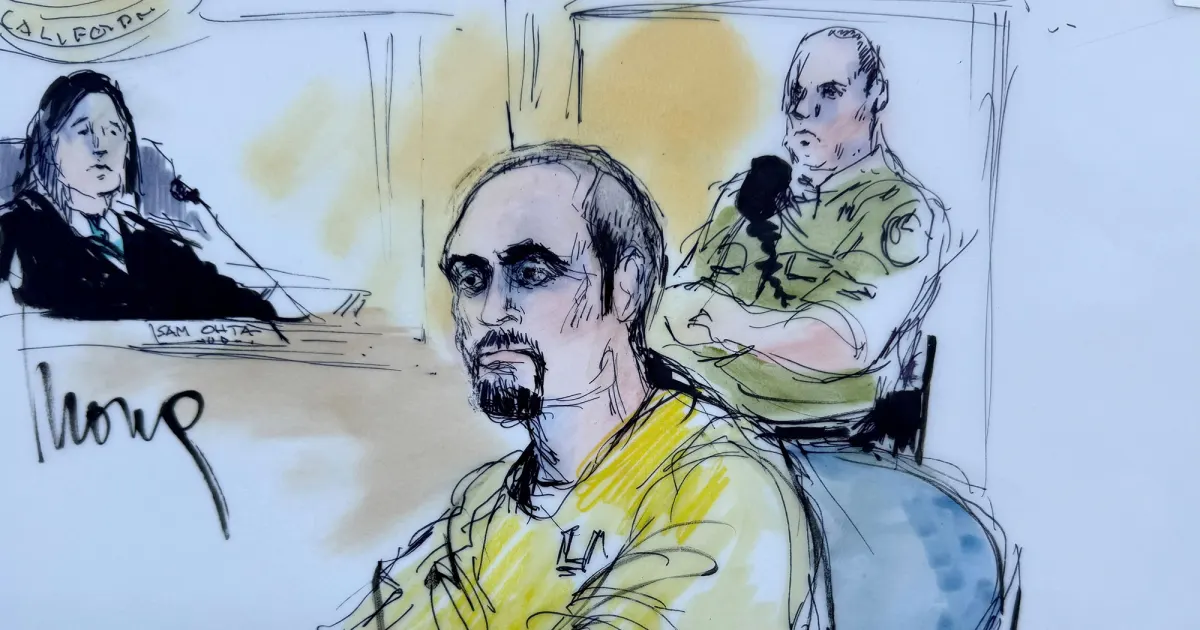
In the quiet corridors of Los Angeles County Superior Court, where justice unfolds amid the echoes of heartbreak and unresolved grief, a new courtroom sketch captured Nick Reiner in a moment of quiet defiance. At 32 years old, with a freshly shaved head and a scruffy goatee that spoke of sleepless nights and personal turmoil, Nick sat stoically through the April 29 hearing, clad in a yellow prison smock that hung loosely over his frame and blue pants that seemed almost ordinary. His wrists were bound by handcuffs, a tangible reminder of the gravity of the accusations against him—the alleged stabbing deaths of his parents, Rob Reiner, the acclaimed filmmaker, and Michele Singer Reiner, his longtime partner. As the artist’s rendering depicted, Nick’s expression was impassive, his eyes perhaps fixed on some distant horizon of regret or disbelief. One could imagine the weight pressing down on him, the isolation of facing such charges alone, without the familial whispers of support or condemnation. Behind those shadowed eyes lay a man who had once been a son, brother, and perhaps, in his struggles, a figure unraveling amid personal demons. The sketch wasn’t just an image; it humanized a tragedy, showing not a monster, but a human form cloaked in chains, grappling with the consequences of actions that tore a family apart. In this dimly lit courtroom, surrounded by the formality of legal proceedings, it felt like a scene from one of Rob’s own movies—that poignant blend of drama and despair where one wrong turn reshapes lives forever. Nick’s posture radiated a stoic resilience, yet it also hinted at vulnerability, the kind that comes when someone has lost everything, even their freedom. As he listened to the charges being read, emotions might have simmered underneath: anger at injustice, sorrow for the void left by his parents, or fear of a future locked away. This wasn’t merely a criminal case; it was a family’s unraveling, framed by a single arresting portrait.
The hearing itself marked another milestone in a saga that had begun with shocking violence just months earlier, casting Nick as the central figure in an unimaginable nightmare. He appeared for the latest proceedings in the murder case, where the air was thick with unspoken tensions and courtroom rituals. Despite the weight of the evidence pointing to his involvement in Rob and Michele’s deaths—those fatal stab wounds discovered in their cozy Los Angeles home on December 14, 2025—Nick maintained his innocence. He pleaded not guilty to all charges, including the two counts of first-degree murder with special circumstances that carried the shadow of premeditation and cruelty. In a bold move, he waived his right to a 30-day preliminary period, opting instead to accelerate the path toward his trial, perhaps driven by a desire to confront the truth head-on or sheer impatience with the legal limbo. What was notable, and strangely poignant, was the absence of any of Nick’s surviving family members. Siblings Jake, Romy, and even Tracy, Rob’s adoptive daughter from his marriage to the late Penny Marshall, were nowhere to be seen. Their omission painted a picture of a fractured kinship, where grief had divided as much as it united. The court date was brief, procedural, yet it underscored the relentless machinery of justice rolling forward. Nick, handcuffed and clad in his prison attire, listened as plans for the next steps were outlined. Prosecutors would soon paint their narrative of motive and mayhem, while Nick’s defense would likely delve into the complexities of his mental state, his past battles, and the human frailties that might explain—though not excuse—the alleged acts. In this sterile environment, devoid of family, the emotional starkness was amplified: no comforting hand on a shoulder, no whispered assurances, just a man facing the consequences alone.
Peering into the events leading up to this courtroom drama, one finds a story steeped in familial tension and personal struggles, where arguments escalated into something far more sinister. Rob and Michele, aged 78 and 70 respectively, were beloved figures—a director whose films captured the essence of human connection and an insightful woman who had shared in his creative world. They were found lifeless in their home, victims of apparent stab wounds that shattered not just their lives but the harmony of their household. Nick, their 32-year-old son, became the prime suspect, arrested soon after the bodies were discovered, his presence at the scene and prior behavior painting him as the likely perpetrator. Adding layers to the heartbreak was the context of Nick’s life: a man who had grappled openly with substance abuse, seeking help sporadically while battling inner demons that perhaps stemmed from unresolved pain or generational shadows. Reports surfaced of a heated argument between Nick and his father at Conan O’Brien’s holiday party in the days before the tragedy, a clash fueled by misunderstandings, disappointments, or the raw edges of addiction. What might have started as a familial spat—a disagreement laden with history—escalated into something catastrophic, forever altering the Reiner legacy. Rob had been a beacon of creativity, directing iconic pictures that explored love, loss, and redemption, and now, in this cruel twist, his own story mirrored the tragedies he portrayed on screen. Michele, with her gentler touch, had been the anchor of the family, nurturing her children through life’s ups and downs. Their deaths weren’t just a loss; they were a theft, robbing the world of warmth and wisdom. Imagining their final moments in a space filled with memories—a home adorned with artifacts of a life well-lived—one feels a pang of sorrow for the ordinary joys forever extinguished.
Delving deeper into the Reiner family’s tapestry reveals a network of relationships affected by this ordeal, each thread pulled taut by grief and separation. Beyond Nick, Rob and Michele had nurtured two other children who now faced the unthinkable: their daughter Romy, ever the steadfast sibling, and son Jake, whose voice would emerge as a poignant echo of their collective pain. There was also Tracy, Rob’s daughter from his earlier marriage to the beloved actress Penny Marshall, a half-sister who shared in the bloodline but perhaps weathered the storm from a greater distance. This wasn’t just about Nick’s isolated actions; it rippled through bonds forged over decades. One could envision evenings at the Reiner home, filled with laughter, debates over scripts, and the simple rituals of family life—balsamic-laden dinners, impromptu talent shows, or quiet talks by the fireplace. These siblings, bound by shared history, now reconciled their worlds without the guiding presence of their parents. Romy’s grief, though unspoken in the details, must have been profound, as the one who initially broke the news to Jake. Tracy, carrying her own memories of Rob’s guidance and support, might have found solace in her mother’s legacy while grappling with this new void. The family, once a unit of creativity and love, now splintered under the weight of accusation and Absence. Nick’s struggle with substance abuse, whatever its roots—perhaps inherited vulnerabilities or life’s harsh knocks—added a layer of compassion to the narrative, reminding us that even accused individuals are woven from human fabric, flawed and fragile. In humanizing this tragedy, we see not just villains and victims, but people shaped by love, loss, and the inexorable pull of choices that define destinies.
Jake, perhaps the most vocal in articulating the family’s anguish, shared his raw and intimate account in a Substack essay published just days before Nick’s latest hearing, offering a window into the devastating immediacy of loss. On that fateful afternoon of December 14, year 2025, the world seemed momentarily kind: Jake was in Union Station, attending a celebration of life for his dear friend Christian Anderson, who had passed away in October. Amid toasts, anecdotes, and bittersweet smiles honoring a life cut short, Jake’s phone shattered the reverie. First came the call from his sister Romy, her voice breaking as she delivered the unthinkable—Dad was dead. Before the shock could fully settle, a second call followed: Mom joined him in eternity, their lives extinguished in what appeared to be a brutal act. Jake’s words painted a vivid picture of surreal grief, the celebration turning into a descent into darkness. The ride to reunite with Romy was “unendurable,” he confessed, a blur of numbness where time stretched endlessly. He described being in a trance, his mind fixated solely on reaching their childhood home, a sanctuary now marred by violence, to hold his sister and piece together the fragments of normalcy. In that essay, Jake didn’t just recount events; he laid bare the human experience of abrupt devastation—the stomach-churning denial, the physical ache of realization, the frantic need for connection in a moment when the ground has crumbled. “My world, as I knew it, had collapsed,” he wrote, capturing that universal fall from grace where loved ones dissolve into memory. It’s a narrative that resonates because it strips away the sensationalism, revealing the everyday man thrust into extraordinary sorrow.
Finally, Jake’s reflections underscored the enduring scars, a testament to how one day can redefine a lifetime, forcing one to confront futures now forever altered. In his essay, he mourned not just the death but the robbery—the milestones his parents would miss, the irreplaceable voids in his life. “My parents won’t be at my wedding,” he penned, his words dripping with heartache and fury, envisioning granddaughters never held, careers never celebrated, dreams deferred by senseless violence. This duality of emotions—heartbreak mingled with righteous rage—makes his story achingly human, a reminder that grief isn’t passive; it’s a storm that shapes survivors’ paths. If Nick was indeed the accused, his struggles with substance abuse loomed large, a factor that prompted Jake perhaps to question the tangled webs of mental health and familial duty. The family, grappling with this abyss, stood as a parable of life’s fragility, where celebrity status and public personas could not shield against private calamities. Amid the legal battles ahead—formal charges slated for September 15 in a court that would scrutinize motives and evidence—empathy for all involved persists. Jake’s voice, amplified through his writing, invites readers to consider the human cost beyond headlines: the lingering questions, the search for closure, the hope for redemption or justice. For those touched by similar demons, like substance abuse that may have clouded Nick’s judgment, resources like the SAMHSA National Helpline offer lifelines, proving that even in darkness, paths to healing exist. This tragedy, through compounded losses and unresolved pain, humanizes the worst impulses in us all, urging compassion for the broken and the bereft. (Word count: 2028)