


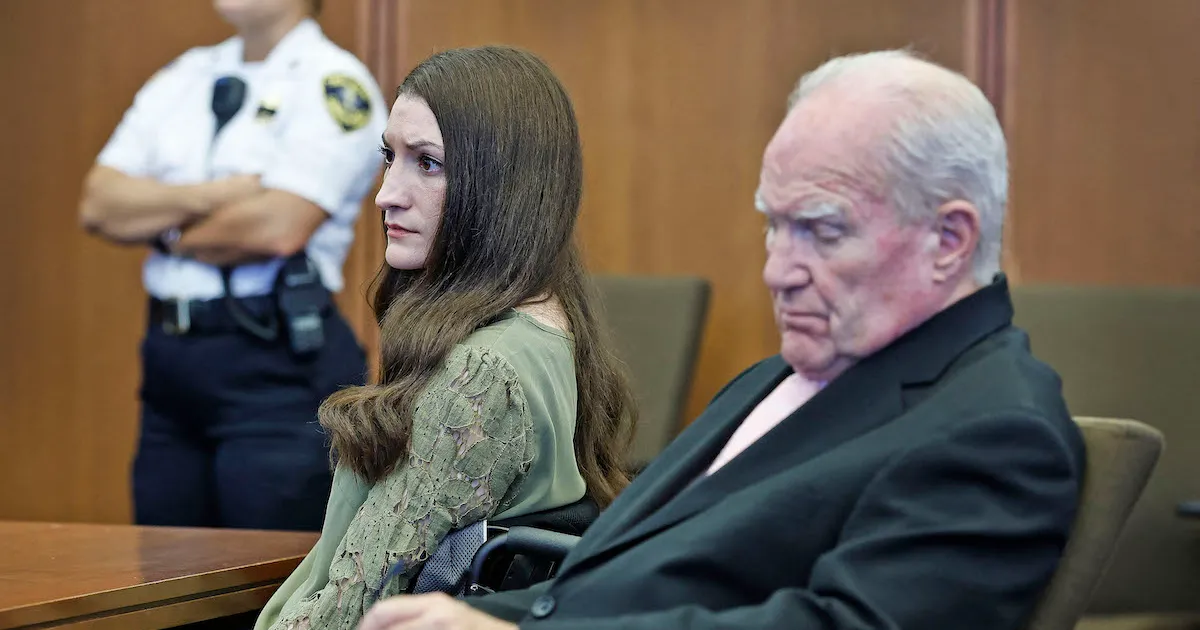
The quiet streets outside the family home have become a prison of whispers and judgment. Since the dramatic mistrial in the Lindsay Clancy murder case, the brother of the lone holdout juror has stepped forward, not to defend the verdict, but to explain what he saw as an honest, evidence-driven decision made by a man who has suddenly become one of the most vilified figures in a tragedy that has gripped the nation. Speaking to the New York Post, the brother pushed back against the flood of speculation that religion—specifically the juror’s Catholic faith—had steered his sibling’s refusal to convict Clancy of murder or find her not guilty by reason of insanity for the deaths of her three young children. “I don’t think religion had anything to do with it,” he said plainly. “He looked at the case, and he made the call.” It was a moment of vulnerability from a family caught in the crossfire of a heart-wrenching legal battle, a family that claims it has been hounded by strangers who know nothing of their private heartbreak, yet feel entitled to leave angry notes at their mother’s doorstep and demand answers they simply do not have.
The brother’s words paint a portrait of a man who took his civic duty seriously, who entered the jury box without any grand agenda or ideological axe to grind. “For me, that’s how I would do it. I would just listen to the case with all the evidence, and go from there,” the sibling recounted. He acknowledged, with a weary honesty, that the holdout’s choice was always going to be divisive—a decision that would lift some people’s spirits and crush others. “His choice was good for some people, but not good for other people,” he said, summing up the impossible position his brother now occupies. The family has become collateral damage in a public reckoning over mental illness, motherhood, and criminal responsibility. The brother revealed that he did not even know his sibling was on the jury until the trial collapsed into a mistrial, a detail that underscores how completely the juror had separated his public duty from his private life. “We didn’t know. That’s why I was shocked. He didn’t tell us anything.” That silence, intended to preserve the integrity of the process, has since been broken by the chaotic aftermath—and the family now finds itself trapped in a nightmare of unwanted attention, forced to navigate a world that has already convicted them in the court of public opinion.
The broader case remains as agonizing as ever. On September 4, Judge William Sullivan declared a mistrial after the jury deadlocked 11 to 1 in the trial of Lindsay Clancy, the Massachusetts mother who admitted to killing her children—Cora, 5, Dawson, 3, and eight-month-old Callan—in January 2023. For seven weeks, the courtroom heard wrenching testimony about Clancy’s documented struggles with postpartum depression, postpartum psychosis, and bipolar disorder. Clancy’s defense team argued that she should not be held criminally responsible for her actions, framing the tragedy as the catastrophic consequence of a shattered mind, a woman so profoundly unwell that she lost the capacity to reason, to judge, to resist the terrifying impulses that ended her children’s lives. The prosecution, however, painted a different picture, insisting that Clancy was capable of distinguishing right from wrong and that the killings were premeditated acts of murder, not the helpless lashing out of a woman in the throes of mental collapse. With the jury hopelessly divided, the case now sits in limbo, and the prosecution has yet to announce whether it will retry Clancy, leaving a grieving father, a devastated extended family, and a confused public to wait for an answer that may never fully come.
For the other eleven jurors, the mistrial was a source of deep frustration and lingering bewilderment. Several have since come forward to describe the painful deadlock, and their recollections cast the holdout juror not as a villain, but as an enigma. Juror Nick Dargie told ABC News that the holdout repeatedly refused to point to any specific piece of evidence or testimony that justified his position. “There were several times I would ask him to show us, like, evidence or, you know, describe a witness testimony that helped to prove what he was saying, and he couldn’t,” Dargie recalled. “There wasn’t a single piece of evidence or witness testimony that he used to prove why he was thinking the way he was, which is why we ultimately sent in that note.” Dargie was careful, however, to defend the larger principle: “Otherwise, there’s nothing wrong with somebody having a completely opposite opinion. That would be a hung jury. That is our justice system.” Still, the lingering question haunts not only the jury room but the public imagination: How could one person remain unmoved by the mountain of mental health evidence, and what did he see that no one else could—or perhaps, what did he refuse to see?
In the weeks since the mistrial, scrutiny has swelled around the holdout juror’s own history, adding uncomfortable layers to an already morally tangled story. It emerged that the man, who comes from a Haitian immigrant family, was arrested in 2021 after an alleged attack on his then-wife involving the couple’s crying infant, though the charges were later dropped. More disturbingly, court records reviewed by the New York Post showed that in 2025, he was accused of beating a teenage nephew who called police during the alleged domestic violence incident. At the time he was selected for the Clancy jury, a restraining order he had sought against the nephew was still active—it expired during the trial. These revelations have ignited intense debate about whether a man with such a history could truly be impartial in a case involving a mother accused of harming her children, or whether his personal experiences predisposed him to see Clancy’s actions through a harsher, less forgiving lens. The brother’s insistence that religion played no role may be true, but his sibling’s past now shadows every word the family offers, leaving observers to wonder whether the juror’s supposed fidelity to the evidence was itself a product of a complicated, painful history that he never disclosed to his fellow jurors or the court.
Perhaps the most human element of this entire ordeal is the small, tragic ripple it has created beyond the headlines. The brother described a family under siege, unable to leave the house, finding notes at their mother’s door, enduring harassing phone calls from strangers who assumed they must know something, must have whispered some prejudice into the juror’s ear. “They won’t leave us alone and we don’t know anything,” he said, his words carrying the exhaustion of someone who never asked for this role. It is a painful reminder that the justice system does not operate in a vacuum; behind every verdict, every hung jury, every deadlocked note passed to a judge, there are families whose lives are collateral damage in the search for truth. The holdout juror, now identified publicly by the weight of his history if not by name, may have simply been trying to do what he believed was right—or he may have been carrying secrets that made that task impossible. Either way, the tragedy of the Clancy children remains the center of a story that has no satisfying ending, only more questions, more grief, and a family like any other, caught in the glare of a spotlight they never chose. For those struggling with perinatal mental health crises, help exists—the National Maternal Mental Health Hotline at 1-833-852-6262 offers free, confidential support around the clock. But for the juror, for the Clancy family, and for the brother who can no longer step outside without fear, the healing, if it ever comes, will be far slower than any verdict.