






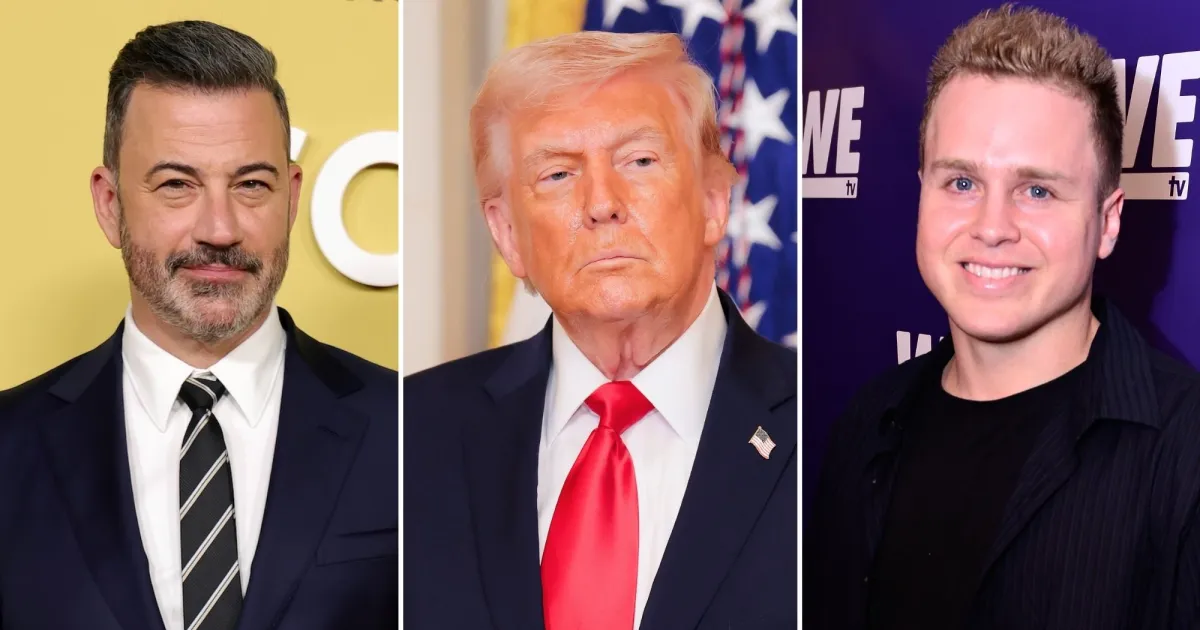
The landscape of American late-night television has evolved from a simple source of lighthearted evening entertainment into a highly visible, deeply influential arena for political commentary, cultural critique, and public reckoning. At the forefront of this shift is Jimmy Kimmel, the fifty-eight-year-old host of ABC’s Jimmy Kimmel Live!, who recently used his monologue to highlight the increasingly bizarre intersection of reality television, fringe political conspiracies, and executive-level commentary. The catalyst for Kimmel’s sharp-tongued humor was an unexpected and highly unusual alliance between former President Donald Trump, seventy-nine, and Spencer Pratt, the forty-two-year-old reality star known for his polarizing presence on MTV’s The Hills. Pratt had launched an ambitious, if unconventional, campaign for the mayoralty of Los Angeles, promising to save the sprawling metropolis from what he described as a slide into dystopian ruin. When the preliminary results of the early June primary election revealed that Pratt had failed to secure a spot in the upcoming general election runoff, Trump swiftly entered the chat, using an Oval Office press conference to publicly assert that the democratic process had been systematically corrupted. According to Trump’s theory, shadowy Democratic operatives—whom he affectionately dubbed “cheating dogs” and “Dumb-ocrats”—had actively manipulated the ballot counting to block Pratt’s political rise. Kimmel, recognizing the sheer absurdity of a former commander-in-chief spending valuable national press time defending the honor of a reality television star’s mayoral bid, seized upon the narrative with relentless enthusiasm. He took great pleasure in pointing out the fundamental logical flaws inherent in the theory, mocking the idea that political schemers would execute a massive voter fraud operation that was somehow incredibly sophisticated yet completely nonsensical in its execution. By examining this odd political spectacle, Kimmel did not merely seek to generate cheap laughs; he sought to expose the broader, more concerning societal trend of delegitimizing electoral outcomes whenever a preferred candidate fails to win, demonstrating how easily local municipal affairs can be transformed into nationalized conspiratorial dramas designed to capture headlines and stoke division.
To truly appreciate the ridiculousness that Kimmel found so entertaining, one must look closely at the actual mechanics of the California voting system and the specific results of the Los Angeles mayoral primary. Under California’s unique top-two electoral framework, a direct runoff is triggered between the two candidates who receive the most votes, unless an individual candidate manages to capture an outright majority of more than fifty percent in the primary round. In this highly watched race, the incumbent Mayor Karen Bass, seventy-two, clinched the leading position with a solid 34.30 percent of the total vote, while City Councilwoman Nithya Raman, forty-four, secured the second-place spot with twenty-nine percent, thereby earning her right to challenge Bass in the November general election. Pratt, despite his high public profile and intense social media campaigning, lagged behind in a distant third place, capturing landlocked support of just 25.52 percent, according to official data released by L.A. Vote. The core of Trump’s grievance lay in the assertion that these numbers were artificially manufactured to suppress Pratt’s momentum. However, Kimmel brilliantly exposed the gaping logical void in this argument by highlighting that the mayoral primary was printed on the exact same physical ballot paper as the state’s gubernatorial primary. In that gubernatorial race, the Trump-backed Republican challenger Steve Hilton, fifty-six, successfully advanced to secure a spot in the upcoming runoff against the prominent Democratic contender Xavier Becerra. Trump tried to resolve this glaring contradiction during his press briefing by claiming that election officials only allowed Hilton’s votes to go through because “the heat was on them,” forcing them to let one Republican succeed to cover up their wider misdeeds. Kimmel played this footage to a roaring studio audience, marveling at the mental gymnastics required to believe that these allegedly corrupt administrators were simultaneously diabolical geniuses and incredibly foolish planners. Kimmel noted with biting irony that, in a rational society, such a performance would have prompted immediate medical intervention and a quiet evening of rest, rather than serving as a major talking point in national news, perfectly illustrating the surreal reality of the current political climate.
Beyond the high-level political theater and the abstract debates over election integrity, the feud quickly shifted into a far more personal, localized, and emotionally charged territory. Before the ballots were even officially cast and counted, Spencer Pratt had made a dramatic, highly publicized pledge to the citizens of Los Angeles: if he did not win the mayoral race, he would pack his bags and abandon the city entirely, declaring that a defeat would signal the permanent cultural and structural death of the metropolis. Kimmel, never one to let a theatrical promise go unpunished, dedicated a significant portion of his Tuesday night broadcast to holding the reality star’s feet to the fire. With a mock-solemn expression and a drippingly sarcastic tone, Kimmel bid an emotional farewell to Pratt, telling his national audience how deeply the city would miss his unique presence, crystallized lifestyle, and dramatic antics. To assist Pratt with his self-imposed exile, the late-night host revealed that his production staff had gone so far as to rent a large U-Haul moving truck on Pratt’s behalf, complete with ample storage space, double beds, tables, and custom decorations designed specifically to accommodate Pratt’s famous and extensive collection of healing crystals. Kimmel openly mocked the financial realities of Pratt’s campaign, suggesting that out-of-state donations were likely drying up and that a free moving truck was exactly the kind of charitable assistance the cash-strapped former candidate needed in his time of transition. This segment was classic late-night television, blending aggressive satire with a direct challenge to a public figure’s credibility, forcing the audience to laugh at the performative nature of modern political promises. However, what began as a routine comedic ribbing of an eccentric celebrity soon took an unexpected turn, highlighting the profound dangers of blending public mockery with real-world television satire when the human behind the character is dealing with genuine, non-political devastation in his private life.
The dynamic of the feud shifted dramatically on Wednesday when Spencer Pratt took to his social media channel on X, formerly known as Twitter, to issue a devastating and deeply personal response to Kimmel’s U-Haul joke. Rather than engaging in a standard political debate or firing back with typical campaign rhetoric, Pratt shared raw, heartbreaking footage of the charred ruins of his former home, which had been completely destroyed in the catastrophic 2025 Palisades Fire. In a poignant and emotionally raw post, Pratt directly addressed the television host, stating that he had no need for a moving truck because the intense wildfires had left him with absolutely nothing to pack, effectively silencing the lighthearted narrative Kimmel had constructed. This stark contrast between Hollywood satire and real-world tragedy brought a somber dimension to the entire spectacle, reminding the public that behind the loud political campaigns and reality television personas are actual human beings who experience genuine loss, trauma, and upheaval. Prior to this tragedy, Pratt had spoken candidly in an exclusive cover story with Us Weekly, explaining his intense connection to Los Angeles and clarifying his controversial statements about leaving the city. He maintained that his political candidacy was never a publicity stunt or an exercise in vanity, but rather a deeply felt mission to rescue his beloved home city from what he viewed as an impending, irreversible decline. Pratt had warned that without a massive change in leadership and a rejection of the political status quo, Los Angeles was destined to deteriorate into a bleak, unlivable environment reminiscent of a dark, dystopian science fiction movie. His fears of disaster unexpectedly materialized in the most personal way possible through the destruction of his own home, transforming his political hyperbole into a tragic personal reality and casting Kimmel’s comedic jabs in an incredibly harsh, insensitive light in the eyes of many onlookers.
This sudden shift from political comedy to personal tragedy quickly ignited a firestorm of public outrage and attracted sharp criticism from prominent media figures, most notably the outspoken conservative commentator and former cohost of The View, Meghan McCain. Taking to social media with characteristic intensity, the forty-one-year-old McCain did not hold back her feelings, launching a direct, scathing attack on Kimmel’s character and calling him a “mean, heartless bastard” for mocking a man who had recently lost everything to a devastating natural disaster. McCain went even further, expressing a sentiment shared by many critics of modern late-night television by asserting that the day Kimmel’s show is finally taken off the air will be a genuinely positive day for the entire country. Her fierce defense of Pratt highlighted the deep cultural and political polarization that defines current public discourse, where comedic monologues are increasingly viewed not as harmless satire, but as cruel, highly partisan weapons used by powerful media elites to punch down at their political opponents. To McCain and her supporters, Kimmel’s refusal to acknowledge or respect the immense personal tragedy of the Palisades Fire in his comedy set represented a profound lack of basic empathy and a failure of journalistic and comedic integrity. The intense backlash demonstrated how quickly the public can turn on late-night hosts when their humor is perceived as crossing the line from healthy democratic skepticism into cruel, unfeeling personal harassment. This controversy also underscored the growing challenges faced by mainstream comedians who must navigate a highly sensitive, hyper-connected media environment where every joke is dissected, contextualized, and evaluated against the real-time tragedies and personal struggles of its targets, making the boundary between acceptable political satire and unacceptable personal cruelty more contested than ever before.
Ultimately, this entire dramatic episode serves as a fascinating, multi-layered case study in the bizarre intersection of celebrity culture, political polarization, late-night media, and personal tragedy in modern American life. What began as a routine municipal primary election in Los Angeles quickly cascaded into a bizarre national conversation involving a reality television star, a former President of the United States, a prominent late-night comedian, and a high-profile media commentator, highlighting how deeply interconnected our entertainment and political spheres have truly become. The dispute exposes the strange, almost theatrical nature of contemporary civic engagement, where serious policy discussions and electoral processes are routinely overshadowed by personal grievances, social media feuds, and accusations of conspiracy. Moreover, the tragic subtext of the Palisades Fire serves as a sobering reminder of the physical realities that exist outside the digital echo chambers and television studios, forcing both the creators and consumers of political entertainment to confront the profound and painful human cost of their public discourse. As Jimmy Kimmel Live! continues to routinely air on ABC weeknights at exactly 11:35 p.m. Eastern Time, the popular variety show and its controversial host find themselves at the very center of a much larger debate about the role, responsibilities, and limits of late-night satire. In our rapidly changing current era where the highly complex lines between news, entertainment, comedy, and tragedy are irrevocably blurred, this conflict leaves audiences to grapple with some tough questions: can we still find humor in our absurd political reality when the jokes are inextricably linked to real-world suffering, and is it possible to restore a sense of basic dignity, human empathy, and mutual respect to a highly fractured public square that currently seems entirely defined by conflict, division, and performative outrage?