

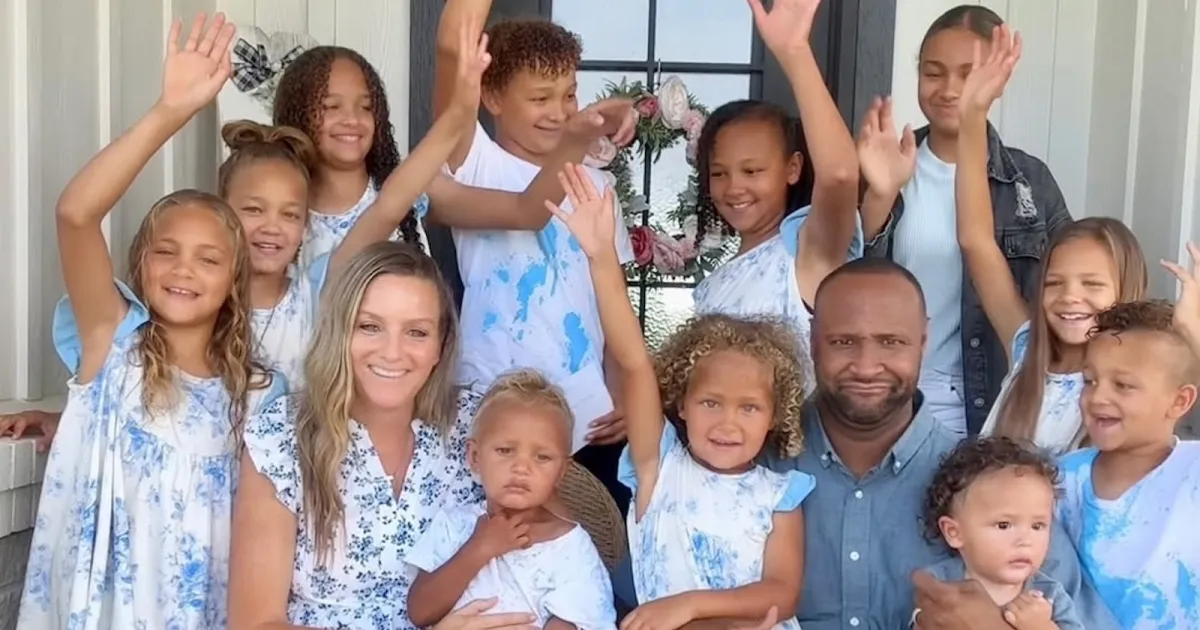
In the quiet, uncertain hours after a positive pregnancy test, many women learn to hold their breath. They celebrate in whispers. They count down to appointments. They try not to imagine a nursery too soon. Karissa Collins, a 42-year-old Texas mother of 11 who has become one of the internet’s most recognizable Christian influencers, knows that particular kind of guarded hope intimately. In an Instagram post shared on Saturday, October 10, she reflected on the anxiety that accompanies pregnancy after loss. “No one talks about the anxiety of finding out you’re pregnant after loss. The fear to be too excited is real,” she wrote. The words were simple, but they resonated far beyond her usual audience. Karissa has always shared her life openly—the everyday chaos of a large family, the rhythms of homeschooling, the faith that anchors her motherhood. But this post was different. It exposed a vulnerability she had not always shown so plainly. She explained that she and her husband, Mandrea Collins, deliberately waited to tell their children about the pregnancy until they could see the baby for themselves at nine weeks. They wanted to avoid putting their children through the emotional whiplash of another disappointment. “The only problem was my belly grew faster than expected and I was sicker than expected so they figured it out before we could even surprise them,” she wrote, offering a glimpse of the sweet, unplanned moment when the family’s secret came out. The children recognized the signs before any formal announcement could be made. In a way, the surprise was even more beautiful because it was discovered rather than announced.
The video Karissa posted alongside her reflection showed the exact moment on July 13 when she and Mandrea learned they were expecting again. In the footage, her shock is palpable. This was not the staged, theatrical surprise of a curated announcement. This was a woman who had learned to brace herself for bad news, suddenly confronted with a heartbeat. “Let’s just say on this day in July, I was in complete shock and covering this sweet baby in prayer every day,” she wrote. The phrase “covering this sweet baby in prayer” is the language of someone who knows she cannot control the outcome. She can eat the right foods, take the right vitamins, and show up to every appointment, but the life growing inside her is ultimately not in her hands. So she did the only thing she could do: she prayed. And she kept praying, day after day, as the weeks crawled by. “We’re so grateful God chose us to carry this child,” she added. There is a quiet surrender in those words, a recognition that pregnancy itself is a gift and not a guarantee. Karissa’s gratitude is not the bright, uncomplicated gratitude of a first-time mother. It is the deeper, more fragile gratitude of someone who has known loss and still dares to hope. By sharing this moment, she gave her followers permission to feel the same complexity—to be grateful for a pregnancy while also being terrified, to rejoice in a positive test while also guarding their hearts.
Karissa’s candor about her current pregnancy cannot be separated from the loss that preceded it. In June 2025, she revealed on social media that she had suffered a miscarriage while carrying what would have been her 12th child. The news was devastating enough on its own, but the details she shared later made it even more heartbreaking. In a TikTok video posted on July 17, 2025, she explained that she was experiencing a missed miscarriage—a condition in which the pregnancy has ended but the body has not yet recognized the loss. “I am currently, possibly, still pregnant with a missed miscarriage baby,” she said. “I have not fully miscarried the baby, which I found out about a month ago. I have been carrying this miscarriage … anywhere from four to six weeks.” Imagine living with that knowledge. Imagine going about your daily routine, caring for eleven children, filming videos, making meals, and trying to sleep at night, all while knowing that the baby inside you has already died. A missed miscarriage is a particular kind of emotional limbo. There is no immediate physical confirmation of loss, no clear moment of goodbye. Instead, there is a waiting period that can last days or weeks, during which the body continues to carry a pregnancy that is no longer alive. Karissa’s willingness to speak openly about this experience was a gift to the countless women who have suffered in silence. She also acknowledged that she had experienced other pregnancy losses over the years, which contextualized the fear she now feels. Every new pregnancy, for her, is shadowed by the ghosts of the ones that came before.
The Collins family’s public journey began long before the miscarriage and the new pregnancy. They rose to prominence in 2017 by posting everyday videos on YouTube, giving viewers an inside look at the logistics, joy, and exhaustion of raising a large family. Over time, their channel became a community, and Karissa became a figure of fascination and debate. Some admired her unshakeable faith and her willingness to trust God with her family size. Others questioned the choices she made, especially as her platform grew. That scrutiny intensified dramatically in the days after her miscarriage news, when she uploaded a TikTok video of her younger children playfully hitting her belly. The video was deleted after it sparked widespread backlash, but the damage was already done. Critics accused her of being insensitive, of using her children for content, and of failing to respect the grief of the baby she had just lost. Karissa responded not with an apology or a retreat from public life, but with a clear explanation of her intentions. “I don’t do clickbait. I don’t like controversy. I don’t post offensive things for followers. I don’t want followers like that. I’m not all about a following,” she said. For Karissa, the purpose of her online presence is not fame or influence in the conventional sense. It is ministry. “I am just about sharing the message that God has given me, and the ministry that I have, which is that you can trust God with your womb,” she explained. “We encourage women to trust God with how many children he wants to give.” Whether or not viewers agree with her theology, her response revealed a woman who is not easily swayed by public opinion. She has a mission, and she intends to carry it out.
Perhaps the most humanizing part of Karissa’s recent post is her admission that she deliberately withheld her own joy. Our culture tends to treat pregnancy announcements as uncomplicated celebrations, but for women who have experienced miscarriage, a new pregnancy is rarely a pure happy occasion. It is, instead, a season of intense emotional whiplash. Every symptom is either reassuring or terrifying. Every quiet day feels like a warning. Every trip to the doctor is a hurdle that must be cleared before joy is allowed. Karissa’s phrase “the fear to be too excited is real” names this experience perfectly. To be too excited is to risk being crushed more deeply. To be too excited is to imagine a future that might not come to pass. To be too excited is to feel the new life kicking while still grieving the life that ended. This is why she and Mandrea decided to wait until the nine-week ultrasound to tell their children. They did not want to burden their children with the weight of a fragile pregnancy. They did not want to see their children’s faces fall again. But the body had other plans. Karissa’s belly grew faster than expected, and the sickness that plagued her early pregnancy was impossible to hide. The children, who had watched their mother carry so many babies before, figured it out on their own. The planned surprise became an unplanned revelation, and in the end, that may have been better. The children were not told about a pregnancy; they discovered it. They were part of the secret from the moment they noticed. And as the family moved forward, they carried that secret together.
Karissa Collins is many things to many people: a mother of eleven, a wife, a homemaker, a social media personality, a source of controversy, and, for some, a source of comfort. But above all, in this season of her life, she is a woman trying to reconcile faith with grief. She has been transparent about the losses that have shaped her, the fear that shadows her current pregnancy, and the prayer that sustains her. She has also refused to let public criticism dictate how she shares her story. In a world of carefully curated feeds and polished narratives, her willingness to be messy and honest is a reminder that influencers are human too. They feel fear. They carry grief. They make mistakes. They post videos they later regret. They hold their breath in ultrasound rooms. And they continue to trust God even when the road is uncertain. “No one talks about the anxiety of finding out you’re pregnant after loss,” Karissa wrote. But she talked about it. She named it. She gave voice to an experience that millions of women share but rarely articulate. And in doing so, she created a small space of solidarity for anyone who has ever felt that terrible, beautiful, frightening flicker of hope after heartbreak. Her story is not over. The baby she is carrying has not yet arrived. But whatever happens, she has already shown that she will meet it with honesty, with faith, and with the stubborn determination to be excited anyway. “We’re so grateful God chose us to carry this child,” she wrote. It is a sentence born of loss, strengthened by prayer, and offered to the world with open hands.