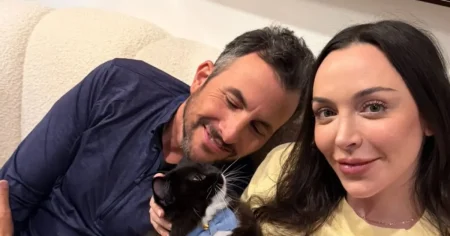


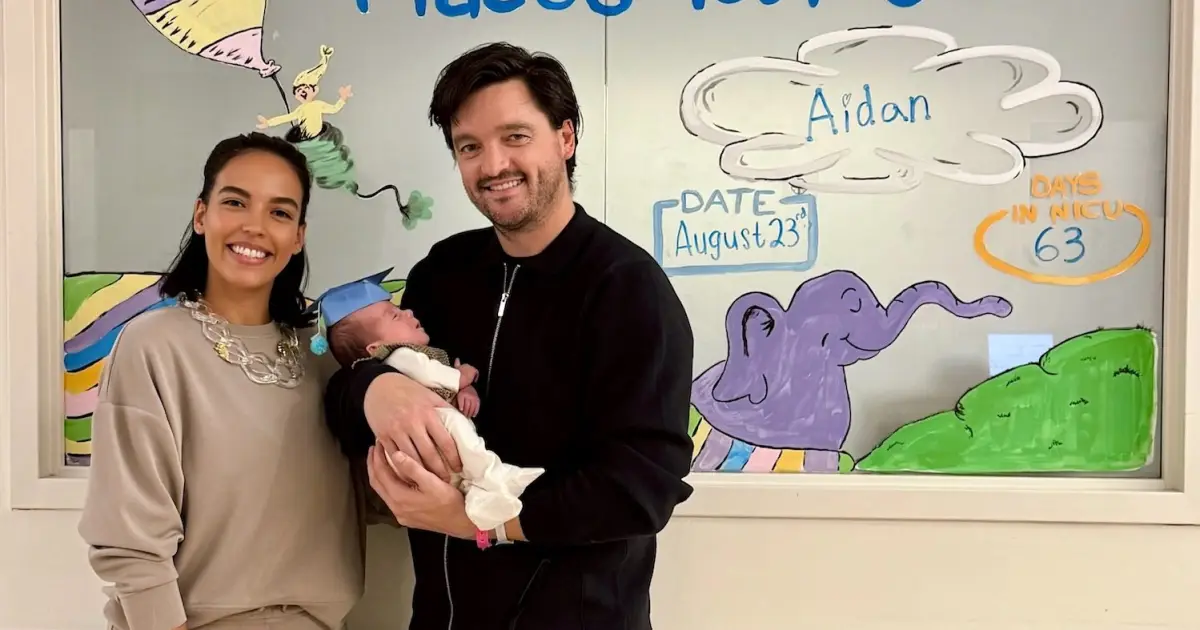
There is a distinct, sacred line that divides the world into two kinds of parents: those who have left a hospital holding their newborn, and those who have left a hospital without one. For Danielle Olivera and Eoin Heavey, that line blurred for sixty-three seemingly endless days—a stretch of time measured not in weeks or months, but in the rhythmic beeping of monitors, the sterile scent of antiseptic, and the fragile hope tucked inside a plastic isolette. On Sunday, August 23rd, that line finally snapped back into focus. With their son Aidan wrapped securely in their arms, the couple walked out of the hospital, and on Monday, August 24th, Danielle—known widely as a vibrant star of Bravo’s Summer House—shared the triumphant, tear-jerking moment with her millions of followers. The accompanying photograph was beautifully simple: the proud parents, glowing with a mixture of exhaustion and pure elation, holding a sign that proclaimed Aidan’s incredible victory. “After 63 days in the NICU, it’s time for me to move in with my family on this 23rd day of August, 2026,” the sign read. The word “graduated” was splashed across the top, a term that holds monumental weight for anyone who has ever experienced the Neonatal Intensive Care Unit. It is not merely a discharge; it is a hard-fought battle cry, a badge of honor earned through relentless perseverance, medical miracles, and the unyielding strength of a tiny fighter. In the photograph, their faces are etched with the unmistakable relief of parents who can finally exhale. Danielle, 37, looked effortlessly radiant despite the emotional rollercoaster of the past nine weeks, while Eoin, 39, stood as a pillar of quiet strength beside her. Their little boy looked perfect—a miracle of modern medicine bundled in a soft white blanket, his tiny fingers curling against the fabric. The sign they held wasn’t just a piece of cardboard; it was a testament to their endurance. It represented 63 days of hospital gowns, 63 days of pumping breast milk in small sterile rooms, 63 days of watching nurses perform delicate procedures, and 63 days of the terrifying yet hopeful task of watching a premature infant grow strong enough to face the world. Danielle’s caption, “He graduated!!!” paired with a cascade of crying-laughing emojis, cut straight to the heart of every parent who had ever feared for their child’s life. For the star of Summer House, a show often filled with sun-drenched parties and interpersonal drama, this was the most profound and grounded reality she had ever shared. The “finally” in her message was not just a word; it was a release of all the pent-up anxiety, a surrender to joy. It was the moment the collective breath of her family, her friends, and her millions of online followers was finally let out in a collective sigh of relief. The NICU had been their temporary home, a bizarre limbo, but now, the real adventure of parenthood could finally begin within the walls of their own home.
But to truly understand the magnitude of that August day, one must rewind to the beginning of the summer, when their world was turned upside down in a matter of hours. Aidan arrived ten weeks before his due date, a startlingly early entrance that no amount of birthing classes or nursery preparation could ever truly brace a parent for. The excitement of impending parenthood was abruptly replaced by a primal fear that gripped their hearts as their newborn was whisked away to the intensive care unit, his tiny body dependent on machines and skilled specialists to perform the basic functions his developing systems were not yet ready to handle. In those initial days, the reality of the situation was numbing. Danielle turned to social media on June 25th, just days after the birth, to provide an update that was both raw and hopeful. She described the journey as a “long road ahead,” a phrase that felt like a quiet admission of the uncertainty that lay before them. Eoin, attempting to find a sliver of light in the darkness, offered a unique and somewhat whimsical perspective, likening their new reality to “summer camp.” It was a bizarre but surprisingly effective coping mechanism—the idea of living in a shared space, eating cafeteria-style meals, adhering to strict schedules, and becoming fast friends with a rotating cast of nurses and doctors who would become their guides through this foreign land. They knew, however, that this “camp” would last for what they estimated to be the “first 2/3 months in this world.” Danielle’s June post was accompanied by a beautiful photo of the new parents gently holding their son, their fingers dwarfing his impossibly small hand. She wrote about how the baby and the parents were “doing well,” a simple reassurance to the thousands of people who were worrying from afar. Yet, the emotional toll was evident. Danielle spoke openly about being “overwhelmed by the love and support” they had received, clinging to the kind words from fans, friends, and family as lifelines while she navigated the complex emotions of postpartum recovery without the traditional comforts of bringing her baby straight home.
The decision to share such a deeply vulnerable and medical journey was a departure from the typical curated aesthetic of a reality television star, and it was a choice that resonated profoundly. Danielle’s willingness to bare her soul during this trying time transformed her from a celebrity into a relatable, breathing human being who was experiencing one of the most harrowing events a parent can face. By allowing her followers into the NICU, she shed light on a reality that is often kept behind closed doors—the harsh statistics of prematurity, the emotional rollercoaster of good days and bad days, and the financial and psychological strain it places on families. The response was an outpouring of solidarity, a digital village rallying around the new parents. Among the countless comments, one standout message came from influencer Kristen Knutson, a friend who understood the specific pain and triumph of this experience on an intimate level. “Sooooo sweeettt,” Kristen wrote, her comment dripping with genuine affection. She continued, “Best feeling ever for mom and dad!! Congrats, you finally get to have your baby snuggles at home.” Then, she added a heartbreakingly accurate insight: “As a preemie mom, you’ll never forget this day.” It was a profound validation of the gravity of the moment. Kristen wasn’t just offering empty platitudes; she was speaking from a place of shared trauma and resilience, reminding Danielle and Eoin that they were part of an unspoken sorority and fraternity of parents who had walked through fire and come out the other side. This public display of empathy highlighted the incredible power of social media when used as a force for good—a place where a stranger’s comment can feel like a warm embrace, and where a shared experience can bridge the gap between a Bravo celebrity and an average mother sitting in a hospital waiting room, feeling utterly alone. The sheer volume of love and prayers directed at little Aidan created a protective digital blanket around the family, giving them strength on the days when the machines seemed to beep too loudly and the progress seemed too slow.
As the calendar turned to August, the narrative shifted from the initial shock and fear to one of steady, measurable triumph. On August 1st, Danielle provided a heartwarming update that felt like a major victory lap for the family. Aidan had hit a staggering milestone, tipping the scales at 6 lbs, 15 oz and stretching out to 20.5 inches long. For a baby who had arrived ten weeks early, this was a monumental achievement—a physical representation of all the hard work his tiny body was doing. The update was filled with joyful minutiae that only a NICU parent could truly appreciate. Danielle cheerfully announced that Aidan had “started oral feeds to gradually wean him off the feeding tube,” a crucial step toward independent eating that signaled his body was learning to coordinate the suck-swallow-breathe reflex that most full-term babies take for granted. Perhaps the most delightfully mundane, yet exciting, milestone was that they had “traded his preemie diapers in for newborn size.” A simple change of clothing, but it was equivalent to a college graduation to a NICU family. She also shared a tender observation about her son, noting that he “loves his amazing nurses who make him feel special” and quipping that he was “currently Daddy’s twin,” a feature that surely melted Eoin’s heart. Yet, buried within this joyful update was a stark reminder of their ongoing reality. Danielle expressed immense gratitude for the ability to “monitor Aidan even when they were at home thanks to a live feed set up by the NICU care team.” This small technological mercy was both a blessing and a curse. It allowed them to feel connected during the hours they had to spend away, but watching their baby through a screen, unable to hold him, was a special kind of torture. Their lives had become a delicate balancing act—sleeping in their own beds, but with one eye glued to a computer screen, checking the feed at 3 AM to see if his chest was rising and falling evenly. The “getting stronger” caption was not just a medical assessment; it was a promise that the end WAS in sight.
The final stretch of their NICU journey was a flurry of tests, checklists, and a fluttering anticipation that was almost too much to bear. NICU discharge is notoriously rigorous; a baby must prove they can maintain their body temperature in an open crib, pass a car seat test (sitting upright for an hour without their heart rate dropping), and consistently gain weight through oral feeds. Every day brought them one step closer, but the fear of a setback lingered in the shadows. Then, the word finally came: “graduation.” In the lexicon of the NICU, graduation day is the holiest of days. It is the culmination of sleepless nights, of celebrating the smallest victories, and of learning to navigate the complex world of medical equipment. For 63 days, their lives had revolved around fluorescent lights, the constant hum of ventilators, and the rhythmic hiss of oxygen. They had watched their son grow from a fragile, barely-there creature into a robust, healthy baby who was ready to take on the world. The sign they held on August 23rd, announcing that it was time for Aidan to “move in with my family,” was a whimsical, humorous nod to the fact that the hospital had been a strange, temporary home. The physical act of leaving the hospital was surreal. There was no grand fanfare, just the quiet, deliberate gathering of belongings—the tiny outfits that once seemed too big, the knitted hats, the stack of pamphlets on infant CPR. They dressed Aidan in his “going home” outfit, a task that felt monumental in its simplicity. As they stepped out of the hospital doors, the warmth of the late summer sun hit their faces, and the sounds of the outside world—cars honking, birds chirping—seemed foreign after weeks of clinical silence. Eoin fastened the car seat base with shaking hands, double-checking and triple-checking the harness. Danielle slid into the backseat beside her son, her hand resting gently on his chest, feeling the reassuring rise and fall of his breath without the aid of a monitor. The drive home was slow, and the air was thick with unspoken emotion—relief, joy, and a staggering sense of responsibility. They were no longer patients in a hospital; they were simply a family going home.
Now, as the dust settles and the soft glow of a nursery lamp replaces the sterile hospital fluorescence, Danielle and Eoin are finally navigating the messy, beautiful, sleep-deprived world of new parenthood. The 3 AM feedings are no longer punctuated by the beeping of IV pumps, but by the sweet, contented sounds of a baby who is safe and sound in his own crib. The transition is not without its anxieties—a first cold, a sleepless night, the sudden urge to check if he’s still breathing—but these are the ordinary worries of every parent, unburdened by the weight of medical fragility. Danielle’s final Instagram post was a breathtaking collage of gratitude, wrapping their journey in a bow of heartfelt thanks. She thanked the incredible NICU team at Stony Brook Medicine in New York, the family and friends who held them up, and the “every NICU mom who’s reached out.” “You’ve carried us through more than you’ll ever know,” she wrote, her words echoing the profound sense of community she found in the darkest of times. But the most significant thank you was reserved for her son, the “smiley little legend” who taught them the true meaning of strength. Their story is not just a celebrity anecdote; it is a universal tale of resilience. For every parent currently sitting in a NICU, watching their own tiny fighter battle for every breath, Danielle and Eoin’s journey serves as a beacon of hope. It reminds them that the 60-day countdowns do have an end, that the monitors will eventually be silenced, and that one day, they too will walk out of those hospital doors with their precious miracle in their arms. For Danielle, the star of a party-centric reality show, real life has taken center stage, and it is far more beautiful and meaningful than any televised drama. Aidan is home, the baby snuggles are real, and the whole world can finally let out the breath it has been holding since June.