





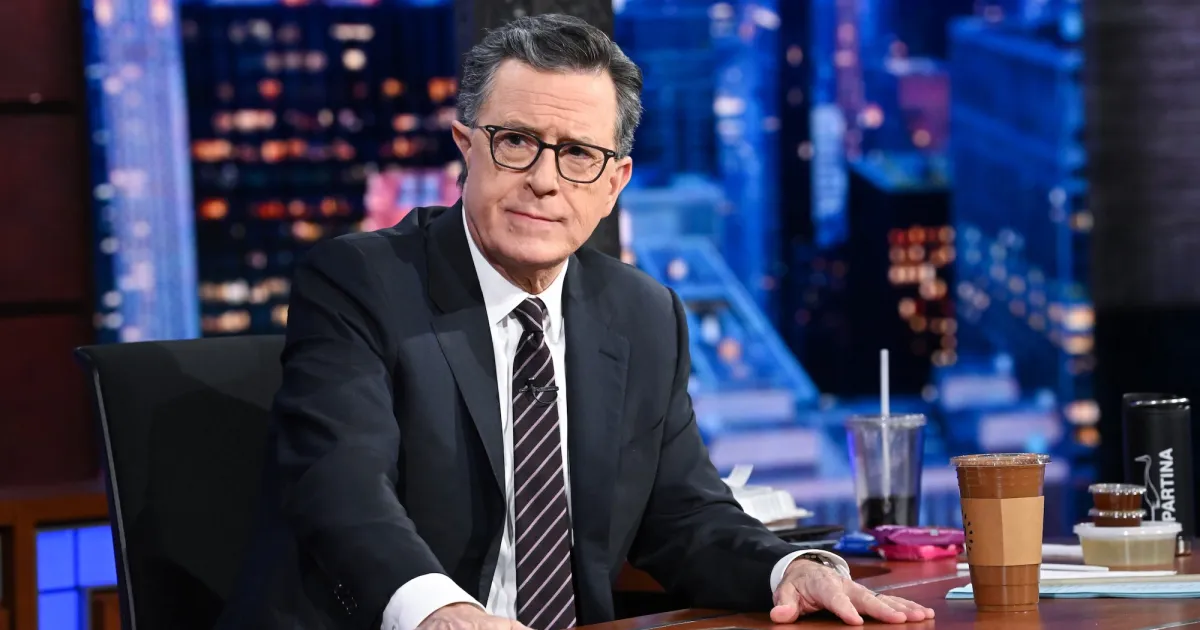
The historic Ed Sullivan Theater in New York City has witnessed countless moments of cultural definition, but the evening of Thursday, May 21, carried a uniquely bittersweet charge as Stephen Colbert took the stage for his final episode of The Late Show. Rather than slipping quietly into the night or wallowing in purely sentimental retrospective, the 62-year-old comedian chose to exit exactly as he had spent his career: wielding sharp, fearless, and highly targeted satire. During his signature “Meanwhile” segment, a beloved nightly routine where he routinely roasted the absurdities of modern news headlines, Colbert highlighted a peculiar legal story. He informed his audience that the copyright owners of the music from A Charlie Brown Christmas and other iconic Peanuts television specials had filed four aggressive lawsuits against unauthorized users of the famous theme song, “Linus and Lucy.” Feigning immense corporate seriousness, Colbert turned to his band leader, Louis Cato, warning him that the Peanuts brand was a formidable juggernaut and that anyone caught using their music without explicit permission would “have to pay through the nose.” Right on cue, Cato and the Great Big Joy Machine band burst into the upbeat, instantly recognizable piano chords of the beloved cartoon theme. Colbert played along with masterful comedic timing, feigning mock panic as he interrupted the music to ask if the band was doing the exact thing he had just warned would invite a massive lawsuit. He then delivered a devastatingly funny parting shot at his corporate employers: “Oh no, I hope this doesn’t cost CBS any money.” This playful act of musical insubordination was a perfect encapsulation of Colbert’s comedic essence—using a lighthearted cartoon melody to land one last, highly public punch on the network that had decided to bring his late-night tenure to a sudden and controversial end. The studio audience erupted in appreciative laughter, understanding the layer of subtext hidden within the playful tune.
To understand the deep-seated irony of Colbert’s parting shot, one must examine the sudden and highly scrutinized demise of The Late Show, which began with an abrupt announcement that shook the entertainment landscape. In July 2025, CBS corporate executives blindsided audiences by declaring that the upcoming season of the flagship show would be its last, a decision that triggered immediate, passionate backlash from a devoted fanbase. Attempting to manage the public relations fallout, network corporate executives released a defensive statement asserting that the cancellation was completely unrelated to the show’s stellar ratings, creative content, or any internal turmoil occurring at Paramount, CBS’s parent company. Instead, they chalked the decision up to cold, hard financial calculations and budget restructurings within the highly competitive streaming and broadcast markets. Colbert, however, was left with the difficult task of breaking this devastating news directly to his live audience, a moment that highlighted the raw emotional reality of corporate media decisions. During a taping shortly after the network’s announcement, Colbert halted the usual laughter to speak honestly with those in attendance, revealing that he had only found out about the program’s cancellation the night before. As the audience erupted in a chorus of passionate booing and collective grief, Colbert did not pull his punches; he openly validated their anger, declaring that he shared their feelings. He made the stark reality of the situation painfully clear: this was not a simple changing of the guard, but the permanent end of The Late Show on CBS. He told the stunned crowd that he was not being replaced, and that the institution itself was simply going away. Yet, even in the midst of his visible disappointment, Colbert maintained a profound level of professional grace, expressing sincere gratitude to CBS for their years of partnership and thanking his global audience of devoted late-night companions. He wanted them to know that while the corporate machinery had stopped moving, the human connection they built would always remain intact.
Despite the polite corporate statements emphasizing financial restructuring, a much more controversial and politically charged narrative quickly captured the public’s imagination, casting a long shadow over CBS’s explanations. Many media analysts and skeptical viewers found the timing of the show’s cancellation highly suspicious, pointing to a direct clash between Colbert’s political commentary and his parent company’s business dealings. Just prior to the network’s sudden announcement, Colbert had used his platform to deliver a searing critique of Paramount for settling a legal battle with former President Donald Trump. Organized around a segment on CBS’s flagship news program 60 Minutes, Trump’s lawsuit alleged that an interview with Vice President Kamala Harris had been unfairly and deceptively edited to present her in a more favorable light. Trump originally sought an astronomical $20 billion in damages, but Paramount eventually chose to settle the dispute for $16 million—a move Colbert publicly ridiculed as a “nuisance lawsuit” capitulation. When questioned about this suspicious timing by The New York Times in April, Colbert showed a rare vulnerability, admitting he could see both sides of the public debate. While he stated he did not explicitly dispute the network’s official claim that budget cuts drove the cancellation, he confessed that he frequently made jokes about the official narrative because he understood why viewers found it incredibly “fishy.” Colbert candidly argued that the network had ultimately brought the public skepticism upon themselves by “bending the knee” to the Trump administration over a settled, $16 million payout on a lawsuit he described as completely frivolous. This candid assessment humanized Colbert’s struggle, representing a creator caught in the middle of corporate fear and his own commitment to calling out political intimidation. For him, the joke was a form of therapy, a way to reclaim power from a corporate entity that had compromised its integrity for political expediency.
This delicate dance between biting satirical commentary and corporate loyalty is precisely what has made Stephen Colbert such a compelling and beloved figure on American television for decades. Navigating the brutal demands of a daily broadcast requires more than just comedic talent; it demands a resilient emotional core, particularly when your nightly duty is to speak truth to the very powers that sign your paychecks. Throughout his eleven years hosting The Late Show, Colbert managed to build a bridge of trust with his viewers, a bond forged in the fires of intense political polarization, a global pandemic, and a rapidly shifting media landscape. For Colbert, comedy was never merely a job or a vehicle for personal celebrity; it was a profound civic duty and a therapeutic tool for a country trying to navigate tumultuous times. The cancellation of his show felt, to many, like the silencing of a sane voice in an increasingly chaotic world, making his final broadcast an emotionally charged event for both the performer and his audience. By continuously making light of the network’s financial excuses and addressing the political elephant in the room, Colbert demonstrated a rare brand of artistic courage. He refused to let his final weeks be sanitized by corporate public relations, choosing instead to stand firmly in his truth. Humanizing this corporate battle showed his viewers that even when up against multi-billion-dollar conglomerates, individuals can still maintain their dignity, utilize their creative voice to speak to power, and reject the culture of fear by completely disarming it with laughter. This refusal to conform, even at the cost of his own television home, cemented his status as a legendary satirist who valued integrity over institutional comfort.
Yet, as the final hour of his late-night journey unfolded, Colbert intentionally shifted his focus away from corporate politics and toward the beautiful, human relationships that sustained the program for over a decade. Standing in the center of the Ed Sullivan stage, he addressed both the energetic crowd packed into the theater seats and the millions of families watching from their living rooms, offering them a heartfelt glimpse behind the scenes of a monumental television operation. He warmly explained that he and his dedicated team affectionately referred to the production as “The Joy Machine.” This title was more than just a catchy phrase; it was a poignant metaphor for the demanding, daily grind of late-night television production, which requires a massive, complex structural apparatus of writers, editors, technicians, and artists to successfully execute high-quality entertainment night after night. Colbert beautifully illustrated that in order to keep such a relentless machine running smoothly for eleven years without breaking down under the weight of the endless news cycle, it had to be fueled by genuine, authentic joy. He emphasized that the show was never a passive piece of media meant to be consumed in isolation, but rather a collaborative and deeply emotional endeavor shared with the community. In an age of digital disconnection, Colbert highlighted how the visceral, reciprocal energy of his physical audience was an essential life force, a sparkling current of human connection that the cast and crew relied upon to deliver their very best work. He made a crucial distinction that went to the very heart of his creative philosophy, expressing that while he loved performing for his viewers, what he truly cherished above all else was the profound experience of creating the show with them. This shared space of laughter functioned as a sanctuary, bringing people together across divides to celebrate a common sense of wonder and humanity.
As the final minutes of the broadcast began to tick away, the initial sarcasm and corporate roasts dissolved into a moment of pure, heartfelt resolution that brought many in the theater to tears. Colbert delivered a parting address that felt less like a celebrity farewell and more like a deeply personal conversation between old friends who had weathered a long, stormy journey together. He reaffirmed the profound importance of his viewers, reminding them of the invaluable life and support they had poured into the show over the course of its eleven-year run, and promised that every ounce of corporate frustration had been balanced by the pure love of the craft. With his final words, he brought his historic late-night career to a full and satisfying circle, uttering the exact phrase that he had used to send his audience into commercial breaks and launch every single broadcast since his first night on air: “Have a good show. Thanks for being here. And let’s do it, y’all.” Those simple, reassuring words signaled the end of a television era, leaving behind a massive void in the cultural landscape that will be incredibly difficult to fill. Stephen Colbert’s departure does not just represent the loss of a nightly television program; it marks the silencing of a warm, intellectual, and deeply empathetic host who helped millions of people laugh through some of the darkest days of modern history. While the physical gears of “The Joy Machine” have officially stopped turning on CBS, the enduring legacy of courage, truth-telling, and unyielding human warmth that Colbert championed will continue to inspire audiences long after the Ed Sullivan studio lights have gone completely dark. The echoes of his final sign-off remain a powerful reminder that while late-night shows may come and go, the community of shared hope they foster will never truly disappear.