


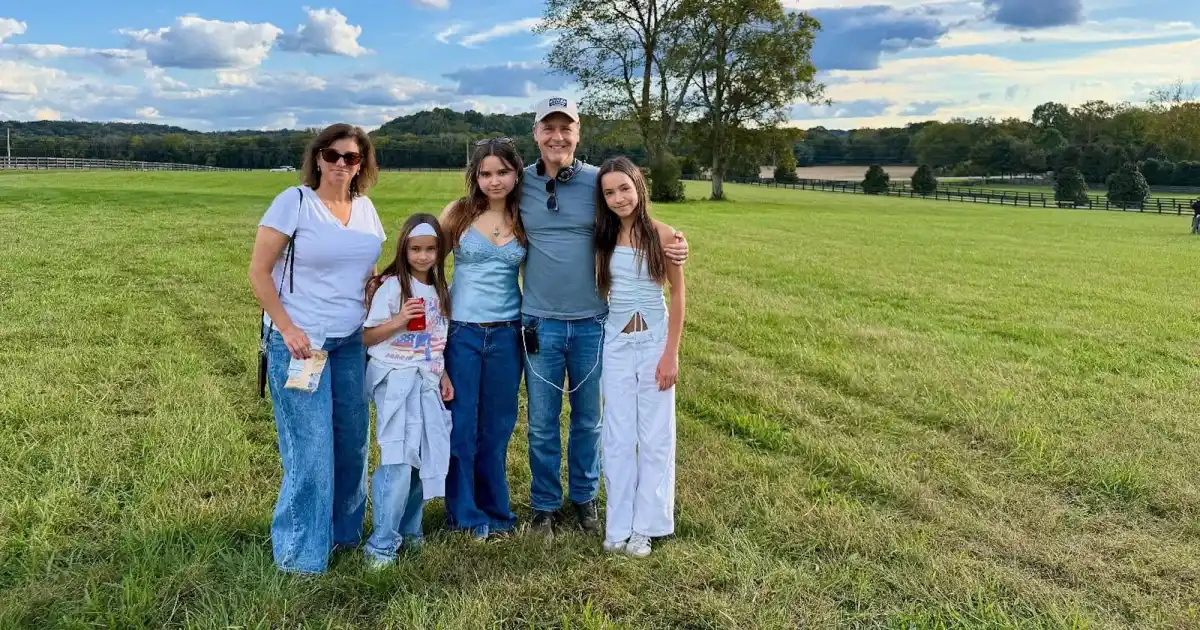
On Saturday, October 10, under the soft California sun, the Lowe family gathered for a wedding that was both a celebration and a lifeline. Chad Lowe and his wife, Kim Painter, were among the guests at Matthew Lowe’s marriage to Emily Markus in Santa Barbara, according to photos obtained by Page Six. The couple was not alone: they brought their daughters Mabel, 17, and Nixie, 10, to witness their cousin’s vows. Matthew, 33, is the eldest son of Chad’s brother, Rob Lowe, and Rob’s wife, Sheryl Berkoff. Rob, 62, and Berkoff, 65, were there too, along with their younger son, John Owen, 30. It was a full family occasion, the kind that photographers love and relatives treasure. But in the weeks leading up to that date, the family had been shattered by tragedy. Fiona, Chad and Kim’s 13-year-old daughter, had died by suicide. The wedding became the backdrop for a quiet public appearance by a family trying to find its footing after an unimaginable loss. Attending a wedding after losing a child is not simply a choice; it is an act of enormous emotional strength. It means brushing off the heaviness of sorrow, putting on formal clothes, and standing in a room full of people while carrying a grief that no one can really see. And yet that is exactly what Chad and Kim did, with their surviving daughters beside them. It was not a return to normal life, but it was a step toward the world, a way of saying that they were still present for the people who needed them.
Weddings have a way of reflecting the passage of time and the resilience of family bonds. For the Lowes, the day carried a sharp, bittersweet edge. Matthew and Emily’s love story was being celebrated, but Fiona’s absence was felt in every moment that families normally share: the hugs, the toasts, the quiet conversations between cousins. There must have been a strange heaviness in the air, the knowledge that joy and grief can occupy the same space. For Chad and Kim, however, the happy occasion must have felt almost surreal. They had not come to the wedding to discuss their loss, and no one expected them to smile through every moment. But their presence mattered. It said to Matthew and Emily that the family’s love for them was intact. It also said to Mabel and Nixie that even when life is painful, you can still show up for the people you love. The ceremony in Santa Barbara was no doubt beautiful, but the most powerful image is likely that of a family refusing to let grief isolate them. For the two girls, seeing their parents stand tall despite heartbreak may become a lesson in resilience. And for Chad, being surrounded by his brother and extended family may have offered a fleeting sense of comfort, a reminder that he was not alone in missing Fiona. The wedding may also have offered a kind of permission to feel joy without guilt, because honoring the living is one of the ways we honor the dead.
Just over a week before the wedding, on September 29, Chad and Kim had shared their devastating news with the public. Their joint statement began, “We are deeply heartbroken by the loss of our beloved Fiona.” They described her as “a loving young girl who was smart, creative and loved to dance.” They wrote that she was “adored by her sisters” and “deeply loved by her parents,” and they called her “the light of our lives.” The statement ended with a request for prayers and privacy, and it included a crucial, selfless addition: a reminder for anyone struggling with mental health to call or text the 988 Suicide & Crisis Lifeline. That final detail reveals a family that, even in its darkest moment, was thinking of others. They knew that their own loss could not be undone, but they could perhaps help someone else avoid a similar tragedy. This is not easy language for public consumption; suicide is hard to talk about, and many people still struggle to find the right words. Yet Chad and Kim chose honesty and directness. They did not hide behind euphemisms. They said their daughter died by suicide, and they used the moment to point toward resources. That takes courage and compassion in equal measure. Their statement was not just an announcement; it was an invitation for others to understand that mental health crises are real, that they can strike without warning, and that help is always available.
On October 3, Fiona’s sister Mabel took to Instagram to write her own memorial. She was just 17, but her words carried the weight of someone who had been forced to grow up too soon. “I love you so much, Fiona. I wish your short time here was easier and I hope your mind is at ease now,” Mabel wrote. “I will honor you forever and keep your memory alive. I love you, I hope you knew just how much.” The rawness of that note is difficult to read. It captures the particular anguish of sibling loss: the love, the regret, the unanswered questions, the wish that you could have done something more. Mabel did not have to speak publicly. She could have grieved in private, away from the pressure of social media. But she chose to honor her sister with words, and in doing so she gave a voice to all those who have lost someone to suicide. Her post also shows that grief is not an adult-only experience. Children and teenagers feel it intensely. They may not always have the language to fully express what they are going through, but Mabel did. Her promise to keep Fiona’s memory alive is also a promise to herself: to live in a way that reflects the love she had for her sister, and to carry that love forward into the future. For a young person, such a promise can be both a burden and a source of strength. It means that Fiona will not be forgotten, even as the family slowly learns to live around the empty space she left behind.
Chad’s own response to the tragedy came through his choice of shared content. A few days after Mabel’s tribute, he returned to social media and reposted a clip from the “On Healing” podcast. The episode had first aired in June 2025, but by sharing it now, Chad brought it into a new context—one of loss, confusion, and the search for meaning. In the clip, guest Gerry Hussey said: “You have to just trust because when you see the world through the eyes of the human ego, nothing makes sense. When you ask yourself the deeper, bigger questions and you move beyond human existence and through meditation or something else, you experience the transcendental experience. We are connected to everything that is, it just makes sense and there’s nothing there but peace in love.” Chad did not add a caption. He did not explain why he was sharing it. The silence around the post is perhaps what makes it so powerful. He was not offering a neat answer to the question of why Fiona died. He was simply acknowledging that, from the perspective of ordinary human understanding, none of this makes sense. To move forward, a grieving parent may need to look beyond reason, beyond ego, and into something larger than the self. The clip’s message—that we are all connected, and that peace and love exist at the deepest level—could be a source of comfort to anyone trying to survive a loss they will never fully understand. In a way, Chad used the words of someone else to speak what he might not have been able to say himself. It was a quiet, spiritual gesture, but for those paying attention, it said more than any lengthy statement could.
Taken together, these small, fragile steps—attending a wedding, posting a tribute, sharing a meditation—are not signs that the Lowes are “over” their loss. No parent ever gets over the death of a child. Instead, they are signs of how a family begins to adapt to a life that will never look the same. Grief has no linear progression. It comes in waves. One day may bring a moment of quiet acceptance; the next may bring a flood of tears. What matters is that the family is not retreating from the world. They are continuing to show up for each other, to use their voices, and to connect with something larger than their own pain. Their experience also underscores the devastating reality of youth suicide: it can happen in any family, no matter how loving, supportive, or publicly successful. It is a reminder that mental health struggles are real and that resources exist. If you or someone you know is struggling or in crisis, help is available by calling or texting 988, or by chatting at 988lifeline.org. The Lowes have asked for privacy, and they deserve it. But in their public moments, they have already offered a legacy: that even in the midst of heartbreak, love remains, and that reaching out for help can make a difference. Their presence at Matthew’s wedding was not an act of forgetting. It was an act of enduring, and sometimes, that is the most human thing any of us can do.