






XRP Ledger Moves Closer to ‘Batch’ Upgrade as Validator Support Exceeds 85%
Digital asset platform Uphold says the network is on track for an Oct. 9 activation, provided validator support stays above the required threshold.
Digital asset platform Uphold said in a post on X that more than 85% of validators on the XRP Ledger have signaled support for the Batch amendment, a proposed upgrade designed to make asset delivery and payment more flexible on one of the industry’s oldest blockchain networks. If that support holds above the threshold required by the network, the upgrade could activate on Oct. 9. The announcement has been closely watched by developers and institutional participants alike, because Batch is not just another incremental improvement. It introduces a new way for transactions to be composed, executed, and settled — one that could make the XRP Ledger more useful for tokenized assets, cross-party trades, and complex financial workflows.
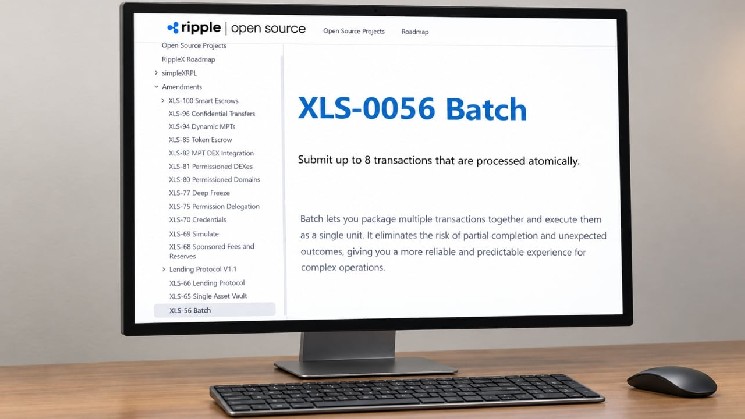
Batch, in essence, allows multiple operations to be grouped into a single submission. That may sound straightforward on the surface, but the implications are significant. Rather than requiring a buyer and seller to complete separate steps and trust that the other side will eventually follow through, Batch makes it possible to combine both sides of an exchange into one coordinated instruction. Uphold’s update suggests the proposal has now cleared a meaningful validator majority, a signal that the network’s participants are ready for a more advanced transaction model. The next few days will determine whether that momentum translates into a successful activation, but the early indicator is clearly positive.
All-or-Nothing Execution Turns Asset Delivery Into a Single Conditional Trade
The most talked-about feature in the Batch amendment is its all-or-nothing execution mode. In this mode, a buyer exchanging payment for a digital asset can make both transfers conditional on the success of the entire batch. If either step fails — whether because of an insufficient balance, an authorization issue, or a network processing problem — neither transfer takes effect. The result is a form of atomic settlement, where both sides of the trade are completed together or not at all. This eliminates a major pain point in peer-to-peer digital asset transactions: the need for one party to complete their side of the deal before the other, and the trust gap that comes with it.
The specification also permits operations that involve one account or multiple accounts. That means the feature is not limited to a simple two-party trade. It can be used to coordinate more complex exchanges, such as a settlement involving several accounts that must all move in sync. Participants in a multi-account exchange are required to authorize the entire group, which adds a layer of governance and security. This is particularly useful for institutional use cases, where multiple parties may need to sign off on a transaction before any part of it can be executed. By allowing participants to coordinate an exchange without completing one side independently, Batch opens the door to a broader range of settlement strategies that were previously difficult, or even impossible, to execute on the ledger.
For the broader ecosystem, this is an important step toward making the XRP Ledger a more credible venue for real-world financial activity. The ability to bundle operations into a single conditional transaction is a common pattern in more advanced smart contract platforms, and bringing that pattern to XRPL’s native transaction layer is a significant upgrade in capability. It doesn’t turn the ledger into a general-purpose smart contract platform, but it does give developers a powerful new tool for building more reliable and user-friendly applications. Whether the use case is a simple token swap, a payment with delivery versus payment, or a multi-party settlement, the all-or-nothing model provides a foundation that feels more like traditional finance than typical blockchain transactions.
Transaction Modes and Processing Costs in the New Framework
The Batch amendment does not introduce just one way to handle grouped operations. It defines four execution modes, each designed for a different set of circumstances. The first is the all-or-nothing mode, where the entire batch is treated as a single unit. If any operation fails, all operations fail together. The other three settings offer more granular control. One mode executes only the first successful action, which can be useful in scenarios where a developer wants to attempt multiple fallback options in order. Another mode stops processing at the first failure, providing a strict sequence of operations where progress halts as soon as something goes wrong. The final mode handles each included operation independently, meaning one operation can succeed even if another fails. Each mode carries its own logic and trade-offs, giving developers the flexibility to choose the behavior that best matches the intended user experience.
One important clarification, however, is that bundling does not eliminate processing costs. Even though multiple operations are grouped together, the combined charge includes the underlying fees for each operation, an overhead charge for the batch itself, and applicable signature charges. In other words, users should not expect a dramatic reduction in transaction costs simply because they are submitting a batch instead of individual transactions. In fact, failed attempts can still incur fees. During September’s transaction record, failed attempts still generated XRP fees, and the same principle applies to Batch submissions. Processing charges remain payable even when an all-or-nothing submission’s actions do not take effect. This is an important consideration for developers and users who might assume that a failed atomic transaction would be completely free.
The fee structure also highlights a key point about how decentralized networks consume resources. Every operation that gets submitted to the ledger — whether it succeeds or fails — must be evaluated, validated, and recorded. That process requires computing power and network bandwidth, and the XRP Ledger’s fee mechanism is designed to reflect those costs. The Batch amendment does not change that fundamental reality. What it changes is the way operations can be grouped and coordinated. For developers, understanding the fee model is essential, especially when building applications that rely on multi-step transactions. The overhead charge helps prevent spam and ensures that complex submissions are not given a free ride, but it also means that careful planning is still required to optimize costs.
Separate Security Fix Creates an Oct. 9 Software Deadline
Alongside the Batch feature, the XRP Ledger is also preparing for a separate security-related amendment that is directly tied to the same activation timeline. On Sept. 25, the XRPL released server software version 3.4.1 to address security-sensitive issues. That release introduced fixBatchV1_2, a separate amendment that corrects how grouped actions are checked. While BatchV1_1 focuses on enabling new functionality, fixBatchV1_2 is about making sure that functionality behaves correctly and safely in all edge cases. The distinction matters, because a feature like Batch introduces new ways for operations to interact. If those interactions are not properly validated, there could be risks of unintended behavior, improperly authorized transactions, or other protocol-level issues. The fix is designed to close those gaps before they become problems.
The practical consequence of fixBatchV1_2 is significant. If it activates, servers running older software will become unable to stay synchronized with the network. In XRP Ledger’s consensus ecosystem, that means node operators will need to update to version 3.4.1 or later before the amendment goes live. Otherwise, they risk falling behind the rest of the network and losing their ability to participate in consensus or serve accurate data to their users. This is a hard deadline in practice, even if the network does not forcibly shut down old software. The projected activation date for the security amendment is Oct. 9 at approximately 10:12 a.m. EDT, followed by the BatchV1_1 amendment around 10:46 a.m. EDT, provided each retains the required validator majority. That gives node operators a clear window to prepare.
The fact that the security fix is tied to the feature upgrade is a reminder that protocol changes rarely happen in isolation. A new capability often requires a corresponding correction or adjustment to ensure that the network remains consistent and secure. For exchanges, wallet providers, and institutional users, staying in sync with these changes is not just a technical necessity — it is an operational priority. The period leading up to an amendment activation often sees a flurry of activity as node operators upgrade their software, validators confirm their positions, and applications test their integrations. This time is no different. The release of version 3.4.1 was an important milestone, but the final activation depends on continued validator support. If that support dips before the deadline, the amendment could be postponed, leaving uncertainty for developers who have already begun building around the new functionality.
A Settlement Feature Built for a Tokenizing Ecosystem
The Batch amendment is not arriving in a vacuum. It follows a period of significant growth in XRP Ledger transaction activity and tokenization. Data summarized on Sept. 2 showed average daily transactions rose 21% to 2.4 million during January through July. That steady increase reflects a network that is being used for more than just simple payments. Tokenization, in particular, has become a central theme. Tokenization represents assets — such as funds, bonds, or other financial instruments — as blockchain-based tokens that can be transferred between holders. This model promises faster settlement, greater transparency, and broader access to assets that have traditionally been locked away in slow, paper-based processes. The XRP Ledger’s native features, including its low fees and fast settlement times, make it an attractive venue for that kind of activity.
Ripple, the company most closely associated with XRP, has also pursued infrastructure for issuing and trading tokenized assets. In August, Ripple announced investments in Zilo and Licuido, two companies focused on the infrastructure side of tokenization. These moves signal a long-term strategy that goes beyond payments and into the broader world of tokenized finance. The Batch amendment fits directly into that strategy. By making it easier to coordinate multi-party exchanges and conditional transactions, Batch lowers a critical barrier for tokenized asset trading. Buyers and sellers can complete transactions in a way that mirrors traditional delivery-versus-payment settlement, where the transfer of securities and the transfer of cash happen simultaneously. That kind of assurance is essential for institutional adoption, and it is exactly what the all-or-nothing batch mode is designed to deliver.
The broader market context adds another layer of relevance. As interest in tokenized real-world assets has grown across the blockchain industry, networks that can support complex transaction types are likely to attract more attention from financial institutions. The XRP Ledger’s combination of fast finality, low overhead, and now more sophisticated transaction logic could make it a stronger competitor in this space. But the technology alone is not enough. The network must also demonstrate reliability, security, and a track record of successful upgrades. The Batch amendment, and the accompanying security fix, will be an important test of that reliability. If the activation goes smoothly, it will reinforce confidence in the network’s ability to evolve. If it runs into trouble, it could slow the momentum that has been building around tokenized assets on XRPL.
Two Amendments, One Date: What Happens Next
Looking at the calendar, Oct. 9 is shaping up to be a pivotal day for the XRP Ledger. The security amendment is projected to activate at approximately 10:12 a.m. EDT, and the Batch amendment is expected to follow shortly afterward, around 10:46 a.m. EDT. Both need to retain the required validator majority in order to go live. If that happens, the network will suddenly have a much more powerful set of tools for composing transactions. Developers will be able to build applications that use conditional, multi-step settlement logic without relying on external contracts or off-ledger coordination. That is a significant upgrade in native capability.
For the XRP Ledger community, the upcoming activation represents more than just a technical milestone. It is a signal that the network is continuing to evolve in response to real-world demand. The growth in daily transactions, the push into tokenized assets, and the investments by Ripple all point in the same direction: the ledger is being positioned as a settlement layer for a broader range of financial activity. The Batch amendment is an important piece of that puzzle. It gives the network a more sophisticated transaction primitive, one that can support use cases that were previously awkward or impossible to execute with confidence.
The next few hours before the deadline will matter. Validator support can change, and the network’s governance model requires more than just early enthusiasm. It requires sustained agreement among those who operate the infrastructure. For now, the signs are encouraging. Uphold’s announcement that more than 85% of validators have backed the Batch upgrade is a strong indication that the network is ready to move forward. If that support holds, Oct. 9 could mark the beginning of a new phase for the XRP Ledger — one in which asset delivery and payment are no longer separate events, but two sides of the same conditional trade. For the broader digital asset market, that is a development worth watching closely.