



Crypto Races Past AI Stocks as Bitcoin and Ethereum Draw Institutional Money
For much of the recent market cycle, artificial intelligence was the undisputed king of Wall Street. Technology stocks absorbed enormous amounts of investor capital as the promise of AI-driven productivity and profit growth fueled one of the most concentrated rallies in modern market history. Nvidia became the bellwether, and the broader equity market increasingly followed its every move. But a fascinating shift has taken place over the last 50 trading days, and it is one that has caught the attention of professional investors, asset managers and retail traders alike. According to the latest performance comparison, Bitcoin has surged 31.60% over that stretch, while Ethereum has jumped an eye-catching 53.50%. During the same period, the S&P 500 has managed a much more modest gain of just 2.26%, and the Nasdaq, heavily weighted toward Big Tech and AI names, has barely moved, rising only 0.22%. Even traditional safe-haven assets and precious metals have outpaced the broader equity market, with gold up 14.31% and silver up 19.26%. The numbers underscore a clear narrative: momentum has decisively rotated away from AI stocks and toward digital assets.
What makes this shift all the more striking is that it is not happening in a vacuum. For years, crypto was viewed by many institutional investors as a speculative sideshow, while AI was treated as the foundational bet of the next technological era. But the latest data suggests that the tables have turned, at least for now. The question is not simply whether crypto is outperforming AI stocks, but why, and whether this rotation marks a fundamental change in investor psychology or just a temporary repricing of risk and reward. As is often the case in financial markets, the underlying drivers are more nuanced than the headline numbers suggest. Crypto’s recent run has been powered by stronger ETF demand, better liquidity and a wave of institutional adoption that has begun to reshape the asset class. At the same time, AI stocks are facing mounting pressure from higher Treasury yields, valuation concerns and the market’s growing sensitivity to any sign that the AI investment cycle might be slowing. The combination has created a perfect backdrop for digital assets to seize the momentum, and so far they have done so in dramatic fashion.
Why Crypto Is Suddenly Outperforming AI Stocks
One of the most compelling explanations for crypto’s sudden leadership is that digital assets have attracted a fresh wave of liquidity and institutional interest at precisely the moment when stock market momentum has started to stall. This is not just a story about retail traders jumping on the latest trend. The evidence points to meaningful participation from institutional investors using regulated financial products. Between Monday and Thursday of the week spanning August 17–21, US spot Bitcoin ETFs pulled in approximately $1.6 billion, according to recent data, marking the strongest weekly inflow of 2026 so far. Thursday alone accounted for around $606 million of that total. Ethereum is experiencing a similarly notable trend, with spot Ether ETFs recording approximately $221 million in inflows on August 20 alone, their fourth consecutive day of positive flows. These numbers are significant because they signal that the rally is being built on something more durable than speculative enthusiasm. Institutional money flowing through regulated ETFs carries a different weight than retail buying on unregulated exchanges, and it suggests that the investor base for crypto is broadening even as equity investors grow more cautious.
The contrast with AI stocks is hard to ignore. For much of the past year, technology stocks were the default destination for investors looking to participate in the AI boom. But the latest market action indicates that the narrative has become more complicated. Higher Treasury yields have put persistent pressure on long-duration tech stocks, which are valued on the assumption that future earnings will materialize years down the road. When bond yields rise, those future earnings get discounted at a higher rate, making growth stocks less attractive. That dynamic has been a headwind for the S&P 500 and the Nasdaq, even as crypto has benefited from its own set of catalysts, including greater liquidity, expanding regulatory clarity and the growing perception that digital assets are becoming a mainstream investment category. The fact that Bitcoin and Ethereum are both outperforming while equity indices are treading water points to a market environment where crypto is no longer dependent on the broader risk-on sentiment that historically drove its rallies.
Is Capital Moving From AI Stocks Into Crypto? Not So Fast
The gap in performance makes it tempting to conclude that investors are selling their AI stocks and plowing the proceeds into Bitcoin and Ethereum. But market reality is rarely that simple. The performance gap tells us that crypto is beating stocks, but it does not tell us where the money is coming from. An investor can hold Nvidia, an S&P 500 ETF, Bitcoin and Ethereum all at the same time, and many institutional portfolios now do exactly that. The divergence we are seeing might be powered by multiple factors working simultaneously, rather than a straightforward rotation out of one asset class and into another. Crypto’s recent strength has been driven by stronger ETF demand, better liquidity and improving sentiment around digital assets. On the other hand, as reported by Reuters, the S&P 500 and Nasdaq were heading for weekly losses, and higher Treasury yields kept putting pressure on tech stocks. These are not necessarily conflicting stories. They can coexist in a market where investors are reallocating some risk exposure while also adjusting for macro shifts in interest rates and growth expectations.
It is also important not to overinterpret the short-term performance numbers. AI stocks have delivered extraordinary returns over the past couple of years, and a brief period of underperformance does not mean investors have suddenly gone cold on the technology. Rather, it suggests that crypto has stronger drivers at the moment. The recent wave of ETF inflows gives digital assets a structural tailwind that did not exist in previous market cycles. Institutional investors who were previously hesitant to allocate to crypto now have a regulated, familiar vehicle through which to gain exposure. That shift alone can fuel sustained buying over a matter of weeks or months, even when the broader equity market is struggling. At the same time, AI stocks are facing tough comparisons, scrutiny over profit margins and a growing debate about when the enormous capital spending on AI infrastructure will translate into visible earnings growth. None of this means the AI trade is broken, but it does mean the market is increasingly looking for evidence that can justify the lofty valuations.
Momentum: Crypto’s Biggest Edge — and Its Greatest Risk
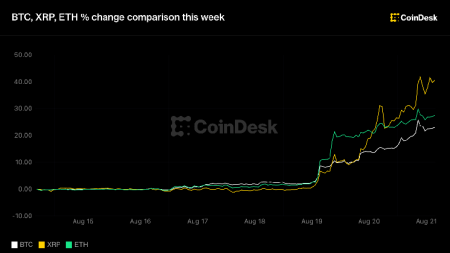
Right now, the biggest difference between the two markets is momentum, and crypto leads in that regard by a significant margin. Bitcoin is approaching the $80,000 level after rising roughly 30% from its recent low near $60,000. Perhaps more notably, the leading cryptocurrency is close to posting its strongest weekly performance in more than two years, with the price up around 22% during the week. Ethereum has been even more explosive, and crypto’s total market capitalization has increased sharply, indicating that the rally is not limited to a single token. This kind of broad-based strength is a sign of healthy demand, but it also carries a cautionary note. When an asset goes from lagging badly to leading strongly in a very short period, momentum itself can become a risk. Short sellers who have positioned against the market may be forced to cover their positions, driving prices higher in a cascade of buying. Traders may rush to ride the uptrend, adding fuel to the fire. Such dynamics can intensify gains, but they can also make any pullback much harsher. The same momentum that pushes prices to new highs can reverse violently when the tide turns, leaving latecomers exposed to sudden and painful losses.
That is why the strongest bullish signal for crypto would be continued ETF inflows, accompanied by better liquidity and broader participation across digital assets beyond Bitcoin. If the rally is being driven by durable institutional demand rather than short-term speculation, it will show up in the flow data. If, on the other hand, ETF inflows begin to slow or reverse, the market’s sudden shift in sentiment could be just as sharp as the move higher. There is also the question of how sustainable the current pace is. A 50-day gain of more than 50% for Ethereum and over 30% for Bitcoin is exceptional by nearly any standard. History suggests that outsized moves are often followed by consolidation, and investors should be prepared for volatility regardless of the long-term outlook. The key is to watch the underlying indicators that reveal whether this is a speculative spike or the beginning of a more mature structural rally.
What It Would Take for Crypto to Keep Leading
The most important factor for sustaining crypto’s leadership will be the continuation of institutional flows through regulated investment vehicles. The recent performance of spot Bitcoin ETFs and spot Ether ETFs shows that demand is not just coming from individual traders looking for quick gains. It is coming from financial institutions, family offices and even pension funds that are increasingly comfortable adding digital assets to their portfolios. That shift represents a profound change in the way crypto is viewed by mainstream finance. Just a few years ago, Bitcoin and Ethereum were largely dismissed as too volatile and too risky for institutional portfolios. Today, they are being embraced as alternative assets with distinct drivers and portfolio benefits. If that trend continues, it could provide a sustained foundation for higher prices, even as the broader equity market wrestles with inflation, interest rates and the uncertain pace of the AI investment cycle.
But momentum alone is not enough. For crypto to maintain its lead, it will need to show that the rally has breadth. Bitcoin’s dominance has been a feature of the current market cycle, but Ethereum’s strong performance is a positive signal because it suggests that investors are willing to look beyond the original cryptocurrency. A healthy market is one in which multiple assets are participating, and the recent action in Ether ETFs is a promising sign in that regard. At the same time, the digital asset market will need to withstand potential headwinds from regulatory developments and shifts in global liquidity conditions. If the flow of capital into ETFs stalls, or if another wave of uncertainty hits the crypto market, the momentum advantage could evaporate quickly. In that scenario, AI stocks, which are far from being written off, could easily reclaim the spotlight.
Nvidia’s Earnings Test and the Future of the AI Trade
Despite crypto’s recent dominance, the AI market should not be dismissed. The fundamental thesis behind the AI trade remains intact: companies are spending heavily on infrastructure, and that spending is likely to continue even if the pace of adoption is uneven. The key question is whether the earnings payoff will arrive quickly enough to justify the valuation multiples that AI stocks currently command. That is why Nvidia’s upcoming earnings report, scheduled for August 26, is being watched so closely. It represents a crucial test for whether the AI investment cycle can regain its momentum and restore confidence in the broader technology sector. A strong earnings report could quickly pull capital back toward tech stocks and shift the narrative once again. A disappointing result, on the other hand, could reinforce the view that AI valuations have run ahead of fundamentals and give crypto an even bigger opening.
In the end, the competition between AI stocks and crypto is not a zero-sum game. Both asset classes are responding to deep structural trends: one is betting on the future of computing and technology, while the other is betting on the future of digital finance and decentralized value exchange. The recent performance data suggests that crypto has the upper hand right now, thanks to stronger ETF demand, better liquidity and a powerful wave of momentum. But markets are cyclical, and leadership changes are a normal part of the investment landscape. The smartest approach for any investor is to remain nimble, watch the flow data and understand that today’s winners are not guaranteed to be tomorrow’s leaders. If the past few years have taught us anything, it is that the market can turn faster than almost anyone expects.