






Geopolitical Shockwaves Trigger Global Market Sell-Off: Crypto Tumbles and Dollar Rises as Middle East Tensions Reignite
The Escalation of Undersea and Aerial Warfare Spurs a Sudden Global Shift Toward Safe-Haven Assets
The delicate illusion of geopolitical stability shattered on Wednesday as fresh military escalations in the Middle East triggered a swift, synchronized retreat from risk assets worldwide. Financial and cryptocurrency markets coiled in defensive posture following reports that the United States Central Command (CENTCOM) launched pre-emptive airstrikes targeting more than 60 Islamic Revolutionary Guard Corps (IRGC) fast-attack craft. According to official military spokespeople, the strikes were executed to neutralize an imminent threat to international shipping lanes in the Persian Gulf. The regional theater rapidly deteriorated when Iran retaliated with targeted strikes on installations in Kuwait and Bahrain. As the sound of explosions echoed across the Gulf, the diplomatic fallout reverberated in Brussels. Addressing NATO leaders, U.S. President Donald Trump delivered a blunt assessment of the situation, declaring that the previously negotiated ceasefire was officially “over” and stating that further negotiations with Tehran represented a “waste of time.” Although diplomatic backchannels reportedly remain active behind closed doors, the aggressive public rhetoric immediately extinguished investor optimism, sending shockwaves through Wall Street and digital asset exchanges alike.
With institutional confidence fragile, a classic “risk-off” domino effect coursed through global brokerage systems. The U.S. Dollar Index (DXY), the traditional barometer of global economic anxiety, moved sharply upward as market participants scrambled to secure liquidity in the world’s reserve currency. This surge in the dollar reflects deeper, systemic anxieties that a wider, prolonged regional war in the Middle East will disrupt critical energy transit corridors, choke supply chains, and reignite global inflationary pressures that central banks have spent years trying to tame. Equity markets offered no shelter from the storm. In New York, the technology-dense Nasdaq 100 index futures fell alongside the broader S&P 500 index futures, with both benchmarks sliding as much as 1.5% during early trading hours. The suddenness of the military escalation caught algorithmic trading models off guard, leading to a rapid, coordinated repricing of risk that penalized high-beta growth stocks and speculative assets in unison.
Digital Assets Face Steep Corrections as the CoinDesk 20 Index Plunges Amid Widespread Liquidations
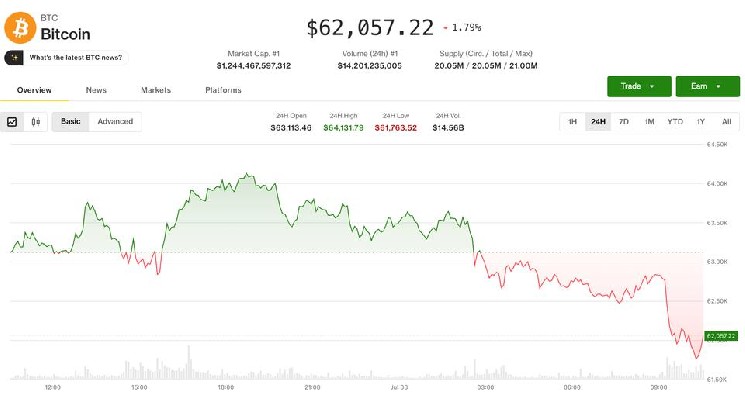
For the cryptocurrency sector, which has increasingly behaved as a highly sensitive seismograph for macroeconomic and geopolitical stress, the military escalation ignited an immediate sell-off. The CoinDesk 20 Index, a curated benchmark tracking the most liquid digital assets, registered a sharp 2.9% drop since midnight UTC, with the pain distributed uniformly as all but one token in the index slid into the red. Bitcoin ($BTC), the undisputed leader of the asset class, was dragged down from its recent constructive levels, slipping over 2% to trade at approximately $62,097. Ether ($ETH) followed an identical trajectory, shedding more than 2% of its value as sellers dominated the spot order books. The downside volatility was far more pronounced across the highly illiquid altcoin landscape, where a lack of deep market-maker buffers exacerbated price slippage. High-profile decentralized finance (DeFi) and ecosystem tokens bore the brunt of the panic, with Jupiter (JUP), Ether.fi (ETHFI), and the meme-token Pump (PUMP) all recording rapid double-digit declines, crashing more than 5% within hours of the initial news alerts.
MARKET REACTION AT A GLANCE:
Asset Class / Indicator | Movement / Level
CoinDesk 20 Index | ▼ 2.9%
Bitcoin ($BTC) | ▼ 2.0% ($62,097.77)
Ether ($ETH) | ▼ 2.0%+
Nasdaq 100 Futures | ▼ 1.5%
S&P 500 Futures | ▼ 1.5%
U.S. Dollar Index (DXY) | ▲ Rising (Inflationary pressure)
Solana ($SOL) | ▼ Retraced to $77 (from $84)
According to data compiled by blockchain analytics platform CoinGlass, the leverage-fueled architecture of the crypto market once again amplified the underlying spot market correction. The cascading decline triggered a punishing wave of forced liquidations, totaling more than $450 million across all digital asset derivative products. Strikingly, the fragile altcoin sector accounted for $350 million of these liquidations, highlighting the extreme vulnerability of retail traders holding leveraged long positions in secondary tokens during a geopolitical shock. Solana ($SOL), one of the top performers of the summer, suffered a painful technical setback; its latest correction completely retraced a promising multi-week bull run that had commenced on July 2. After aggressively challenging the $84 resistance level on Monday, SOL’s price succumbed to intense selling pressure, retreating back to key support at $77.
Derivatives Data Reveals Contrasting Trader Behavior as Bitcoin Holds Key Monthly Support
Despite the intensity of the intraday drop, an analytical autopsy of the bitcoin derivatives market suggests that the underlying structural bullish trend of the prime cryptocurrency is not entirely broken. While Bitcoin dipped toward the $62,000 threshold, it remains net positive for the month, clinging to a respectable 6% gain over a 30-day window. Crucially, the latest marketplace data indicates that sophisticated derivatives traders are refraining from aggressively shorting this geopolitical retracement. Open interest (OI) in Bitcoin futures contracts actually contracted over the last 24 hours, dropping from over 740,000 BTC to approximately 730,000 BTC. In derivatives market theory, a decline in open interest alongside a dropping spot price suggests that long positions are willingly unwinding and taking profit or cutting losses, rather than fresh, aggressive short-sellers stepping in to drive the price lower. This structural nuance provides some solace to spot holders, suggesting that institutional players view this dip as a temporary, externally driven shock rather than the start of a fundamental, long-term bearish trend.
DERIVATIVES LANDSCAPE (24-HOUR CHANGE):
Bitcoin Futures Open Interest: ▼ 740K BTC to 730K BTC
Ether Futures Open Interest: Stable at 13.95M ETH
Bitcoin 24-Hr Liquidations: ~$100 million
Ether 24-Hr Liquidations: ~$90 million
Total Market Liquidations: ~$450 million ($350M Altcoins)
The story for Ether, however, is much more concerning. Unlike Bitcoin’s orderly deleveraging, open interest in Ether futures remained stubbornly unchanged, hovering near 13.95 million tokens despite the collapsing spot price. This decoupling of price and open interest indicates that speculative longs are refusing to fold their positions, even as the spot decline triggered the mechanical liquidation of leveraged bets worth over $90 million (compared to Bitcoin’s $100 million in 24-hour liquidations). In other areas of the market, the situation is even more precarious. The sell-off in the Canton Network’s native CC token pace accelerated significantly, with its price plunging to its lowest valuation since January. This price drop coincided with CC futures open interest climbing to a two-week high, while its funding rate plunged to a deeply negative -20%. This rare combination of rising open interest, falling prices, and negative funding rates points to a concerted effort by market participants to short the asset, signaling deep distress for the network’s short-term outlook.
Sophisticated Hedging Strategies Intensify as Options Skew Heavily Toward Downside Protection
A broader, more holistic view of the major cryptocurrencies indicates that the bears have successfully tightened their grip on short-term price action. This shift is clearly demonstrated by the negative 24-hour open-interest-adjusted Cumulative Volume Delta (CVD) across both Bitcoin and Ether. In financial market micro-structure, a negative CVD reading indicates that price depreciation is being actively driven by aggressive market sell orders rather than passive, resting limit orders. In essence, traders are hitting the “sell” button with urgency, willing to accept prevailing market prices to exit their exposure immediately rather than waiting for bids to be filled. This urgency has translated into a scramble for portfolio insurance in the options markets.
OPTIONS MARKET INDICATORS:
BVIV (Bitcoin Implied Volatility): ▲ Up 2 consecutive days
EVIV (Ether Implied Volatility): ▲ Up 2 consecutive days
Deribit 1-Week Put Skew (BTC): ▲ 20% (up from 16%)
To shield their portfolios from further geopolitical volatility, institutional desks have aggressively turned to hedging instruments. The 30-day implied volatility indexes for the two majors—the Bitcoin Volatility Index (BVIV) and the Ether Volatility Index (EVIV)—rose for a second consecutive day, reflecting a steep rise in the cost of option premiums. This demand for downside protection is further corroborated by the options skew on Deribit, the world’s largest crypto options exchange. The one-week options skew jumped to nearly 20% in favor of puts, up from 16% just 24 hours prior. Because put options grant the holder the right to sell an asset at a predetermined price, this aggressive skew expansion indicates that institutional desks are paying premium prices to establish floors for their portfolios. Interestingly, despite this immediate fear-driven hedging behavior, long-term optimism has not vanished entirely; the single highest pocket of 24-hour trading volume on Deribit was recorded in Bitcoin call options with an optimistic strike price of $80,000, suggesting that some deep-pocketed players still anticipate a powerful year-end recovery.
GEOPOLITICAL SENTIMENT TRANSMISSION[ Middle East Military Escalation ] —> [ DXY Safe-Haven Inflow ]
| |
v v
[ Commodity/Inflation Anxieties ] [ Global Equities Liquidation ]
| |
+—————–+——————–+
|
v
[ Crypto Market Retrenchment ]
/ |
/ |
[ $BTC Holds Support ] [ $ETH Long Squeeze ] [ Altcoin Liquidations ]
(OI Drops to 730K BTC) (OI Flat at 13.95M) ($350 Million Flushed)
Isolated Pockets of Resilience and Technical Indicators Offer Hope for an Altcoin Rebound
While the dominant narrative across trading desks remains one of caution and defensive repositioning, a few pockets of the decentralized digital economy are showing notable resilience. Standing out in opposition to the prevailing bearish sentiment is Morpho (MORPHO), a decentralized lending protocol token. Morpho’s native utility asset defied the market gravity, printing a 4% gain since the midnight UTC bell. This contrarian price movement is backed by solid fundamentals; according to decentralized finance database DefiLlama, the total value locked (TVL) within the Morpho protocol scaled a fresh historic milestone this week, exceeding 4 million ETH. This substantial accumulation of capital suggests that yield-seeking investors are increasingly viewing Morpho’s risk-mitigated, collateralized lending vaults as a safe harbor to generate native yields while waiting out the storm in spot markets.
Beyond individual token success stories, quantitative indicators suggest that the worst of this synchronized sell-off may soon run its course. The violent flush-out of leveraged accounts has pushed several major altcoins back into technically “oversold” territory. The market-wide average 14-day Relative Strength Index (RSI), a widely monitored momentum oscillator that measures the speed and change of price movements, dropped sharply to 40/100, down from a neutral 47/100 recorded on Tuesday. Historically, when the broad market RSI approaches or dips below the 30 thresholds, it signals that selling pressure has become overextended and that a local bottom is forming. For patient, cash-rich spot buyers, this geopolitical pullback may soon present a highly attractive entry point, as the underlying structural drivers of digital asset adoption remain unchanged despite the temporary noise of global conflict.
Navigating the Crosscurrents: What Lies Ahead for Digital Assets as Geopolitics Intersects with Monetary Policy
As the dust settles on Wednesday’s turbulent trading session, the global financial community finds itself at a historical crossroads where geopolitical volatility, currency debasement fears, and technological innovation directly intersect. The immediate reaction of the markets—characterized by a rising dollar, falling equities, and a sharp liquidation of leveraged crypto positions—demonstrates that high-beta assets remain vulnerable to sudden shifts in global stability. However, the resilient underlying structure of the Bitcoin derivatives market, characterized by an orderly reduction of futures open interest and sustained interest in long-term $80,000 call options, suggests that institutional capital increasingly views these corrections as structural buying opportunities rather than systemic failures. Unlike previous market cycles where a geopolitical crisis triggered a prolonged crypto winter, the current ecosystem benefits from deep institutional integration, regulated exchange-traded funds (ETFs), and a growing recognition of Bitcoin’s dual role as both a risk asset and an emerging alternative store of value.
Looking forward, the trajectory of the digital asset market will likely be determined by how quickly the situation in the Persian Gulf stabilizes and how central banks react to the looming threat of energy-driven inflation. Should the conflict intensify, further disrupting global trade, the Federal Reserve and its global counterparts may find themselves in the difficult position of managing sticky inflation while supporting softening labor markets—an economic backdrop that has historically highlighted the long-term value proposition of decentralized, programmatic assets like Bitcoin. For traders and investors alike, the coming weeks will require a disciplined approach to risk management, with a keen focus on options skews, funding rates, and key support levels. While the immediate outlook remains clouded by the fog of war, the underlying tokenomics, improving RSI technical indicators, and isolated pockets of strength like Morpho suggest that the digital asset market possesses the structural resilience necessary to weather this storm and emerge stronger on the other side.