






The Onchain Revolution: Why Tokenization Is Following the AI Boom’s Historic Playbook
A Milestone Day for Tokenization
Tokenization has officially moved from the outer margins of the cryptocurrency conversation to the center of mainstream financial-market development — and one of the most closely followed investment chiefs in the digital-asset space believes the real opportunity is only just beginning to take shape. Matt Hougan, chief investment officer at Bitwise Asset Management, made waves on September 17 with a blunt assessment of the sector’s trajectory: the global financial system is moving onchain, and tokenization is not a fleeting market theme but a multi-year structural transformation whose implications will extend far beyond crypto’s traditional borders. His remarks landed on a day that underscored the point in spectacular fashion. The U.S. Securities and Exchange Commission opened a formal regulatory pathway for tokenized stocks to trade on blockchain-based infrastructure within the United States, handing the industry a compliance framework it has never had at the federal level. On the same day, S&P Global — one of the most established names in financial data, indices, and credit ratings — announced it had agreed to acquire OpenZeppelin, the company whose smart-contract technology underpins many of the most significant stablecoins, tokenized funds, and decentralized finance applications currently in operation. Meanwhile, DeFi tokens began ripping across global trading desks as investors digested the implications of both events. For Hougan, the convergence sent a signal that was impossible to miss. “Tokenization is a mega trend,” he wrote to his followers, directly addressing skeptics who had questioned the industry’s staying power. “The world is moving onchain.” The three developments unfolding within a matter of hours were not disconnected headlines; they were interlocking evidence that the financial industry’s long-anticipated digital transformation is finally shaking off its theoretical phase and entering the era of practical implementation. For the legions of investors and institutions observing the sector from the sidelines, the message was unmistakable: the moment they have been waiting for has arrived.
NVIDIA’s Trajectory Maps the Tokenization Journey
Hougan’s conviction rests on a comparison that has resonated deeply with investors who lived through the early days of the artificial-intelligence boom. Drawing on the trajectory of NVIDIA, the semiconductor giant that became the defining outsized beneficiary of the AI era, he argues that timing is everything — and that being early does not mean arriving too late. When OpenAI launched ChatGPT in November 2022, NVIDIA’s share price sat near $16. About a year later, as the market began to grasp the full scale of AI-driven demand, NVIDIA had climbed to roughly $46, a 176 percent surge that turned heads and attracted billions in fresh inflows. Today, the stock trades in the neighborhood of $219, and the AI infrastructure buildout continues to power valuations that would have seemed unthinkable at the start of the cycle. Hougan’s point is not that tokenization will follow this same price curve as a semiconductor bellwether. The deeper lesson is that the moment investors begin to recognize a major technological shift is rarely the moment the opportunity evaporates. In practice, it often marks the starting gun for a prolonged adoption cycle. AI infrastructure took years to fully embed itself in the global economy after mainstream recognition; blockchain infrastructure, and the tokenization of financial assets that runs atop it, appears to be sitting at a comparable inflection point. To Hougan, the market’s dawning acknowledgment of what is underway is precisely the phase that produces durable winners — and the events of a single September day gave him concrete evidence: regulators, enterprises, and markets moving in coordination, almost as if a switch had been flipped. The takeaway for investors, he stressed, is that technology megatrends reward patience. Identifying an early-stage trend is a rare and valuable skill; knowing how to stay positioned through the often volatile process of mainstream adoption is what separates those who merely observe from those who truly participate. Tokenization, in this reading, is not a trade to be timed but a structural shift to be understood, supported, and given the space to develop.
SEC Opens a Regulated Path for Tokenized Equities
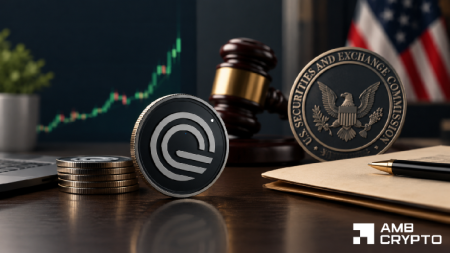
That conviction was given its most concrete expression in Washington the same day. The SEC’s action on tokenized equities is the kind of milestone that silently changes the legal terrain for an entire industry. Announced under the agency’s temporary exemption authority, the new framework permits certain designated venues to trade tokenized versions of national market system (NMS) stocks in the United States — with a crucial safeguard: these tokenized securities must carry the full shareholder rights that investors would receive when holding traditional equity. This includes dividends, voting power, and the other legal privileges embedded in conventional stock ownership. What the SEC did not do is equally important. The exemption explicitly excludes synthetic products that merely track or mimic the price movements of a stock; those instruments remain outside the safe harbor and now sit subject to the full weight of federal securities law. Issuers of publicly traded securities also receive additional protections under the framework. If a company does not want its stock tokenized by a third-party venue, it retains a 30-day window to formally object, ensuring that corporate control over one’s own equity is preserved in the tokenized era. The temporary exemption runs for a maximum of five years and comes with clearly defined boundaries around participating venues, the scope of eligible securities, and trading volumes. SEC officials described the initiative as an effort to let innovation flourish while the Commission continues its broader policy deliberation. For the tokenization industry, the effect is immediate, remarkable, and concrete: a legitimate, compliant pathway into one of the world’s deepest capital markets is no longer hypothetical. It is here. Asset managers and market infrastructure providers that had been waiting for regulatory guardrails before committing serious capital now have precisely what they asked for — and the coming quarters are likely to see a wave of applications, partnerships, and product launches designed to leverage the new framework. The SEC may extend, refine, or ultimately make the exemption permanent in future rulemaking, but the direction of travel is unmistakable: tokenization has entered the world of regulated finance.
S&P Global’s OpenZeppelin Deal Signals Institutional Commitment
If the SEC supplied the regulatory scaffolding, S&P Global’s acquisition of OpenZeppelin provided the institutional validation. The deal, announced the same day, brings into the orbit of one of America’s oldest financial-data stalwarts a company whose code has become the default standard for blockchain-based financial contracts. OpenZeppelin’s engineering platform is ubiquitous across the digital-asset industry. Its smart-contract standards support many of the largest stablecoins, tokenized funds, and DeFi protocols currently in operation; the company says its contracts have facilitated more than $37 trillion in transferred value and that it has completed more than 900 security engagements over the course of its history. That scale and trust is precisely what S&P Global is buying. For decades, S&P has built its reputation as the institutional guardian of financial information and risk assessment; bringing OpenZeppelin into its portfolio signals unmistakable intention to lead in the next generation of financial-market infrastructure. The deal also tells observers something significant about where tokenization stands as an industry. The story is no longer the province of crypto-native startups scrapping for market share. General-purpose financial institutions are now building for a world in which blockchain rails, onchain settlement, and smart-contract automation become standard components of the capital market system. That so established a name as S&P Global would make such a foundational acquisition — at a moment of regulatory clarity in the United States — speaks volumes. Incumbents are not merely watching the tokenization story unfold anymore; they are preparing the infrastructure required to serve it for decades. For OpenZeppelin, the acquisition offers an enterprise-scale future with vastly expanded distribution, pairing best-in-class security expertise with the resources of a global institution. For the broader crypto ecosystem, the deal demonstrates how the boundaries between traditional finance and onchain finance are dissolving in practice, if not in name. Industry analysts greeted the announcement as a validation of the open-source security model that has underpinned the growth of decentralized technology, noting that the acquisition places serious institutional muscle behind the continued development of the standards on which the tokenized economy will depend.
DeFi Momentum and the Convergence of Forces
The market’s reaction added its own exclamation point to the narrative. DeFi assets were already demonstrating notable momentum on September 17, with trading desks reporting outsized moves across major decentralized-finance tokens and related onchain asset classes. Hougan’s description of the price action as “ripping” underscored the sense that capital is actively rotating into the ecosystems that will underpin tokenized financial products in the years ahead. But the deeper significance isn’t merely a short-term rally. The simultaneous emergence of a clear regulatory pathway, a storied institutional brand acquiring foundational smart-contract infrastructure, and a vibrant DeFi marketplace is exactly the synchronization of forces that must exist before sustainable mainstream adoption can take hold. For years, tokenization conversations were plagued by uncertainty. Which regulator has jurisdiction? Will established institutions participate? Is the technology battle-tested enough? Do real investors actually want to use these markets? The events of mid-September went a long way toward answering those questions. The SEC provided jurisdictional clarity. S&P Global aligned itself with the ecosystem’s canonical security layer. DeFi’s robust activity demonstrated the presence of real users, real liquidity, and genuine demand for onchain markets. The convergence closes the sector’s proof-of-concept era and marks the start of something far bigger: a construction phase in which the theoretical promise of blockchain-based financial markets becomes standardized, competitive, and scalable across the global economy. As the infrastructure matures, the relationship between traditional finance and DeFi appears increasingly complementary rather than adversarial. Traditional institutions bring trust, distribution, and familiarity; decentralized platforms bring transparency, efficiency, and composability. That combination is what the tokenization movement has been searching for since the first security token emerged years ago — and the market is beginning to see what it looks like in practice. Each development amplified the others: the SEC pathway gave DeFi builders a regulated endpoint for their products, the S&P acquisition gave regulators an enterprise-grade partner to engage with, and the market’s enthusiastic response signaled to both that demand is real. What emerges is a self-reinforcing cycle of adoption that analysts expect to accelerate as institutional-grade projects begin to launch under the new regulatory regime.
The Long Financial Transition Begins
Hougan’s framing provides the most natural conclusion to the day’s events. “The world is moving onchain,” he wrote, and in context, the assertion reads less like a slogan and more like a description of reality in formation. Tokenization is becoming the single most important bridge connecting blockchain technology to the core infrastructure of conventional finance — not by replacing exchanges overnight, but by reshaping how capital flows, how ownership is recorded, and how assets settle. Among the most significant takeaways from September 17 is that regulators and institutions are now acting in a coordinated fashion rather than waiting for one another. In the span of hours, the industry received both a federal regulatory pathway for tokenized equities and the acquisition of the ecosystem’s foundational technology provider by one of the most trusted names in global finance. The route ahead is visible, and it is paved with compliance standards, institutional-grade security, and genuine demand across a wide range of digital assets. For Hougan, the opportunity set extends well beyond those who have already endured crypto’s volatile early phases. The tokenization marketplace is maturing into a professionalized arena in which pension funds, global asset managers, and internationally active banks can participate with confidence. The full impact will take years — perhaps decades — to unfold, but the direction is no longer in doubt. The onchain financial system is being built, brick by brick, and those who can see its trajectory with the same clarity that NVIDIA’s breakthrough brought to the AI era will understand that the journey is only just beginning. As the tokenized economy matures, the technologies Hougan and other advocates have championed — smart contracts, decentralized ledgers, digital ownership records — will be recognized not as speculative novelties but as the core plumbing of the modern financial system. The market may still be early in this story, but as Hougan’s NVIDIA analogy reminds us, early is precisely where the most consequential opportunities are found.