


The Great Institutional Pivot: Why Wall Street’s Bold Move into CME Bitcoin Futures Signals a New Era for Crypto
The Dawn of a Directional Shift: Wall Street Abandons Neutrality for Outright Bullishness
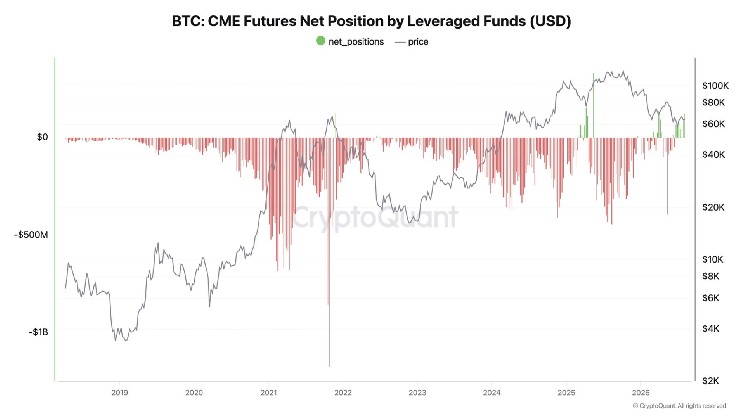
In a historic departure from years of defensive, market-neutral trading, institutional investment firms and hedge funds have aggressively pivoted to a net-long position on Chicago Mercantile Exchange (CME) Bitcoin futures. This unprecedented positioning shift, highlighted by Ki Young Ju, the Chief Executive Officer of the prominent blockchain analytics platform CryptoQuant, indicates that the world’s most sophisticated capital allocators are no longer merely playing the margins of the cryptocurrency market but are actively betting on sustained, explosive upward price momentum. Historically, the institutional presence in the Bitcoin derivatives space has been defined by caution, structured heavily around delta-neutral strategies designed to harvest low-risk yields rather than express outright bullish directional conviction. The sudden reversal of this trend, moving from a multi-year structural short positioning to an aggregate net-long stance, represents a profound psychological and operational transformation among traditional financial institutions, often colloquially referred to on trading floors as “the suits.” For years, these institutional players treated digital assets with a mix of academic curiosity and structural skepticism, preferring to isolate themselves from Bitcoin’s notorious volatility while still extracting profit from its inefficient pricing mechanisms. Today, however, the macroeconomic backdrop, characterized by shifting global monetary policies, persistent fiat currency debasement fears, and the maturing infrastructure of the digital asset class, has forced a dramatic recalculation of risk. This monumental shift in CME positioning suggests that institutional desk managers are dismantling their protective hedges, convinced that the structural tailwinds pushing Bitcoin higher are now too powerful to ignore, and that holding a cash-and-carry position is no longer an efficient allocation of capital when compared to the raw upside potential of the underlying asset.
Demystifying the Basis Trade: The Mechanics Behind Wall Street’s Historical Short Bias
To fully appreciate the gravity of this paradigm shift, one must first understand the mechanics of the “basis trade”—the dominant market-neutral strategy that historically kept hedge fund positioning on the CME net-short for years. In a traditional basis trade, also known as a cash-and-carry trade, an institutional trader exploits the price discrepancy, or “premium,” that typically exists between the spot price of Bitcoin and its corresponding futures contract price on regulated exchanges. Under normal market conditions, futures contracts trade at a premium to the spot market due to the costs associated with carrying the asset over time, a state known as contango. To capture this premium risk-free, a hedge fund would simultaneously purchase physical Bitcoin—or more recently, shares of a spot Bitcoin exchange-traded fund (ETF)—in the spot market while executing an equivalent short position in the CME futures market. As the expiration date of the futures contract approaches, the premium inevitably shrinks to zero, allowing the fund to pocket the difference as a guaranteed, market-neutral profit, regardless of whether Bitcoin’s price plummeted or skyrocketed. Because these sophisticated arbitrage operations required an immense volume of short futures contracts to hedge their spot long positions, the aggregate regulatory reporting data perpetually reflected a massive, structural net-short position for leveraged funds. Consequently, this persistent short bias did not reflect a bearish sentiment toward the asset; rather, it was a testament to the immense profitability of a low-risk, high-yield arbitrage loop that allowed traditional finance players to generate double-digit annualized returns without exposing themselves to the underlying asset’s wild price swings.
The Catalyst of Spot ETFs: How Regulated Vehicles Restructured Market Liquidity
The structural catalyst that ultimately fractured the dominance of the basis trade and paved the way for this net-long transition was the historic regulatory approval and subsequent explosive launch of spot Bitcoin ETFs in early 2024. Prior to the introduction of these spot vehicles, institutional access to Bitcoin was highly fragmented, expensive, and fraught with regulatory, custody, and compliance hurdles, making the CME futures market the primary gateway for traditional capital allocators. However, the debut of exchange-traded funds managed by global financial titans like BlackRock and Fidelity fundamentally altered the plumbing of the crypto market by democratizing access, lowering transaction costs, and creating a highly liquid bridge between legacy banking systems and the blockchain. As billions of dollars in permanent, institutional capital flooded into these spot ETFs, the liquidity pool expanded dramatically, which naturally compressed the spread between spot and futures prices. With the futures premium narrowing significantly, the annualized yield generated by the classic basis trade began to decline, diminishing its appeal to yield-hungry portfolio managers who could no longer justify locking up vast amounts of capital for single-digit returns. Faced with shrinking arbitrage spreads and a rapidly maturing market structure, hedge funds were forced to evolve; they could either wind down their Bitcoin operations entirely or transition their desks toward directional strategies that seek to capture the actual capital appreciation of the digital asset. The current net-long positioning on the CME is clear evidence of this evolutionary step, demonstrating that Wall Street has chosen the latter path, choosing to embrace outright directional exposure as the optimal way to generate alpha in a market that is increasingly viewed as a legitimate, long-term asset class.
Macroeconomic Headwinds and the Search for Asymmetric Upside
This dramatic reallocation of institutional capital does not occur in a vacuum; it is deeply intertwined with a shifting global macroeconomic landscape that has rendered traditional safe-haven assets increasingly unappealing. Across the globe, central banks are grappling with structural dilemmas, navigating the delicate balance between fighting persistent inflationary pressures and preventing systemic economic slowdowns through monetary easing and interest rate cuts. In an era marked by historic levels of sovereign debt, weaponized global reserve currencies, and the steady erosion of the purchasing power of fiat currencies, traditional fixed-income instruments and cash reserves no longer offer the capital preservation or yield that institutional allocators require to meet their long-term obligations. This bleak macroeconomic reality has intensified the institutional search for scarce, non-sovereign, liquid assets that exhibit asymmetric upside potential, positioning Bitcoin as a prime candidate for modern portfolio diversification. Often described as “digital gold” due to its hard cap of 21 million coins and programmatically enforced scarcity, Bitcoin presents a highly attractive alternative to traditional assets that are vulnerable to political intervention and supply dilution. The decision by CME hedge funds to flip net-long suggests that portfolio managers are increasingly viewing Bitcoin not as a speculative, high-beta tech stock, but as an essential macroeconomic hedge that must be held with direct, unhedged exposure to fully benefit from its structural appreciation during times of global monetary expansion.
Order Book Dynamics: The Technical Implications of a Directional Pivot
From a technical and market microstructure perspective, the transition of CME hedge funds from net-short to net-long has profound implications for Bitcoin’s order books, price discovery, and overall volatility profiles. When massive, highly leveraged funds operate in a structural short position, their continuous selling pressure on the futures market acts as a natural dampener on upward price action, creating a ceiling that requires substantial spot buying volume to break through. Conversely, when these dominant players flip to a net-long stance, this structural selling pressure completely evaporates, replaced instead by a compounding layer of buying pressure that can significantly accelerate upward price movements. This shift in positioning creates a highly asymmetric market environment where positive regulatory news, corporate adoption announcements, or favorable macroeconomic data can trigger violent, upward momentum because there are no longer massive institutional short walls absorbing the buying volume. Furthermore, because futures markets inherently utilize leverage, a collective shift toward directional long positioning among institutional traders can create powerful feedback loops, where rising spot prices trigger margin expansions and compounding buy orders in the derivatives market, which in turn drive spot prices even higher. This dynamic fundamentally changes the liquidity profile of the market, reducing the availability of liquid supply and setting the stage for highly explosive price discovery phases that are driven not by retail speculation or retail-oriented FOMO (fear of missing out), but by highly structured, deep-pocketed institutional buy programs.
The Institutional Endgame: Bitcoin’s Integration into the Global Financial Fabric
Looking ahead, the transition of CME futures traders to an aggregate net-long position marks a definitive milestone in the multi-decade journey of Bitcoin from an obscure, cypherpunk experiment to a foundational pillar of the global financial system. This development signals to the broader financial industry—including conservative pension funds, sovereign wealth funds, university endowments, and corporate treasuries—that the world’s most sophisticated and risk-averse risk managers have officially deemed Bitcoin safe for directional investment. As these institutions comfortably navigate the regulated channels of the CME and spot ETFs, the historical stigma surrounding digital assets continues to dissolve, paving the way for a massive, multi-trillion-dollar wave of capital reallocation over the coming decade. Ki Young Ju’s observations serve as a stark warning to market participants who fail to recognize that the structural dynamics of the cryptocurrency market have permanently changed; the days of retail-dominated, highly manipulative, and isolated crypto markets are rapidly giving way to a highly sophisticated, institutionalized ecosystem. By stepping out from behind the safety of market-neutral arbitrage and stepping directly into the directional long arena, Wall Street’s elite have sent an unmistakable signal to the global markets: the “suits” are no longer just passive observers or cautious yield-harvesters—they are now actively betting on a hyper-bullish, high-value future for Bitcoin, forever redefining the boundaries of modern finance.