



A Watershed Moment for Precious Metals: Gold Breaches the Critical 200-Day Moving Average
In a development that has sent shockwaves through global financial markets, gold has officially broken below its 200-day moving average (200DMA), signaling a potential structural regime shift for the world’s oldest safe-haven asset. The 200DMA is widely regarded by institutional portfolio managers, technical analysts, and algorithmic trading desks as the ultimate psychological and mathematical line in the sand—a reliable barometer separating long-term secular bull markets from prolonged bearish downswings. When an asset trades above this moving average, dip-buyers feel secure in the knowledge that the overarching momentum remains structurally supportive; however, a decisive break below it often triggers automated sell programs, margin calls on leveraged long positions, and a broader reassessment of fundamental value.
For the first time since October 2023, spot gold prices have slipped beneath this critical threshold, tumbling below the $4,300 per ounce mark and igniting fears that the multi-month precious metals mania has run its course. This breakdown marks a stark contrast to the relentless upward trajectory that defined the asset class throughout much of the past year, converting what was once an impenetrable technical floor into a formidable ceiling of overhead resistance that will likely cap near-term recovery efforts.
Gold Technical Price Levels (Oct 2023 – Present)
Record High (Jan): $5,600 / oz <– Peak of Debasement Trade
Recent Trading Price: <$4,300 / oz <– Bear Market Territory (-23.2%)
Key Support Level: 200-Day Moving Average (200DMA)
From Soaring Highs to Fiscal Realities: Demystifying the Post-Pandemic Debasement Trade
To understand the magnitude of gold’s current technical capitulation, one must examine the extraordinary macro-economic backdrop that fueled its historic upward trajectory over the preceding eighteen months. Starting in late October 2023, gold embarked on a breathtaking 200% rally, climbing from a baseline of under $2,000 per ounce to an all-time nominal peak of $5,600 per ounce in January of this year. This aggressive capital flight was largely underpinned by the highly popularized “debasement trade”—a collective market conviction that unsustainable government spending, soaring sovereign debt-to-GDP ratios across Western economies, and structurally loose central bank policies would systematically erode the purchasing power of paper currencies.
As global central banks quietly accumulated physical gold reserves at a record-setting pace to diversify away from weaponized dollar-denominated assets, retail and institutional hedge funds followed suit, viewing gold as the premier hedge against monetary degradation. However, as global economic growth proved far more resilient than anticipated and quantitative tightening persisted longer than bearish analysts predicted, the urgent narrative of imminent fiat collapse began to lose its immediate luster, leaving late-stage buyers vulnerable to a severe cyclical correction.
U.S. Monetary Policy & Macro Impact
┌─────────────────────────┐ ┌────────────────────────┐
│ Stronger U.S. Jobs Data ├────>│ Fed Rate Hike Priced │
└─────────────────────────┘ │ in for December │
└───────────┬────────────┘
│
▼
┌─────────────────────────┐ ┌────────────────────────┐
│ Stronger Dollar (DXY) ├────>│ Lower Gold Prices │
│ Back Above 100 │ │ (Bears Take Control) │
└─────────────────────────┘ └────────────────────────┘
The Employment Paradox: Strong Jobs Data Re-Anchors Federal Reserve Rate Expectations
The catalyst that ultimately pushed gold off its technical ledge was a stronger-than-expected U.S. employment report, which fundamentally altered market expectations regarding the future trajectory of federal interest rates. With the labor market demonstrating unexpected structural tightness, the thesis of an aggressive, uninterrupted rate-cutting cycle by the Federal Reserve has rapidly disassembled. According to the CME FedWatch Tool, fixed-income markets have quickly shifted to price in a greater likelihood of monetary tightening, with a 25 basis point interest rate hike now heavily anticipated for the upcoming December meeting.
Such a move would lift the federal funds rate to a restrictive range of 3.75% to 4.00%, raising the opportunity cost of holding non-yielding assets like precious metals. Because gold pays no dividend or yield, its relative attractiveness diminishes sharply in a high-interest-rate environment where investors can capture risk-free, cash-flowing returns via short-term U.S. Treasury bills. The reality of a stubborn Federal Reserve committed to combating sticky inflation has forced market participants to unwind their long-duration inflation hedges, driving gold down more than 20% from its January high of $5,600 and dragging it into official bear market territory.
Silver Feels the Squeeze: High-Beta Metal Teeters on Its Own Line in the Sand
The liquidating pressures plaguing the gold market have inevitably spilled over into the broader precious metals complex, leaving silver in a highly vulnerable technical posture. Often referred to by commodity traders as a high-beta proxy for gold due to its propensity for exaggerated price swings in both directions, silver is currently testing crucial support near its own 200-day moving average of $67 per ounce. Unlike gold, which is primarily driven by monetary dynamics and central bank demand, silver operates at the intersection of investment safe-haven demand and industrial manufacturing utility, particularly within the green energy, solar panel, and electronics sectors.
A breakdown below silver’s 200DMA would not only validate the bearish thesis gripping gold but would also indicate a broader slowdown in global industrial demand, suggesting that systemic macroeconomic headwinds are mounting. If industrial buyers and retail stackers withdraw their bids at this crucial juncture, silver risks a rapid, cascading correction that could accelerate faster than gold’s decline, further dampening investor sentiment across the entire metals sector.
Asset Class Momentum Comparison
┌──────────────────────┬──────────────────────┬──────────────────────┐
│ Asset Class │ Key Technical Level │ Current Status │
├──────────────────────┼──────────────────────┼──────────────────────┤
│ Physical Gold │ 200-Day Moving Avg │ Broken (Below $4300) │
│ Physical Silver │ 200-Day Moving Avg │ Testing ($67 / oz) │
│ US Dollar Index (DXY)│ Psychological 100 │ Reclaimed (Above 100)│
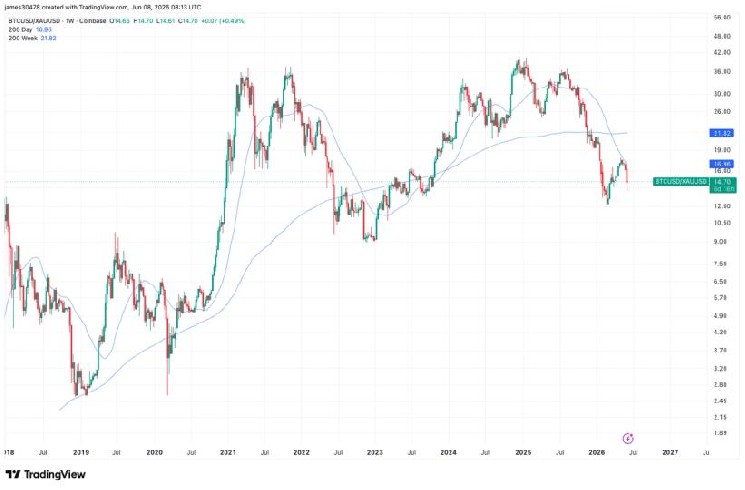
│ Bitcoin/Gold Ratio │ 200-Day Moving Avg │ Rejected (At 14.72) │
└──────────────────────┴──────────────────────┴──────────────────────┘
The Sovereign Asset Rotation: Bitcoin Recovers Ground as the Digital Gold Narrative Shifts
As traditional physical stores of value struggle under the weight of rising yields, the digital asset ecosystem is experiencing a notable divergence, marked by a recent recovery in the Bitcoin-to-gold ratio. This ratio, which measures the purchasing power of a single Bitcoin relative to ounces of physical gold, has ticked up by 3% over the past 24 hours to sit at 14.72 ounces, coinciding with Bitcoin’s resilient push back toward the $63,000 price level. Despite this short-term bounce, the ratio remains roughly 70% below its dizzying December 2024 peak of approximately 41 ounces, highlighting a massive, multi-month correction where physical gold vastly outperformed its digital counterpart.
The relationship between these two competing “sound money” assets remains highly complex; only last month, the Bitcoin-to-gold ratio faced a sharp technical rejection at its own 200DMA, a precursor to Bitcoin’s painful dip below $60,000. However, the fact that the ratio has managed to hold firm above its February lows suggest a subtle, structural floor of support for cryptocurrency bulls, hinting that some capital may be quietly rotating out of physical vaults and back into public blockchain networks in search of asymmetric risk returns.
The Ascendant Greenback: What a Resurgent Dollar Index Means for Global Risk Assets
Compounding the misery for commodities, precious metals, and digital assets alike is the stubborn resurgence of the US Dollar Index (DXY), which has clawed its way back above the psychologically vital 100 level. The U.S. dollar operates as the primary pricing mechanism for global trade; consequently, a stronger greenback acts as an immediate mathematical drag on commodities, making dollar-denominated assets significantly more expensive for foreign central banks and institutional investors holding alternative currencies. Beyond the basic conversion mechanics, a rising DXY reflects a broader tightening of international financial conditions, as dollar liquidity is systematically pulled back into the domestic U.S. banking system to chase higher risk-free yields. This global liquidity drain removes the figurative fuel that drives risk-on rallies, placing a heavy lid on emerging market equities, speculative tech stocks, and cryptos.
As long as the dollar maintains its upward momentum above 100, bolstered by a hawkish Federal Reserve and resilient domestic economic indicators, global markets must prepare for a prolonged era of high capital costs, where cash reigns supreme and traditional safe havens like gold must fight a grueling uphill battle to reclaim their former glory.