

The Great Consolidation: Bitcoin Establishes a Resilient New Line in the Sand
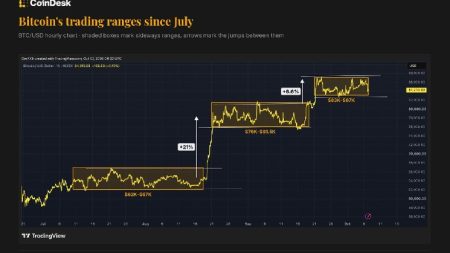
The global cryptocurrency market has entered a phase of intense valuation discovery, characterized by a multi-week consolidation that has bound the price of Bitcoin within a crucial trading corridor between $60,000 and $67,000. Rather than signaling market exhaustion, this sideways trajectory represents a structural transformation where ownership is rapidly shifting from speculative short-term traders to highly committed, long-term custody holders. For market observers and institutional analysts, the $63,000 price point has emerged as one of the most critical structural pivot points in recent digital asset history, acting as a massive gravitational center where vast amounts of capital are exchanging hands. This prolonged period of price compression is systematically wearing out retail leverage and speculative froth, creating a highly stable foundation that mimics the classic mid-cycle consolidation phases observed in previous market cycles. Historically, when an asset class experiences such concentrated price defense during global macroeconomic uncertainty—marked by fluctuating inflation metrics, shifting central bank interest rate policies, and geopolitical tensions—it signals a deep-seated belief among investors that the current baseline represents fair value. As the market continues to chew through the heavy supply overhead at this level, this consolidation is effectively building a launchpad, shifting the narrative from whether the asset will hold its current ground to when the next supply-side shock will propel it toward its ultimate target range between $78,000 and $82,000, where the market established its local peak in late spring.
Mapping the On-Chain Landscape: The Supply Wall at $63,000 and the URPD Metric
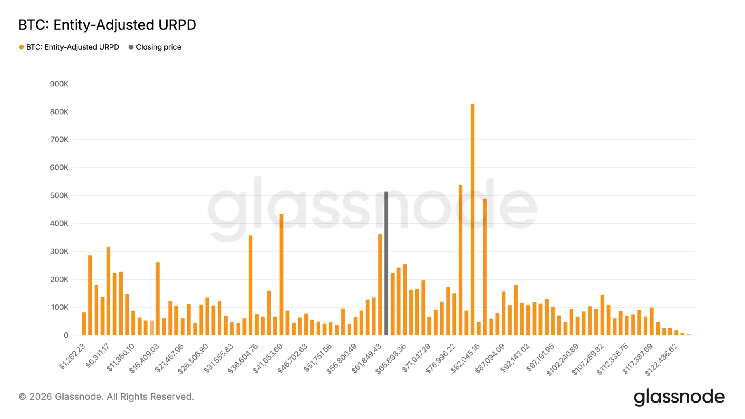
To truly understand the internal mechanics of this consolidation, one must look below the surface of basic exchange price feeds and analyze the underlying architecture of the blockchain through Glassnode’s Entity-Adjusted UTXO Realized Price Distribution (URPD). This sophisticated metric provides an incredibly detailed ledger of market psychology by mapping exactly when and at what price specific coins last moved, assigning each entity’s aggregate balance to their average cost basis. The latest on-chain intelligence reveals an extraordinarily dense concentration of high-conviction buying: more than 3% of the entire circulating supply of Bitcoin, which equates to roughly 515,000 BTC, has been actively acquired and secured in the immediate vicinity of the $63,000 price band. This massive block of capital is further reinforced just below the current market price, where more than 2% of the circulating supply—approximately 362,000 BTC—sits firmly anchored at the $61,000 level. In the realm of technical and on-chain analysis, these concentrated clusters of realized price function as immense psychological and economic shock absorbers; because these buyers have established their entry points at these specific levels, they are statistically far less likely to sell during minor market downturns, effectively turning what was once formidable overhead resistance into an incredibly robust floor of support. This unprecedented clustering of cost bases around the low-to-mid $60,000 range highlights a structural shift in investor behavior, indicating that the broader market has collectively agreed that prices below $63,000 represent a highly attractive buying opportunity, thereby drying up liquid supply and setting the stage for a dramatic illiquidity squeeze if demand begins to accelerate.
The 200-Week Moving Average: Why the Market Pivot Reflects Ultimate Fair Value
Further validating the strength of this current consolidation is the remarkable alignment of Bitcoin’s spot price with its highly revered 200-week moving average, a metric long considered by veteran market technicians to be the ultimate structural dividing line between long-term macro bull markets and cyclical bear markets. Currently, this critical technical indicator stands at approximately $63,657, standing in near-perfect equilibrium with the spot trading price of $63,822, representing a level of convergence that is rarely sustained for long periods in the highly volatile cryptocurrency ecosystem. This rare alignment serves as a powerful validation of the asset’s long-term value, indicating that despite the daily noise of macroeconomic headlines, regulatory shifts, and derivative liquidations, the market is pricing Bitcoin precisely at its historical multi-year average growth trajectory. Historically, when Bitcoin trades directly in line with its 200-week moving average during a consolidation phase, it acts as a magnet for institutional allocators who view this convergence as a low-risk entry window where speculative premiums have been entirely extracted from the asset’s valuation. This technical baseline does not merely represent a line on a chart; rather, it reflects the aggregate behavior of millions of global participants over a four-year horizon, serving as a reliable economic anchor that, once successfully defended and established as support, historically precedes the most explosive and sustained upward expansions in the asset’s history.
Retail Renaissance: The Surprising Power of Everyday Accumulation
While institutional headlines often dominate financial media, Glassnode’s 30-day Accumulation Trend Score, segmented by wallet-size cohorts, reveals that a highly resilient and distributed network of retail investors is currently driving the most aggressive buying behavior at these price levels. This retail cohort—representing smaller, non-custodial wallets and everyday market participants—is purchasing Bitcoin with a level of consistency and conviction that defies the traditional stereotype of retail investors panic-selling during periods of sideways price action. This newfound resilience can be attributed to several factors, including broader educational access regarding blockchain scarcity, the psychological normalization of Bitcoin trading above $60,000, and the widespread availability of automated dollar-cost-averaging tools that allow individuals to accumulate satoshis regardless of short-term market fluctuations. Rather than chasing parabolic tops, these everyday investors are treating the $60,000 to $67,000 range as a highly attractive accumulation zone, systematically removing supply from exchanges and placing it into private storage. This structural shift in retail behavior suggests a maturing market participant base that is increasingly viewing the digital asset not as a quick trading vehicle, but as a premier long-term savings technology and a hedge against systemic fiat currency debasement, thereby creating a highly distributed and decentralized floor of ownership that is incredibly difficult for institutional short-sellers to break.
The Whales Align: Institutional and High-Net-Worth Conviction Gains Momentum
This groundswell of retail accumulation is not occurring in a vacuum; indeed, it is being closely matched by the market’s largest and most influential participants—the legendary “whales” who hold balances of at least 1,000 BTC. On-chain data indicates that these high-net-worth individuals, institutional custody accounts, and corporate treasuries are exhibiting accumulation behaviors that mirror the aggressive buying patterns of the retail sector, creating a powerful, synchronized buying front across all major wallet cohorts. This alignment of interest between the smallest market participants and the largest capital allocators is a relatively rare phenomenon in financial markets, typically occurring only at major cyclical pivot points where there is a shared, high-conviction belief in the asset’s structural underpricing. For these whale entities, the current range represented by the $63,000 cost basis represents a strategic opportunity to build large-scale positions without dramatically moving the spot market price, absorbing the liquid supply made available by short-term traders and capitulating speculative entities. The fact that these sophisticated, well-capitalized players are aggressively buying and holding at these elevated prices—well above the cycle lows of previous years—demonstrates a structural shift in their risk assessment, signaling that institutional capital now views $60,000 not as a speculative ceiling, but as a highly secure, fundamentally sound foundation for the future of global finance.
Looking Beyond the Range: The Roadmap to the Illusive $80,000 Peak
As this dual engine of retail and whale accumulation continues to lock up circulating supply, the macroeconomic and technical roadmap points to an inevitable resolution of this consolidation range, with all eyes fixed on the historic resistance zone between $78,000 and $82,000. This upper boundary, which capped the market’s aggressive rally earlier this year, represents the final major hurdle of supply overhead; once the current $63,000 support level is fully consolidated and the available spot market liquidity is completely absorbed, any sudden surge in institutional demand is likely to trigger a rapid, highly volatile upward expansion. The mechanics of such a breakout are rooted in basic supply and demand: with a significant portion of the total Bitcoin supply now firmly held by long-term entities who acquired their coins near $61,000 and $63,000, the amount of supply actively available for sale on global exchanges is reaching historic lows. When this highly illiquid market structure is met with upcoming catalysts—such as the potential easing of global monetary policy, broader integration of spot exchange-traded funds into traditional wealth management portfolios, and clear regulatory frameworks—the resulting supply squeeze has the potential to propel the asset far beyond its previous all-time highs. Ultimately, the painstaking consolidation we are witnessing today is not a sign of market weakness, but a necessary and healthy period of asset redistribution, building the essential financial infrastructure and investor conviction required to support a sustainable, long-term journey into uncharted six-figure territory.